
Worlding Raga: 4 - Who Worlds?
So far we’ve been discussing Worlding as an art. One that an individual creator can engage in on their own. As Venkat suggested, we are already living in an emerging Worlding culture replete with examples, from superhero franchises, to blogamatic universes, to people as channels of their own lives. It made me think it's worth zooming out for a post to consider: what possesses a person to want to make a World? What reward does Worlding offer over all the other drives competing in an artist's mind? Who Worlds in there?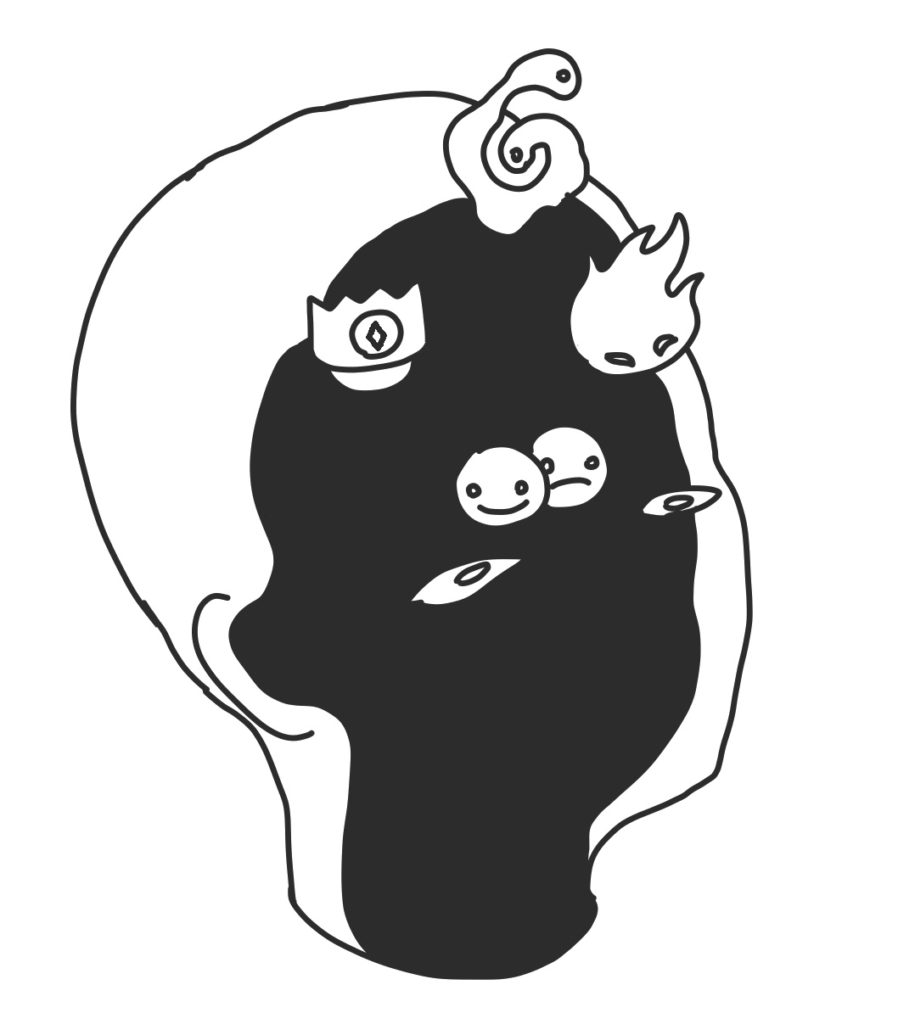 In the midst of the creative process, the artist experiences a jumble of voices and competing directives. To an untrained ear, this seems like the undifferentiated expression of an inner monologue that can't make up its mind. But if you listen carefully, you can begin to hear distinct voices fighting to be heard. It took me a long time to realize that an artist is not one unified person, but something like a crew of sub-personalities or mental demons. Each with their own motivations, sense of opportunity and threat, and unique filter for relevancy. What if we could learn to identify each of these demons? What if we could become more aware of who is speaking, understand what each cares about, and begin to strategize how and when to use them?
Consider this 2x2 of artist’s demons.
In the midst of the creative process, the artist experiences a jumble of voices and competing directives. To an untrained ear, this seems like the undifferentiated expression of an inner monologue that can't make up its mind. But if you listen carefully, you can begin to hear distinct voices fighting to be heard. It took me a long time to realize that an artist is not one unified person, but something like a crew of sub-personalities or mental demons. Each with their own motivations, sense of opportunity and threat, and unique filter for relevancy. What if we could learn to identify each of these demons? What if we could become more aware of who is speaking, understand what each cares about, and begin to strategize how and when to use them?
Consider this 2x2 of artist’s demons.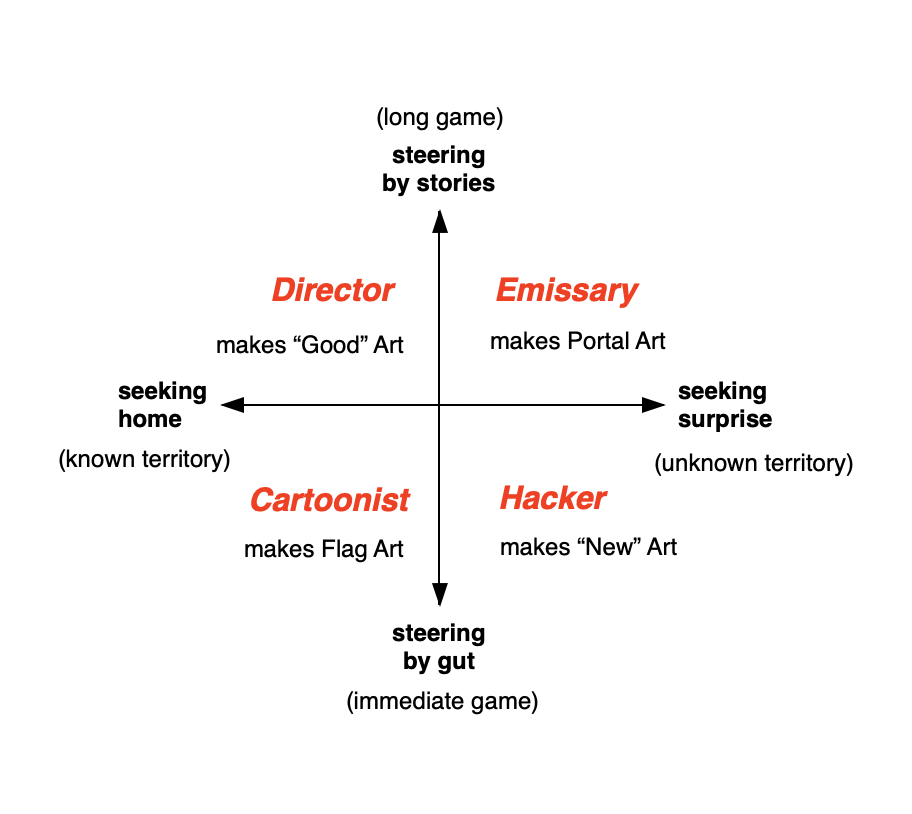 The horizontal axis describes the kind of artistic destination that a demon seeks. A demon Seeking Home is a desire towards art that advances the perfection and durability of known culture by addressing its dysfunctions. It is a desire to work within existing games that have proven to sustain human life, and to refine them in order to make them more enduring. In contrast, a demon Seeking Surprise is a desire towards art that touches a frontier and captures some of its spark. It is a desire that looks to the never ending chaos of Reality for new info and transformative potential.
If Seeking Home becomes too tedious or fixed, the artist may turn to a demon who Seeks Surprise to make things interesting again. And if Seeking Surprise become too disorienting or fluid, the artist may turn to a demon who Seeks Home to reaffirm a fixed cosmology of meaning to work on.
The vertical axis describes the navigational style for how a demon steers towards its artistic destination. A demon who Steers By Gut is navigating by immediate instincts to get immediate results. When the creative seas are choppy, this demon reacts with evolutionarily honed impulses. Feelings are the most trusted compass: there is no broader perspective that can match the reflex and embodied intuition of gut feelings. In contrast, a demon who Steers By Story is navigating with the perspective that the current situation sits within a larger chain of events. Today you're enduring a stormy day, but you know that the bird sighting means you’re close to landfall.
If the Story cannot expand to accommodate the unexpected, the artist turns to the Gut for immediate survival. And if the Gut proves wrong too many times, the artist looks to Stories to put it all into perspective.
Four archetypes of artist's demons come out of this:
The horizontal axis describes the kind of artistic destination that a demon seeks. A demon Seeking Home is a desire towards art that advances the perfection and durability of known culture by addressing its dysfunctions. It is a desire to work within existing games that have proven to sustain human life, and to refine them in order to make them more enduring. In contrast, a demon Seeking Surprise is a desire towards art that touches a frontier and captures some of its spark. It is a desire that looks to the never ending chaos of Reality for new info and transformative potential.
If Seeking Home becomes too tedious or fixed, the artist may turn to a demon who Seeks Surprise to make things interesting again. And if Seeking Surprise become too disorienting or fluid, the artist may turn to a demon who Seeks Home to reaffirm a fixed cosmology of meaning to work on.
The vertical axis describes the navigational style for how a demon steers towards its artistic destination. A demon who Steers By Gut is navigating by immediate instincts to get immediate results. When the creative seas are choppy, this demon reacts with evolutionarily honed impulses. Feelings are the most trusted compass: there is no broader perspective that can match the reflex and embodied intuition of gut feelings. In contrast, a demon who Steers By Story is navigating with the perspective that the current situation sits within a larger chain of events. Today you're enduring a stormy day, but you know that the bird sighting means you’re close to landfall.
If the Story cannot expand to accommodate the unexpected, the artist turns to the Gut for immediate survival. And if the Gut proves wrong too many times, the artist looks to Stories to put it all into perspective.
Four archetypes of artist's demons come out of this:
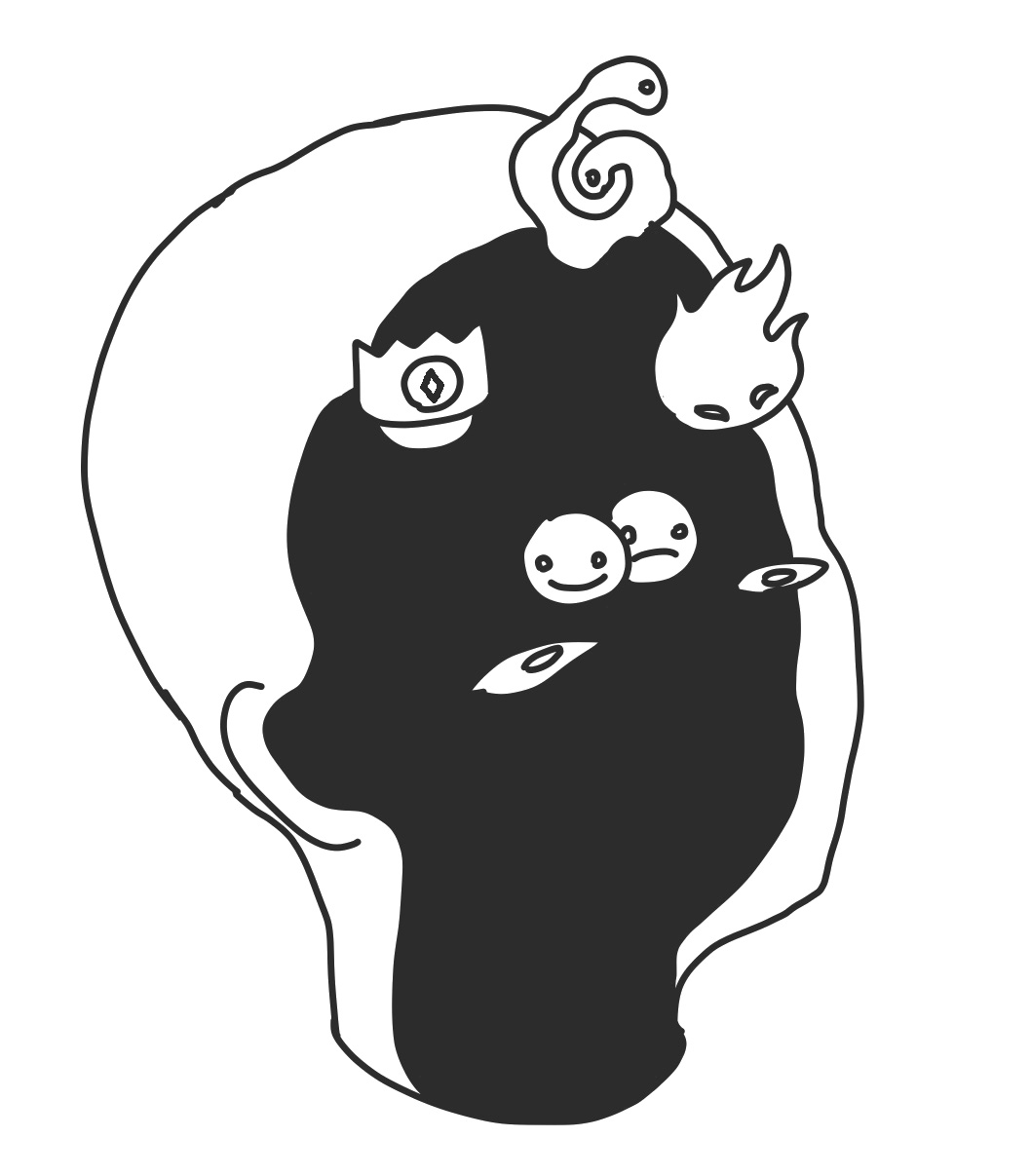 In the midst of the creative process, the artist experiences a jumble of voices and competing directives. To an untrained ear, this seems like the undifferentiated expression of an inner monologue that can't make up its mind. But if you listen carefully, you can begin to hear distinct voices fighting to be heard. It took me a long time to realize that an artist is not one unified person, but something like a crew of sub-personalities or mental demons. Each with their own motivations, sense of opportunity and threat, and unique filter for relevancy. What if we could learn to identify each of these demons? What if we could become more aware of who is speaking, understand what each cares about, and begin to strategize how and when to use them?
Consider this 2x2 of artist’s demons.The horizontal axis describes the kind of artistic destination that a demon seeks. A demon Seeking Home is a desire towards art that advances the perfection and durability of known culture by addressing its dysfunctions. It is a desire to work within existing games that have proven to sustain human life, and to refine them in order to make them more enduring. In contrast, a demon Seeking Surprise is a desire towards art that touches a frontier and captures some of its spark. It is a desire that looks to the never ending chaos of Reality for new info and transformative potential.
If Seeking Home becomes too tedious or fixed, the artist may turn to a demon who Seeks Surprise to make things interesting again. And if Seeking Surprise become too disorienting or fluid, the artist may turn to a demon who Seeks Home to reaffirm a fixed cosmology of meaning to work on.
The vertical axis describes the navigational style for how a demon steers towards its artistic destination. A demon who Steers By Gut is navigating by immediate instincts to get immediate results. When the creative seas are choppy, this demon reacts with evolutionarily honed impulses. Feelings are the most trusted compass: there is no broader perspective that can match the reflex and embodied intuition of gut feelings. In contrast, a demon who Steers By Story is navigating with the perspective that the current situation sits within a larger chain of events. Today you're enduring a stormy day, but you know that the bird sighting means you’re close to landfall.
If the Story cannot expand to accommodate the unexpected, the artist turns to the Gut for immediate survival. And if the Gut proves wrong too many times, the artist looks to Stories to put it all into perspective.
Four archetypes of artist's demons come out of this:
In the midst of the creative process, the artist experiences a jumble of voices and competing directives. To an untrained ear, this seems like the undifferentiated expression of an inner monologue that can't make up its mind. But if you listen carefully, you can begin to hear distinct voices fighting to be heard. It took me a long time to realize that an artist is not one unified person, but something like a crew of sub-personalities or mental demons. Each with their own motivations, sense of opportunity and threat, and unique filter for relevancy. What if we could learn to identify each of these demons? What if we could become more aware of who is speaking, understand what each cares about, and begin to strategize how and when to use them?
Consider this 2x2 of artist’s demons.The horizontal axis describes the kind of artistic destination that a demon seeks. A demon Seeking Home is a desire towards art that advances the perfection and durability of known culture by addressing its dysfunctions. It is a desire to work within existing games that have proven to sustain human life, and to refine them in order to make them more enduring. In contrast, a demon Seeking Surprise is a desire towards art that touches a frontier and captures some of its spark. It is a desire that looks to the never ending chaos of Reality for new info and transformative potential.
If Seeking Home becomes too tedious or fixed, the artist may turn to a demon who Seeks Surprise to make things interesting again. And if Seeking Surprise become too disorienting or fluid, the artist may turn to a demon who Seeks Home to reaffirm a fixed cosmology of meaning to work on.
The vertical axis describes the navigational style for how a demon steers towards its artistic destination. A demon who Steers By Gut is navigating by immediate instincts to get immediate results. When the creative seas are choppy, this demon reacts with evolutionarily honed impulses. Feelings are the most trusted compass: there is no broader perspective that can match the reflex and embodied intuition of gut feelings. In contrast, a demon who Steers By Story is navigating with the perspective that the current situation sits within a larger chain of events. Today you're enduring a stormy day, but you know that the bird sighting means you’re close to landfall.
If the Story cannot expand to accommodate the unexpected, the artist turns to the Gut for immediate survival. And if the Gut proves wrong too many times, the artist looks to Stories to put it all into perspective.
Four archetypes of artist's demons come out of this:
- The Director (D) - seeking home, steering by story. The conscientious reformer demon who believes that there are important problems whose complexities deserve to be explored in depth, typically via narrative, for they contain within them meaningful and praise worthy solutions. The investigator, the professor, the revisionist, the mythologist, the architect, the culture guard. If in charge, makes “Good” Art.
- The Cartoonist (C) - seeking home, steering by gut. The spontaneous reformer demon who believes we are united by what we feel, and that our emotions are ripe to be manipulated in order to alleviate immediate pain and confusion. Achieved through limbically resonant movements and sounds, making characters and symbols, naming. The joker/comedian, the voice of the tribe, the pornographer, the ad man, the meme maker, the persuader. If in charge, makes Flag Art.
- The Hacker (H) - seeking surprise, steering by gut. The spontaneous disruptor demon who tinkers, breaks and modifies systems, discovers first principles, and unlocks new leverages along the way. The wizard, the pharmacist, the magician, the trickster. If in charge, makes “New” Art.
- The Emissary (E) - seeking surprise, steering by story. The conscientious disruptor demon who sees every effort as a step in the continual growth and iterated maintenance of a never-ending story. Sees in terms of living iterations and time scales beyond a human lifespan, protects and aligns core values across efforts, grooms others to be a part of the living story, and accepts its own change as the inevitable adaptation to changes in the wider world. The gardener, shaman, mother, CEO, streamer. If in charge, makes Portal Art.
- one demon creation: prepping an interesting ingredient or sauce. A discrete creative task; fodder for greater uses.
- two demon creation: cooking an artisanal dish. A single work that achieves a sufficient compression of artistic priorities, and is regarded as stimulating to someone somewhere.
- three demon creation: designing a full sequence course. A complete project, worthy of appreciation for its weaving of multiple drives and its stimulation of multiple dimensions of the viewer’s neurology.
- four demon creation: conceiving and running a restaurant, with its own distinct vibe, business model, culture, secrets, dysfunctions. A dedicated home to further produce and support one, two, and three mask creations. An ongoing iteratively satisfying project. The fullest expression of a World.
2 Comments
"Core value maintenance" belongs under director. Probably add multiple and/or non-compulsory narratives to the Emissary definition. If you want to keep "gardener", maybe add "landscaper" to Director for the legibility nod.
My overall favorite comp is:
10% cartoonist (compression and simplification without caricature; maintain some referentiality; if emotionality is also part of cartoonist, mayyybe 15%)
30% hacker (any more and I feel you should do the hacking first and then present your results)
40% emissary
20% director
For something more "audience focused" you need more points in Cartoonist, but I would only go above 20 points for intentional propaganda. I wouldn't go under 20 points in Hacker either.
> Back then, I identified Nassim Taleb and Alain de Botton as my evil twins. I have since demoted Taleb to mostly harmless, and de Botton seems to have diverged from me. I did tentatively add Bruce Sterling in 2016, but he is really more like an evil uncle than an evil twin.
Is this supposed to make us see you as being of the same caliber as the above?