
Constructions in Magical Thinking
If you're one of those sharp-eyed readers who notices such things, you may have noticed that earlier this week, we adopted a new tagline: constructions in magical thinking. We also got a cheery set of new mastheads to go with it (thanks Grace Witherell), which you'll see in rotation at the top of the site from now on.
 In the best traditions of magical thinking, I will now respond to the most Frequently Asked Questions that have never actually been asked about our new tagline, in the hopes that doing so will somehow make them always-already never unasked.
Are you sick of our new schtick yet? No? Well, give it time. We're sticking with this for the next decade.
Q0: What the hell is "constructions in magical thinking"?
Anything you can write with the aid of just a compass and a straight-edge that respects Euclid's first four postulates.
More seriously. We don't know yet. Stick around and find out. As with the previous tagline, the game starts with liking the sound of it. If the previous tagline is any indication, it might take a while.
Q1: Omigod who's going to refactor my perception now?
A: Back in 2007 when I first picked that tagline, I didn't know what the hell it really meant. Now, 12 years later, dozens of writers on and off this blog have devoted hundreds of thousands of words to refactoring perception.
There's even an 8-year-old annual conference devoted to it, called Refactor Camp (submissions open for the next one, in Los Angeles, June 15/16 btw). There is a Mastodon server where we refactor perception in 500-character chunks. There are Facebook groups and meetups. There's a refactorings roundup dragnet, fishing for good refactoring from around the web.
I mean, this refactoring game has almost turned into institutionalized infrastructure.
And after all this noise and fury, none of us is any the wiser about what the hell refactoring perception really means. There's a rumor that 2x2s are involved, and that making fun of rationalists is de rigeur, but nobody knows.
This means I have successfully spread my own fundamental confusions about life, the universe, and everything into what is now a large, thriving community (fine, fine, modest-sized and kinda slouchy community) engaged in the praxis of refactored thinking.
I.e. we may not know what the hell we're doing, but we know how to do it, and have done a lot of it. Like that whole birds flying without pilots licenses and FAA certifications thing.
Which means we can treat this as an established base layer of our stack and build on top of it. And the obvious next layer to build on a layer of established, enterprise-grade refactored perception sustained confusion activity is a layer of magical thinking activity.
So to answer your question, we're leveling up. Or for those who like Carlota Perez, we're moving from the installation phase to the deployment phase of ribbonfarming.
No longer will we be painfully refactoring perception at only the bare-metal assembly language level. Instead, we'll be adding powerful new magical thinking to the mix.
Q2: This sucks, why are you doing this? What was wrong with the classic refactoring?
A: Not that we're abandoning Classic Refactoring™ but... actually, we've already been contaminating that purist ideal for a while now. We've already been on this magical thinking beat for a while. You just may not have noticed it. You could say we've drifted from Seeking Out Insight Porn to Making Up Outrageous Shit. SOIP to to MUOS.
Here are some representative posts from the last few years that we think get at what we mean by Constructions in Magical Thinking
In the best traditions of magical thinking, I will now respond to the most Frequently Asked Questions that have never actually been asked about our new tagline, in the hopes that doing so will somehow make them always-already never unasked.
Are you sick of our new schtick yet? No? Well, give it time. We're sticking with this for the next decade.
Q0: What the hell is "constructions in magical thinking"?
Anything you can write with the aid of just a compass and a straight-edge that respects Euclid's first four postulates.
More seriously. We don't know yet. Stick around and find out. As with the previous tagline, the game starts with liking the sound of it. If the previous tagline is any indication, it might take a while.
Q1: Omigod who's going to refactor my perception now?
A: Back in 2007 when I first picked that tagline, I didn't know what the hell it really meant. Now, 12 years later, dozens of writers on and off this blog have devoted hundreds of thousands of words to refactoring perception.
There's even an 8-year-old annual conference devoted to it, called Refactor Camp (submissions open for the next one, in Los Angeles, June 15/16 btw). There is a Mastodon server where we refactor perception in 500-character chunks. There are Facebook groups and meetups. There's a refactorings roundup dragnet, fishing for good refactoring from around the web.
I mean, this refactoring game has almost turned into institutionalized infrastructure.
And after all this noise and fury, none of us is any the wiser about what the hell refactoring perception really means. There's a rumor that 2x2s are involved, and that making fun of rationalists is de rigeur, but nobody knows.
This means I have successfully spread my own fundamental confusions about life, the universe, and everything into what is now a large, thriving community (fine, fine, modest-sized and kinda slouchy community) engaged in the praxis of refactored thinking.
I.e. we may not know what the hell we're doing, but we know how to do it, and have done a lot of it. Like that whole birds flying without pilots licenses and FAA certifications thing.
Which means we can treat this as an established base layer of our stack and build on top of it. And the obvious next layer to build on a layer of established, enterprise-grade refactored perception sustained confusion activity is a layer of magical thinking activity.
So to answer your question, we're leveling up. Or for those who like Carlota Perez, we're moving from the installation phase to the deployment phase of ribbonfarming.
No longer will we be painfully refactoring perception at only the bare-metal assembly language level. Instead, we'll be adding powerful new magical thinking to the mix.
Q2: This sucks, why are you doing this? What was wrong with the classic refactoring?
A: Not that we're abandoning Classic Refactoring™ but... actually, we've already been contaminating that purist ideal for a while now. We've already been on this magical thinking beat for a while. You just may not have noticed it. You could say we've drifted from Seeking Out Insight Porn to Making Up Outrageous Shit. SOIP to to MUOS.
Here are some representative posts from the last few years that we think get at what we mean by Constructions in Magical Thinking
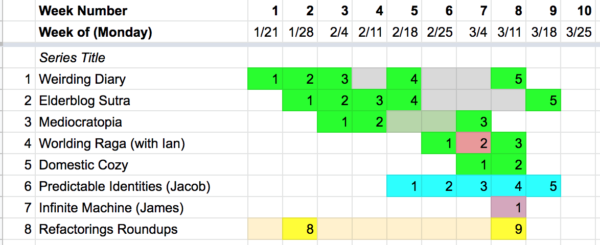 Think of blogchains as an innovation in form to match the retargeted aspirations in content. It is explicit constructionism taken to the level of the container of the text; a form that allows more ambitious constructions. Blogchains are the reinforced concrete of magical thinking.
You'll find ongoing meta-commentary about blogchains in the Elderblog Sutra blogchain.
Q8: It's called a series. You invented the blog series! Why are you making up unnecessary new words?
First see this tweet.
Second, inventing unnecessary new words is another core skill in CIMT.
Third, this particular word isn't actually either redundant or unnecessary.
A traditional blog series is a waterfall-planned longer work that's something like an ersatz book for lazy vanity publishers. A blogchain on the other hand:
Think of blogchains as an innovation in form to match the retargeted aspirations in content. It is explicit constructionism taken to the level of the container of the text; a form that allows more ambitious constructions. Blogchains are the reinforced concrete of magical thinking.
You'll find ongoing meta-commentary about blogchains in the Elderblog Sutra blogchain.
Q8: It's called a series. You invented the blog series! Why are you making up unnecessary new words?
First see this tweet.
Second, inventing unnecessary new words is another core skill in CIMT.
Third, this particular word isn't actually either redundant or unnecessary.
A traditional blog series is a waterfall-planned longer work that's something like an ersatz book for lazy vanity publishers. A blogchain on the other hand:
 Q10: CIMT, EIRP, spreadsheets, strained computing analogies... this is all starting to sound suspiciously like management BS.
Management thinking is one of the best examples of successful, high-quality magical thinking. One of our favorite reads around here is the classic Meyer/Rowan paper, Institutionalized Organizations: Formal Structure as Myth and Ceremony.
One of our aims in this magical thinking era will be to reclaim and redeem ALL of management bullshit jargon the way we did with 2x2s in the refactoring era.
Q11: This is superstition! Isn't magical thinking bad?
"We are as gods now, we might as well get good at it." See also, this post.
Q12: But what about Liberal Enlightenment Values and Truth?
Go away.
Q13: This is irresponsible. Think of the children!
No.
Q10: CIMT, EIRP, spreadsheets, strained computing analogies... this is all starting to sound suspiciously like management BS.
Management thinking is one of the best examples of successful, high-quality magical thinking. One of our favorite reads around here is the classic Meyer/Rowan paper, Institutionalized Organizations: Formal Structure as Myth and Ceremony.
One of our aims in this magical thinking era will be to reclaim and redeem ALL of management bullshit jargon the way we did with 2x2s in the refactoring era.
Q11: This is superstition! Isn't magical thinking bad?
"We are as gods now, we might as well get good at it." See also, this post.
Q12: But what about Liberal Enlightenment Values and Truth?
Go away.
Q13: This is irresponsible. Think of the children!
No.
In the best traditions of magical thinking, I will now respond to the most Frequently Asked Questions that have never actually been asked about our new tagline, in the hopes that doing so will somehow make them always-already never unasked.
Are you sick of our new schtick yet? No? Well, give it time. We're sticking with this for the next decade.
Q0: What the hell is "constructions in magical thinking"?
Anything you can write with the aid of just a compass and a straight-edge that respects Euclid's first four postulates.
More seriously. We don't know yet. Stick around and find out. As with the previous tagline, the game starts with liking the sound of it. If the previous tagline is any indication, it might take a while.
Q1: Omigod who's going to refactor my perception now?
A: Back in 2007 when I first picked that tagline, I didn't know what the hell it really meant. Now, 12 years later, dozens of writers on and off this blog have devoted hundreds of thousands of words to refactoring perception.
There's even an 8-year-old annual conference devoted to it, called Refactor Camp (submissions open for the next one, in Los Angeles, June 15/16 btw). There is a Mastodon server where we refactor perception in 500-character chunks. There are Facebook groups and meetups. There's a refactorings roundup dragnet, fishing for good refactoring from around the web.
I mean, this refactoring game has almost turned into institutionalized infrastructure.
And after all this noise and fury, none of us is any the wiser about what the hell refactoring perception really means. There's a rumor that 2x2s are involved, and that making fun of rationalists is de rigeur, but nobody knows.
This means I have successfully spread my own fundamental confusions about life, the universe, and everything into what is now a large, thriving community (fine, fine, modest-sized and kinda slouchy community) engaged in the praxis of refactored thinking.
I.e. we may not know what the hell we're doing, but we know how to do it, and have done a lot of it. Like that whole birds flying without pilots licenses and FAA certifications thing.
Which means we can treat this as an established base layer of our stack and build on top of it. And the obvious next layer to build on a layer of established, enterprise-grade refactored perception sustained confusion activity is a layer of magical thinking activity.
So to answer your question, we're leveling up. Or for those who like Carlota Perez, we're moving from the installation phase to the deployment phase of ribbonfarming.
No longer will we be painfully refactoring perception at only the bare-metal assembly language level. Instead, we'll be adding powerful new magical thinking to the mix.
Q2: This sucks, why are you doing this? What was wrong with the classic refactoring?
A: Not that we're abandoning Classic Refactoring™ but... actually, we've already been contaminating that purist ideal for a while now. We've already been on this magical thinking beat for a while. You just may not have noticed it. You could say we've drifted from Seeking Out Insight Porn to Making Up Outrageous Shit. SOIP to to MUOS.
Here are some representative posts from the last few years that we think get at what we mean by Constructions in Magical Thinking
- Weaponized Sacredness (Sarah Perry)
- Welcome to the Future Nauseous (me)
- Puzzle Theory (Sarah Perry)
- The Design of Escaped Realities (me)
- The World As If (Sarah Perry)
- Eternal Hypochondria of the Expanding Mind (me)
- Cringe and the Design of Sacred Experiences (Sarah Perry)
- Been There, Done That (me)
- Container shipping analogies apply
- Blockchain analogies apply
- It harmonizes with the revolutionary Gutenberg block editor which introduces, among a lot of other things, reusable container-like blocks.
- It is tractable for scaling past 14,000 words (that's my one-rep max, the average ribbonfarm contributor tends to wimp out at ~3000 words)
- Good for creating tunnel/warren-like architectures that are more "indoors" than "outdoors".
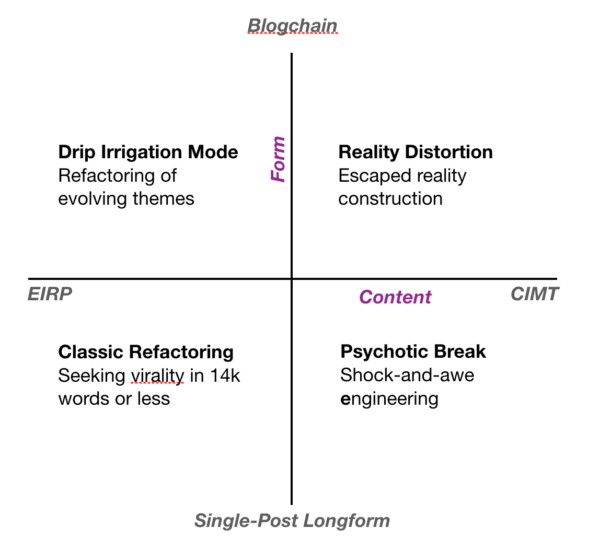
- It allows us to go nuts with producing diagrams like this
Think of blogchains as an innovation in form to match the retargeted aspirations in content. It is explicit constructionism taken to the level of the container of the text; a form that allows more ambitious constructions. Blogchains are the reinforced concrete of magical thinking.
You'll find ongoing meta-commentary about blogchains in the Elderblog Sutra blogchain.
Q8: It's called a series. You invented the blog series! Why are you making up unnecessary new words?
First see this tweet.
Second, inventing unnecessary new words is another core skill in CIMT.
Third, this particular word isn't actually either redundant or unnecessary.
A traditional blog series is a waterfall-planned longer work that's something like an ersatz book for lazy vanity publishers. A blogchain on the other hand:
- is improvised rather than planned
- is responsive to salient events in the environment
- evolves at a certain tempo
- acts like a themed, bite-sized commitment ratchet; gradatim ferociter
- ...but without the oppressive intention-debt of a traditional series
- is designed for sustainability, more sitcom than movie
- is suitable for multi-author collaboration like my Worlding Raga
- is structurally a way to build over time ("construction")
- is capable of supporting an inter-process messaging protocol with adjacent blogchains
- has no necessary or scripted "ending" but more of a crash-only/infinite game character
Q10: CIMT, EIRP, spreadsheets, strained computing analogies... this is all starting to sound suspiciously like management BS.
Management thinking is one of the best examples of successful, high-quality magical thinking. One of our favorite reads around here is the classic Meyer/Rowan paper, Institutionalized Organizations: Formal Structure as Myth and Ceremony.
One of our aims in this magical thinking era will be to reclaim and redeem ALL of management bullshit jargon the way we did with 2x2s in the refactoring era.
Q11: This is superstition! Isn't magical thinking bad?
"We are as gods now, we might as well get good at it." See also, this post.
Q12: But what about Liberal Enlightenment Values and Truth?
Go away.
Q13: This is irresponsible. Think of the children!
No.
3 Comments
Out of a lot of your magical thinking examples. Things like "Welcome to the Future Nauseous" come off to me more like text book refactoring. Literally "let's view everything through the lense of us living in the past idioms and metaphors of times before. Give everything a new name according to said system."
Escaped Realities is similar.
But I would agree your more recent posts enter that Magical Shit We're Making Up territory. Interested in where you go next!
Thanks for sharing this; I am really excited to see how this builds up and out.
How does this connect with your lessons on longform?
Can we expect a course on a blog chain?
Did you read Didion? Should I?