
Worlding Raga: 3 -- Slouching with God
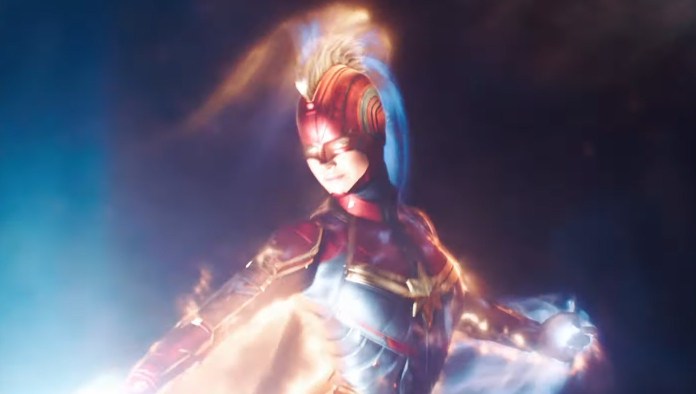
Last week, my wife and I watched the new Captain Marvel movie. It strikes a slightly quieter note than the typical Marvel Cinematic Universe romp, and it occurred to me that that's because the character is arguably the most powerful in the MCU, like Superman in the DC universe. She's more like a god than even Thanos or Thor, so the usual wisecracking smart-assery would have struck a false note.
 A line in Ian's Worlding Raga episode last week, What is a World, leaped out at me in relation to this:
 Discworld map, CC BY-SA 4.0[/caption]
In the novels, the Lady Luck (one of the gods) and Rincewind (a slouchy wizard) form a slouching-with-god pair, but the world itself has a larger governing order-chaos-transformer triad. Except it isn't quite order/chaos.
The Lady probably also ought to be identified with the fifth basic element (surprise, alongside earth, fire, water, air). But you cannot just naively identify luck with chaos. Rincewind, for instance, is predictably unlucky and lucky thanks in part to The Lady. His life is far from chaotic, and his attitude is that of a resignation to fate (Fate, personified, is a separate god on Discworld, but Rincewind is resigned to his peculiar fate, as a puppet of The Lady).
Chaos proper is a lesser divinity, the retired fifth of the four horsemen of the apocalypse, alongside Death, Famine, Pestilence, and War. On Discworld, luck and surprise are the most powerful forces arrayed against order, subsuming even chaos and the other horsemen.
So that's an interesting trope subversion. Even chaos is not chaotic enough to be a first-class citizen of the Discworld multiverse.
On Discworld, the intentions of sentient beings interact with non-sentient elemental world processes. So order, chaos, and transformation are complicated.
Any elemental process has both orderly and chaotic regimes. On Discworld, there are at least four such elemental processes: magic, time, science, and mortal belief.
Discworld map, CC BY-SA 4.0[/caption]
In the novels, the Lady Luck (one of the gods) and Rincewind (a slouchy wizard) form a slouching-with-god pair, but the world itself has a larger governing order-chaos-transformer triad. Except it isn't quite order/chaos.
The Lady probably also ought to be identified with the fifth basic element (surprise, alongside earth, fire, water, air). But you cannot just naively identify luck with chaos. Rincewind, for instance, is predictably unlucky and lucky thanks in part to The Lady. His life is far from chaotic, and his attitude is that of a resignation to fate (Fate, personified, is a separate god on Discworld, but Rincewind is resigned to his peculiar fate, as a puppet of The Lady).
Chaos proper is a lesser divinity, the retired fifth of the four horsemen of the apocalypse, alongside Death, Famine, Pestilence, and War. On Discworld, luck and surprise are the most powerful forces arrayed against order, subsuming even chaos and the other horsemen.
So that's an interesting trope subversion. Even chaos is not chaotic enough to be a first-class citizen of the Discworld multiverse.
On Discworld, the intentions of sentient beings interact with non-sentient elemental world processes. So order, chaos, and transformation are complicated.
Any elemental process has both orderly and chaotic regimes. On Discworld, there are at least four such elemental processes: magic, time, science, and mortal belief.
A line in Ian's Worlding Raga episode last week, What is a World, leaped out at me in relation to this:
This voluntary desire to surf chaos, metabolize it into new order, and then do it all over again, is sometimes called “walking with god.” Maybe it’s more like slouching with god around here.In the MCU, Nick Fury walks with many gods, and Captain Marvel appears to be the most powerful of the lot, which is why Fury sends a prayer-pager call out to her as his last act in Infinity War. Presumably she'll play a key role in defeating Thanos in Endgame. Since I've been jokingly referring to Ribbonfarm and its surrounding web zone as the "Ribbonfarm Blogamatic Universe" (RBU), Ian's characterization immediately provokes the question: am I Captain Marvel or Nick Fury in the RBU? I hope I'm not Hawkeye. There's actually a serious question buried in there, which I'll formulate as follows:
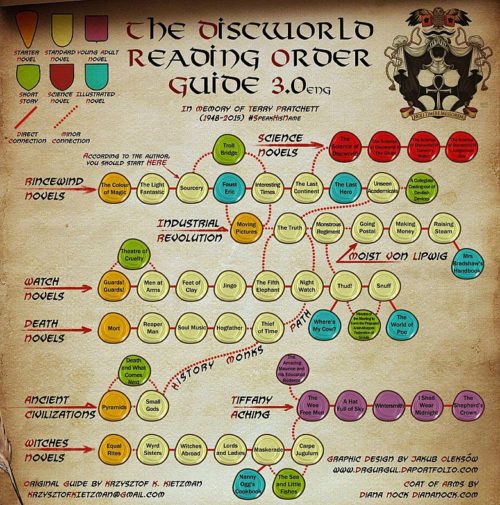
If a world-process is defined by an order-chaos-transformer triad, is the god-mortal-slouching (or god-mortal-walking) triad isomorphic to it? The generator of it? A subset of it? A fractal embodiment of it? Governed by it but distinct?Terry Pratchett's Discworld is a fascinating example world that sheds some light on these questions. Since it is at once a subversive parody of worlding tropes, and reliant on them to power the world coherently, it simultaneously validates and challenges our intuitions about worlding, including elements of Ian's pithy core definitions. This lovely map, which I've been using to guide my reading for the last year (14 down so far), gets at the scope and complexity of the world. It has magic, wizards, witches, dragons, dungeon dimensions, a police procedural sub-world (Watch), and an industrial revolution sub-world. [caption id="attachment_6584" align="aligncenter" width="500"]
Discworld map, CC BY-SA 4.0[/caption]
In the novels, the Lady Luck (one of the gods) and Rincewind (a slouchy wizard) form a slouching-with-god pair, but the world itself has a larger governing order-chaos-transformer triad. Except it isn't quite order/chaos.
The Lady probably also ought to be identified with the fifth basic element (surprise, alongside earth, fire, water, air). But you cannot just naively identify luck with chaos. Rincewind, for instance, is predictably unlucky and lucky thanks in part to The Lady. His life is far from chaotic, and his attitude is that of a resignation to fate (Fate, personified, is a separate god on Discworld, but Rincewind is resigned to his peculiar fate, as a puppet of The Lady).
Chaos proper is a lesser divinity, the retired fifth of the four horsemen of the apocalypse, alongside Death, Famine, Pestilence, and War. On Discworld, luck and surprise are the most powerful forces arrayed against order, subsuming even chaos and the other horsemen.
So that's an interesting trope subversion. Even chaos is not chaotic enough to be a first-class citizen of the Discworld multiverse.
On Discworld, the intentions of sentient beings interact with non-sentient elemental world processes. So order, chaos, and transformation are complicated.
Any elemental process has both orderly and chaotic regimes. On Discworld, there are at least four such elemental processes: magic, time, science, and mortal belief.
.jpg)
- Magic, unleashed in raw form as in Sourcery is a source of chaos (wielded by a villain seeking absolute order), but in the hands of Ponder Stibbons, a disciplined and conscientious wizard, it is an imperfectly governed chaotic evolutionary force.
- Time, in the hands of the Auditors of Reality, is a force of villainous order. In the hands of the History Monks, it is an imperfectly governed chaotic evolutionary force.
- Science, in the hands of intelligent but reactionary species like the dwarves, becomes a force of order, but in the hands of progressive species (mainly humans like steam engine inventor Dick Simnel, and the genius Leonardo da Quirm, but also allied goblins, some trolls and dwarves) it is an imperfectly governed chaotic evolutionary force.
- Belief is a powerful force on Discworld. Gods come into existence and gain and lose power based on belief, rather like stocks on a stock market, which makes them unusually beholden to mortals (Small Gods explores this dynamic). In the minds of reactionaries, belief becomes a force of order, but in the minds of the compassionately alive, like Brutha in Small Gods, it becomes an imperfectly governed chaotic evolutionary force.
- What are the elemental world processes?
- How do order-chaos-transformation and god-mortal-slouching triads relate?
- What role do intentions of sentient beings play?
- How do luck and surprise enter the world?
9 Comments
Discworld also has the powerful https://wiki.lspace.org/mediawiki/Narrativium / Narrative Causality as a key force!
Does Narrativium play a major part in the plot of any of the novels? I've come across it, but haven't yet read a book where it's a key element (heh!). But yeah, if it fits the order/chaos regime model and plays a role in any novels, I'd add that to the list.
Hmm I don't remember it ever being key to an overall narrative but there's plenty of references to https://wiki.lspace.org/mediawiki/Million-to-one_chance working out nine times out of ten.
I also feel like genre savvy is tied in, even when Narrative Causality isn't directly cited. I think there was an example in 'Interesting Times' where an invading army charges into the palace courtyard only to meed a janitor with a broom – they stop in their tracks because they assume that he's secretly a martial arts master who will defeat them all by himself (he's not) because that's how stories work.
Narrative causality is more obvious in the witches stories, both by itself an in relation to headology. IIRC, it's a plot point in one of the books that one sister had to be the evil witch and the other the good witch, and neither of them is particularly happy with their role.
Granny Weatherwax exploits it ruthlessly, against the vampires, her sister, and many others I'm not immediately remembering. She just doesn't apply that term to it, though it is distinctly not Headology (or at least, not only Headology) when it happens.
Witches Abroad includes stories as sort of parasitic threads of causality that are strengthened through repetition - various characters engage directly with this and it's a core part of the narrative (and not just background worldbuilding fluff).
I'd tend to think the ease with which a world can be run as a worldview is a detriment not a strength. This maybe points to the function that "-building" does in the original term.
Re: Middle Earth, basically agreed, except that on another axis it does somewhat better than the franchises you mention -- tonality. I haven't read Discworld but the other franchises you list are either mostly or entirely tonal, whereas Middle Earth enjoys a late-19th century proto-atonality.
What do you mean by "tonality" in the context of literature?
Tolkien's world is essentially catholic. Thus it works on a catholic metaphysical universe and not the pagan metaphysics of Pratchett. The primary force of Order here is Sauron, the evil Satanic figure that is bent on controlling the material plane, and the very subtle influence of the Allfather (Illuvatar) who manipulates events in accordance to free will.
So free will becomes the essential philosophical dichotomy of the Tolkien lore, instead of the more pagan (stoic) outlook of a pragmatic rolling with the punches we see in Discworld.