
The Speakeasy Imagineering Network
Today I learned that the term normalcy was popularized by Warren Harding, US President between 1921-23, over the then-accepted variant normality. His campaign slogan, return to normalcy, promised a return to a Pre-World War I condition.
Harding's administration, however, also saw the beginning of the Prohibition era (1921-33). So presumably he meant a return to normalcy, but without the alcoholism, rampant domestic abuse, and corrupt saloon politics of the pre-War era. During the Roaring Twenties, to the extent it needed alcohol as fuel, the American romantic imagination (and here I mean the tumultuous Sturm und Drang of uninhibited subjectivity rather than the tepid nostalgia of pastoralism) either had to go abroad, to Europe, or hide in speakeasies.
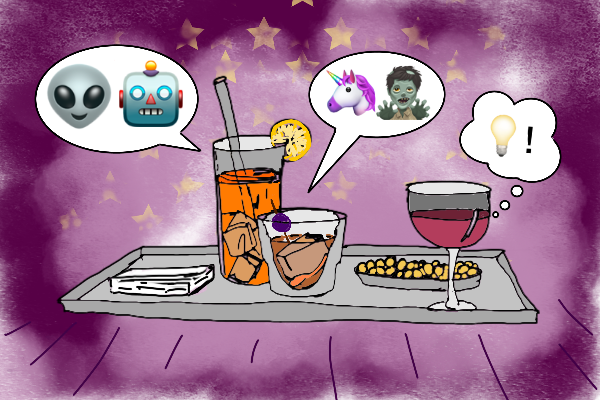 I've been thinking about our own contemporary condition in light of the complicated relationship among cultural production, the romantic imagination, and Prohibition in the twenties, an era which rhymes in somewhat messy ways with our our own.
In particular, looking at the 2010s through the lens of the 1920s, I got to the interesting conclusion that what requires protection during times of overweening reactionary moral self-certainty is not the truth, but imagination.
The truth can take care of itself better than you might think, but without imagination, it cannot take care of you. And imagination, unlike truth, requires a degree of tender loving care, room for unconstrained expansive exploration, and yes, a reliable supply of Interesting Substances and safe spaces to consume them.
I've been thinking about our own contemporary condition in light of the complicated relationship among cultural production, the romantic imagination, and Prohibition in the twenties, an era which rhymes in somewhat messy ways with our our own.
In particular, looking at the 2010s through the lens of the 1920s, I got to the interesting conclusion that what requires protection during times of overweening reactionary moral self-certainty is not the truth, but imagination.
The truth can take care of itself better than you might think, but without imagination, it cannot take care of you. And imagination, unlike truth, requires a degree of tender loving care, room for unconstrained expansive exploration, and yes, a reliable supply of Interesting Substances and safe spaces to consume them.
I've been thinking about our own contemporary condition in light of the complicated relationship among cultural production, the romantic imagination, and Prohibition in the twenties, an era which rhymes in somewhat messy ways with our our own.
In particular, looking at the 2010s through the lens of the 1920s, I got to the interesting conclusion that what requires protection during times of overweening reactionary moral self-certainty is not the truth, but imagination.
The truth can take care of itself better than you might think, but without imagination, it cannot take care of you. And imagination, unlike truth, requires a degree of tender loving care, room for unconstrained expansive exploration, and yes, a reliable supply of Interesting Substances and safe spaces to consume them.
The Rhyming Twenties
Harding's 1920 campaign message rhymes in a messy way with the present. In promising a sort of healing, pacifist, reactionary nationalism to a war-traumatized nation, it somehow manages to blend the soothing rhetorical quality we associate with Obama with the political content we associate with Trump:"America's present need is not heroics, but healing; not nostrums, but normalcy; not revolution, but restoration; not agitation, but adjustment; not surgery, but serenity; not the dramatic, but the dispassionate; not experiment, but equipoise; not submergence in internationality, but sustainment in triumphant nationality."Restoration and reaction, of course, are not the same thing. Restoration heals what has been broken by conflict and trauma; reaction uncritically yearns for a return to an idealized past condition. But sometimes the two desires coincide, as they did in 1921 and do now. When they do, a particular sort of unimaginative politics, founded on boring competing narratives of morality and virtue, becomes possible. In the 1920s, Americans were trying to forget the Great War and reconstruct the 1890-1910 era in an idealized, edited form. As Harding apparently figured out, they were tired of experiments, surgeries, revolutions, and heroics. They were tired of change. They were ready for boring. Yes to peace, no to increasing global integration. Yes to healing, no to alcohol. Yes to technological and scientific advancement, no to Robber Barons. Yes to paternalistic public institutions (many descended from wartime institutions), no to the systematic subjugation of public to private interests. Yes to ambitious public works, no to communist patterns of organizing them. Yes to bankers, no to unions. Yes to Jazz, no to black people. I'll leave the transposition of that list of inclusions and exclusions to the 2010s to you, as an exercise. The result of course, as we now know now, was a decade of sustained but fragile capitalist growth and extraordinary scientific, technological, and artistic creativity. But arguably, the good things happened in spite of the grand designs of contending political narratives, while the bad things happened as a result of them. The economic boom, as we now know, was a fragile one and ended with the crash of 1929. The artistic explosion had to hide in speakeasies, fueled by bootleg alcohol, or retreat to Europe. In retrospect, politics did not even have the right questions, let alone the right answers. Prohibition played an interesting part in this drama. It had roots in genuine social concerns (as does the war on opioids today), unexamined religious motives, powerful ideologically driven support (Rockefeller, a devout Baptist and lifelong teetotaler, was probably the most powerful backer), and a weaker scientific understanding of substance abuse (though not by much) than we enjoy today. Unlike Nixon's Drug War 50 years later, which was arguably the product of sheer malice, the Prohibition era was more a matter of good intentions, misguided religiosity, and flawed sociology, combining in a toxic way. Beneath the sociological justifications, the temperance movement was primarily a moral political narrative, within which alcohol use and abuse was more than a set of needs to be met and problems to be solved. It was the mark of a sinful life, one that stood in contrast to upstanding, sober, churchgoing citizenship. Alcoholism was a mark of weakness of character, to be fought with paternalism and moral education, rather than a genetic predisposition. As best as I can tell from the perspective of a century later, Prohibition was one of two profoundly boring moral narratives that sucked all the air and imagination out of public spaces during the twenties. The other was, of course, nationalism (provoked in particular by fear of communism) coupled with economic triumphalism, which evolved from a strident wartime mode to a muted peacetime mode. The two narratives had an interesting coupling. Apparently -- and I just learned this -- German Americans, along with the Irish, were among the major groups who were against Prohibition, and it didn't help their case that Germany had been the enemy in World War I. While globalism was not quite as much of a bogeyman as it is today, the retreat to 19th century nationalism was decisive enough to ensure that the League of Nations was born a lame duck. Both moral narratives were, of course, assaults on truth, and concerted attempts to institutionalize preferred Noble Lies, as moral narratives always are. They differed in their classifications of vice and virtue, and choice of Noble Lies, but did so in a mutually reinforcing way. But the truth, as always, eventually took care of itself, though at a very high cost. The economic contradictions of the twenties unraveled by 1929, leading to the Great Depression and eventually, World War 2. If the Roaring Twenties represented a failed attempt to return to a sanitized and idealized version of the pre-War world, the Thirties represented a reckoning with the contradictions exposed by the failure itself and a re-engagement with the unfinished business of the 1910s. That much was necessary and inevitable. Truth represents that part of the phenomenology of a system that will self-correct no matter how powerfully Noble Lies attempt to deny it. One does not just turn off gravity by fiat. The truth does not stop sorting itself out merely because we are too exhausted to continue debating it. It merely takes the more expensive route of Darwinian creative destruction. But there was an aspect to the Roaring Twenties that was not necessary, as far as I can tell: the survival of the imagination. Imagination only survived in part due to luck, aided by speakeasies and bootlegging. The imaginative flourishing of the 1920s led, among other things, to the works of the Lost Generation of writers and artists, and the birth of powerful new imaginative modes such as stream of consciousness and modern science fiction. Instead of a resurrection and continuation of the exhausted late cultural era of the 1890s-1910s, fresh new thinking drove cultural production. Powered by bootleg alcohol, the return to normalcy, fortunately, avoided a rerun of art history. While speakeasies and bootlegging provided temporary domestic relief, they were not enough. I suspect Prohibition was a part of the reason why so much of American creative production during the Roaring 20s actually unfolded in Paris (including significant periods in the working lives of such quintessentially American writers as Hemingway and Fitzgerald).
7 Comments
Hmm. Our minds themselves have become moral panic rooms. Fear inducing meme bombs being thrown in all the time by culture warriors. No room for daemon to come and play. Fear does not make a good playmate. It’s like we need to build a border for our borderless playgrounds.
Loved this post and these insights: "The truth can take care of itself better than you might think, but without imagination, it cannot take care of you." and "Truth represents that part of the phenomenology of a system that will self-correct no matter how powerfully Noble Lies attempt to deny it. One does not just turn off gravity by fiat. The truth does not stop sorting itself out merely because we are too exhausted to continue debating it. It merely takes the more expensive route of Darwinian creative destruction."
I think that creative culture is largely muddling through current events fueled by various psychedelics as opposed to alcohol. The success of burning man suggests that an international hiatus for creative people, at least to date, isn't required to breathe (but the increased police presence in and around events like bm each year could turn that over time as could heavy handed enforcement of cannabis normalization nationally).
I also think that part of the attraction to participating in a speakeasy social setting is that the participants all have a shared sense of their "rightness" in the face of oppression. The person who normally was drinking at home with shades drawn (a shameful posture) was now in a setting where they could enjoy the shared experience that their preferred entertainment was in fact something to enjoy and not hide, at least within the confines of the speakeasy. Imagination and freedom seem to go hand in hand.
I think you've got the causality backwards again.
By definition, ideological thoughts are not Interesting, since they offer pre-canned analyses and solutions for problems. And, true, Powers-that-Be often exploit fear to provide ideological funnels into desired directions.
But humans naturally gravitate to ideology when they can't face their real fears, instead deciding to focus on the pre-fab ones with pre-fab solutions on offer. The suppression of imagination is not top-down, but bottom-up.
To think Interesting Thoughts, you need to be willing to look your actual fears in the face, to actually feel them, to confront the stew of contradictory forces and impulses that actually cause them, and be willing to go into new, even scarier, territory. This doesn't sell quite as well.
Unless each individual is willing to do that, any new network is likely to just become some new ideology, and existing ideologies will still hold the power to hijack people's fear.
As usual, the only way to change the world is for each person to change themself.
Do you have a genealogy for your definition of “imagination”?
AFAIK the commonly accepted use goes back to Coleridge and refers to emotionally/“vitally” charged images. Not sure if you are talking about the same thing.
Not disagreeing with your def, just trying to understand it better.
> To shut down the imagination, you have to both prohibit its natural expression and fill the space that would otherwise be naturally occupied by its products.
That reminds me of a passage from "Cultural Amnesia" by Clive James:
"The tyrant’s monologue doesn’t want to be interesting, and that’s its point. Camus was among the first— almost as early as Orwell— to realize that the totalitarian overlord’s power to bore was a cherished and necessary component of his repressive apparatus. Droning on without contradiction was a proof of omnipotence, Stalin had already proved it with his grinding speeches to the Presidium: speeches which had to be applauded at the end of each bromide, and for which the applause at the end had to be endless. (During the Great Terror in the late 1930s, the first person to stop applauding went in peril of his life: it was either bleeding hands or a bullet in the neck.)
"Hitler was boredom incarnate. A typical oratorical effort was his broadcast on the eve of the Anschluß: it lasted a full three hours. And if listening to him was hard work in public, it was living hell in private. As we have it in transcribed form, his table talk makes us long for Goebbels. In the salon of the Berghof, for hours after midnight, Hitler would keep his punch-drunk guests from their beds with an interminable monologue about his early struggles and the shining Nazi future: a Ring cycle minus the music. Secretaries who worshipped him fell asleep trying to write it all down, while amputee officers reporting to him from the eastern front longed to get back to the comparatively spontaneous entertainment provided by the Red Army’s massed artillery.
"Hitler had the con man’s insight into other people’s reactions and must have been well aware of what he was doing. He was proving himself. Or rather he was proving his position: proving his power. Tyrants always do, and Camus spotted it. If Mussolini strikes us as a partial exception, it was because he was a partial tyrant. In Fascist Italy, the idea of individuality never quite died among the people. The true political monster insists that, apart from a few hand-picked satraps, there shall be no individuals except himself. Everyone must be reminded, all the time, that solitude is all there is: solitude in the sense of helpless loneliness, awaiting its instructions from the leader’s voice."
> "An imagination once expanded by an interesting thought does not return to its original size, and will not remain content with the old and the familiar."
Guess that is what's "wrong" with me.
Fantastic article. Eloquent. Entertaining. It perfectly illuminated Thanksgiving dinner with my extended family. Everyone was on tenterhooks, afraid to talk about anything serious. Which led to stultifying conversations about recipes and the weather. Until the youngest sibling started rambling about Marxism. Which led to people storming off. This post helped me make sense of that day and long for a better one.