
Light of the American Whale
It’s fun to use phrases like “the nineteenth century,” as if there existed some vantage point from which one might apprehend one hundred years of life for over a billion people. To say “the nineteenth century” is to pretend that there’s a mountain, if only a figurative one, from which one can look down on the topography of a hundred years’ time, and somehow come away with a general picture of it. Furthermore, to casually mention “the nineteenth century” is to suggest that one personally visits this vantage point, as one does, to keep an eye on the entire century.
When I think about the nineteenth century, most of what comes to mind seems to be cinematic in nature: “costume dramas.” In movie consciousness, the past is primarily a kind of fashion. (“Movie consciousness” is the kind of being that dominated reality during the 20th century, until the rise of social media.) There might be exotic modes of transportation (train, horseback, carriage), special ways of speaking, and archaic architecture, but primarily, there is a particular kind of fancy dress. These cues together - the sound of the train whistle, say, and the way women move in heavy skirts, and perhaps a formal, clipped interaction between parties of distinct social class - these items of cinematic vocabulary are enough to suggest the American Western nineteenth century, as it is known at the end of twentieth century Hollywood movie culture. The nineteenth century in China, as it is known through twentieth century Hong Kong movie culture, has altogether different fashion, accessories, speech, mannerisms, architecture, etc., but the signs add up to meaning in the same way.
Some movies deal with specifically nineteenth-century moods and problems; others use archaic trappings as a kind of “skin” (in the video game sense) to make an essentially modern story look more interesting. One groans when a nineteenth-century police officer administers Miranda rights to a suspect, or when a nineteenth-century person says “I’m sorry for your loss” verbatim. It’s not authentic to merely transport modern concerns and mannerisms into historic fancy dress. But who is to know what’s authentic and what is not, other than through epistemic accident?
Movies are not a magic mountain from which to look down upon the past in all its detail and clarity. But movies are a pretty good start. The most important thing, during the reign of movie consciousness, was that movie images of the past were shared. Movie images provided a set of cultural markers that people used to use - and still sometimes use - to communicate about the past. Movies can provide enough landmarks to navigate around the nineteenth century, but the “grip” it can provide on millions or billions of years is lacking.
 Photograph of the Andromeda Galaxy by Chris Wage[/caption]
For geography as well as time, there is the cinema: images of people in their habitats, wearing their characteristic clothes and displaying their characteristic moods. With geographical entities, unlike times, there is also the possibility of travel. To learn from travel, a traveler must start with a framework in which to organize experiences and meaning, and movies sometimes provide this, even though the experience is fully “real.”
Photograph of the Andromeda Galaxy by Chris Wage[/caption]
For geography as well as time, there is the cinema: images of people in their habitats, wearing their characteristic clothes and displaying their characteristic moods. With geographical entities, unlike times, there is also the possibility of travel. To learn from travel, a traveler must start with a framework in which to organize experiences and meaning, and movies sometimes provide this, even though the experience is fully “real.”
Satellite View
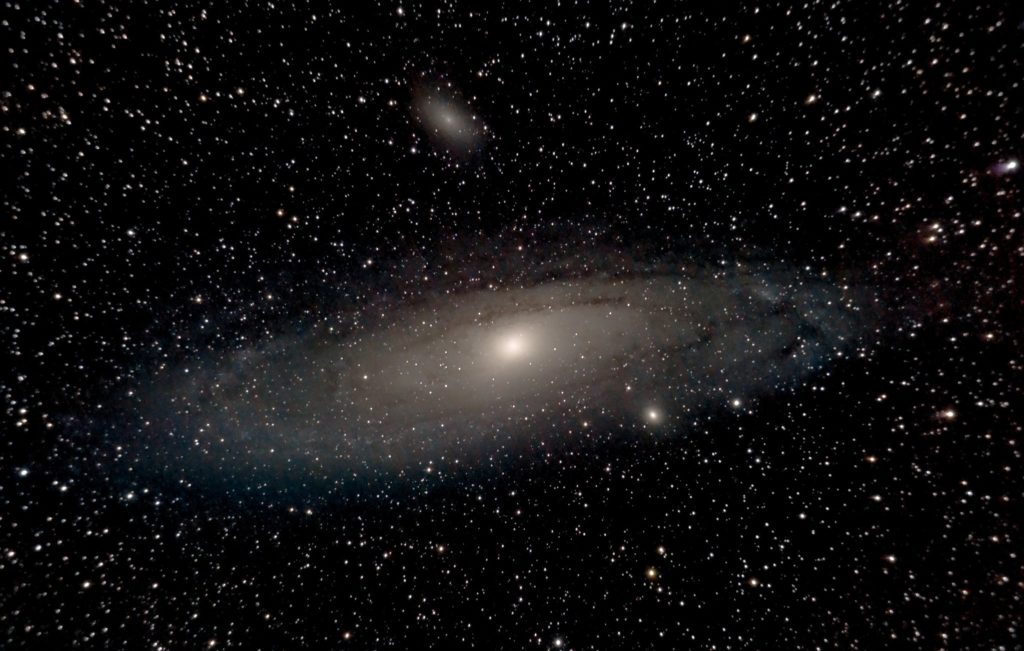
For certain other kinds of extreme abstractions - not centuries of time, but geographical continents, oceans, countries, etc. - we do have a mountain-like vantage point from which we imagine that we view them. The supremely abstracted form of a very large geographical feature is the view of a globe or map. “The Pacific Ocean” or “South America” is viewed in the mind’s eye as if perched on a satellite, a shape bearing little hint of the human activity far below. This zoomed-out vantage point does not offer clarity on the problems that matter to us; we can’t see individuals at this distance, only their extruded infrastructure. At the top of a mountain, however, somewhere below cruising altitude, looking down on an enormous swath of partially-settled landscape, one gets a giddy feeling of perceiving too much at once. There is suddenly, and continuously, too much topography. Merely looking at it is pleasurable, similar to the quality of awe. Relating this view to landmarks known from other views (say, down in the city, or from another distant but visible mountain) feels more satisfying than just looking; it feels like learning. My friend Chris Wage took this picture of the Andromeda Galaxy; it’s the first time I remember astrophotography giving me the same sensation of “suddenly perceiving too much topography” as standing on a very high mountain observing the valleys below. In this photo, rather than points of light in the sky, there are objects with spatial extent, planes of orientation, and relation to each other. If I looked up into the sky and saw such a thing, I think it would make me dizzy. This view of the ancient light emitted from Andromeda feels satisfying in both an aesthetic and epistemic way. But even with all that spatial information, it tells us only about the universe, not about any kind of world where beings like us might live. [caption id="attachment_6407" align="alignnone" width="1024"]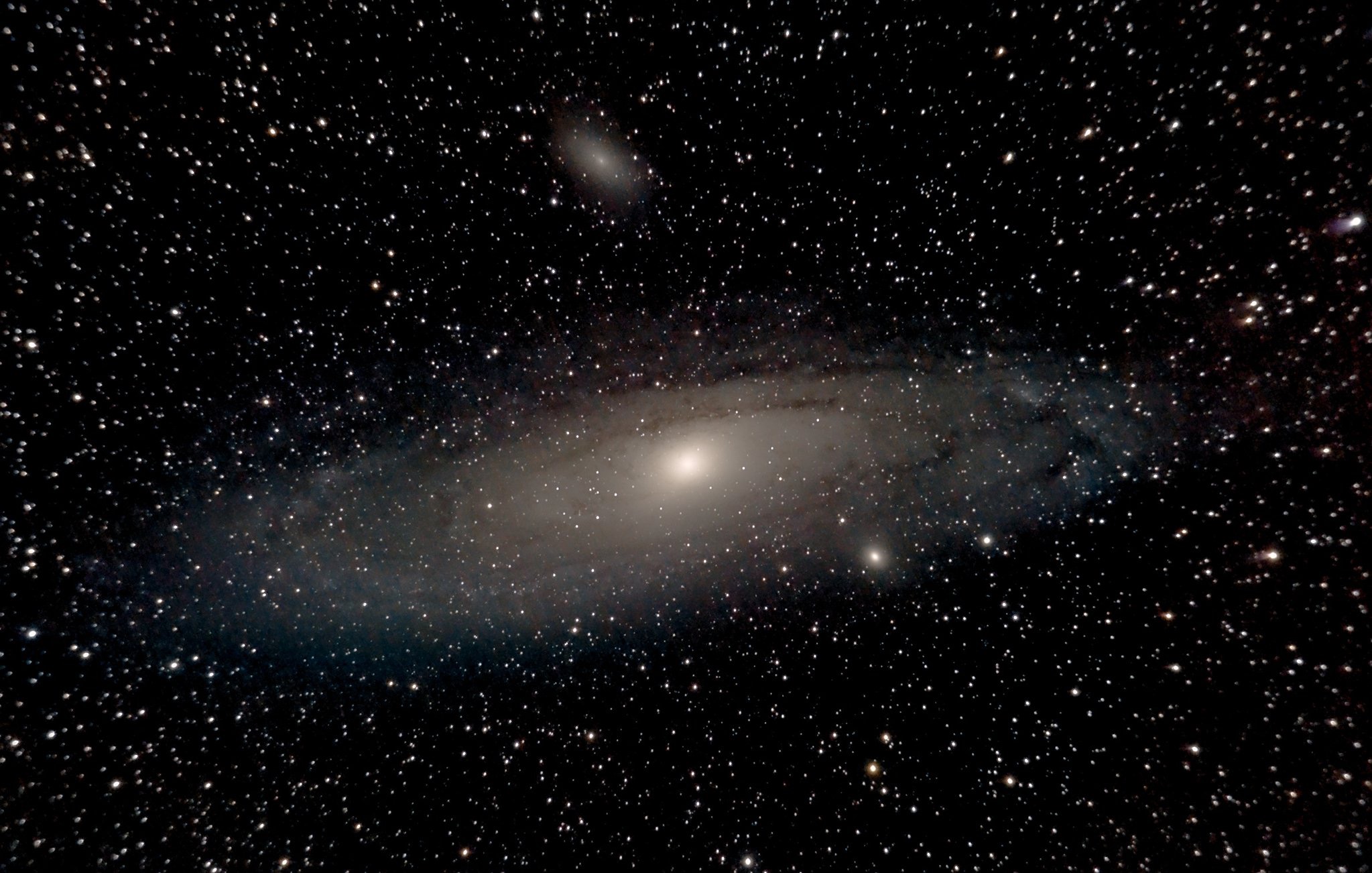 Photograph of the Andromeda Galaxy by Chris Wage[/caption]
For geography as well as time, there is the cinema: images of people in their habitats, wearing their characteristic clothes and displaying their characteristic moods. With geographical entities, unlike times, there is also the possibility of travel. To learn from travel, a traveler must start with a framework in which to organize experiences and meaning, and movies sometimes provide this, even though the experience is fully “real.”
Photograph of the Andromeda Galaxy by Chris Wage[/caption]
For geography as well as time, there is the cinema: images of people in their habitats, wearing their characteristic clothes and displaying their characteristic moods. With geographical entities, unlike times, there is also the possibility of travel. To learn from travel, a traveler must start with a framework in which to organize experiences and meaning, and movies sometimes provide this, even though the experience is fully “real.”
Science of the American Whale
High vantage points, costume dramas and other narratives, personal travel - how reliable are these? Isn’t formal, academic science and history much better? Here are some of the ways people in formal academic disciplines try to get a grip on the nineteenth century (all are journal article titles in no particular order, with years of publication):- The literacy myth: Literacy and social structure in the nineteenth-century city (1979)
- The emergence of Latin America in the nineteenth century (1994)
- Paris, the capital of the nineteenth century (1935)
- Yoruba warfare in the nineteenth century (1964)
- The dermatology and syphilology of the nineteenth century (1981)
- Street violence in the nineteenth century (1993)
- Dear Reader: The Conscripted Audience in Nineteenth-Century British Fiction (1996)
- The chemical industry during the nineteenth century: A study of the economic aspect of applied chemistry in Europe and North America (1958)
- Saudi Arabia in the nineteenth century (1965)
- Madness and Morals: Ideas on Insanity in the Nineteenth Century (1975)
- The nineteenth century roots of ‘everything is everywhere’ (2007)
- The Growth of Cities in the Nineteenth Century: A Study in Statistics (1899)
- Cholera and society in the nineteenth century (1961)
- The patent controversy in the nineteenth century (1950)
- Medicine in Virginia in the nineteenth century (1933)
- American indifference to basic science during the nineteenth century (1948)
- Pathetic fallacy in the nineteenth century: a study of a changing relation between object and emotion (1942)
- The Combination Laws as Illustrating the Relation between Law and Opinion in England during the Nineteenth Century (1904)
- The history of mathematics in the nineteenth century (1904)
Whiteness, Gods, and Moods
Why is the whale white? He is white, and very much blank, because he personifies (Dreyfus offers “mammal” for “person”) the indefinable, “the universe” rather than the world of people, that which refuses to be nailed down to a particular meaning in the eternalist/ontotheological worldview. Each character has a different response to the unknowable white whale, who cannot be seen beneath the dark water, and even if fished out to the air and light, cannot truly be seen, because his form becomes distorted out of the water. (I have tried to paint the nineteenth century in a similar light, above.) Ahab in particular, the monomaniac eternalist, demands the impossible from the whale: that it reveal itself to him, its one final meaning, whether the universe cares about him or not, whether he is important or not. Here is the really nice move of Dreyfus: colors are moods. The way to experience human reality - worlds - according to Dreyfus, is to be in a mood. We are always in moods, falling into and out of them, sometimes stuck in one. Moods are not merely feelings (affect or emotion): a mood reveals a world to us. Without moods, we would have no reason to do anything - to love, to maintain homeostasis, to read. Once we have a sort of meta-mood that provides emotional grounding and basic motivation (which can be destroyed, for instance, in severe depression), then many possible moods present themselves. As far as I can tell, moods typically have three components:- a bodily feeling,
- an affective or emotional feeling (which might feel like a judgment of general goodness or badness),
- and some idea content (thoughts about something).
Beyond Spectra
Honestly, I do not find the “spectrum” structure very satisfying. Would it have been more mysterious and satisfying during the nineteenth century? It’s a basically linear arrangement of colors in an unchanging arrangement. Slipping into and out of particular colorful moods, experiencing it all sequentially, being seduced by each new mood, sounds very desirable; but a linear rainbow spectrum, while beautiful, is no map. I like Dreyfus because he is willing to be pinned down, even if the pinning is to something rather nebulous. Melville won’t be pinned even that far. But consider this talk of literature as a map to human interaction, in The Confidence-Man (Chapter Fourteen, whose title is “WORTH THE CONSIDERATION OF THOSE TO WHOM IT MAY PROVE WORTH CONSIDERING”). Melville seems to take a deep breath and excuse himself (in something like his author persona) to the reader, for allowing a character to do something that is arguable “out of character.” He says that poor novelists make human nature look too simple:Always, they should represent human nature not in obscurity, but transparency, which, indeed, is the practice with most novelists, and is, perhaps, in certain cases, someway felt to be a kind of honor rendered by them to their kind. But, whether it involve honor or otherwise might be mooted, considering that, if these waters of human nature can be so readily seen through, it may be either that they are very pure or very shallow. Upon the whole, it might rather be thought, that he, who, in view of its inconsistencies, says of human nature the same that, in view of its contrasts, is said of the divine nature, that it is past finding out, thereby evinces a better appreciation of it than he who, by always representing it in a clear light, leaves it to be inferred that he clearly knows all about it.Using phrases like “the nineteenth century” in and of itself, I think, presents things in a too-clear light, and leaves it to be inferred that one “clearly knows all about it.” Poor authors give the illusion of clarity, but their maps of unchanging, oversimplified “people” don’t help us navigate the human world at all:
...all those sallies of ingenuity, having for their end the revelation of human nature on fixed principles, have, by the best judges, been excluded with contempt from the ranks of the sciences—palmistry, physiognomy, phrenology, psychology. Likewise, the fact, that in all ages such conflicting views have, by the most eminent minds, been taken of mankind, would, as with other topics, seem some presumption of a pretty general and pretty thorough ignorance of it. Which may appear the less improbable if it be considered that, after poring over the best novels professing to portray human nature, the studious youth will still run risk of being too often at fault upon actually entering the world; whereas, had he been furnished with a true delineation, it ought to fare with him something as with a stranger entering, map in hand, Boston town; the streets may be very crooked, he may often pause; but, thanks to his true map, he does not hopelessly lose his way. Nor, to this comparison, can it be an adequate objection, that the twistings of the town are always the same, and those of human nature subject to variation. The grand points of human nature are the same to-day they were a thousand years ago. The only variability in them is in expression, not in feature. But as, in spite of seeming discouragement, some mathematicians are yet in hopes of hitting upon an exact method of determining the longitude, the more earnest psychologists may, in the face of previous failures, still cherish expectations with regard to some mode of infallibly discovering the heart of man. Ibid., emphasis mine.As for the structure of reality - not the structure of the universe, but of the human world, revealed by moods - I have the barest inkling that it is not a spectrum, but rather takes a form that I struggle to express other than crassly: it is fractally up its own ass. Consider a Klein bottle; this structure is merely up its own ass, but still comes closer to the truth of the structure of the human world than the linear spectrum. Beyond the Klein bottle is a bustling, moving world in which all the objects and moods and referents and fashions and views stick up through each other like the “goose neck,” but all over, in every direction. There is nothing about this informational world that requires it to take a comprehensible three-dimensional form. It can be shaped like the internet, in part, and in fact must be. Up close, and far in the distance, there is the squirming texture of reality encountering itself, disappearing up its multitudinous assholes and reappearing in new and surprising places. In The Phenomenology of Mood and the Meaning of Life, Matthew Ratcliffe defines an “existential feeling” as a type of mood that doesn’t refer to anything outside in the world in particular, but constitutes the sense of belonging to a meaningful world. This, he says, is presupposed by the existence of actual moods. In order to be angry, one must be angry about something, for instance; in order for that to make sense, something must matter enough to be angry about. This is not a relationship of one flat layer politely resting on another. No; the structure indicated is one of profound and constant involvement between existential moods and everyday emotions. The sense of belonging to a meaningful world - based upon no evidence at all, and composed of pure feeling - is a condition of possibility for less “deep” moods to exist and make sense. Worlds are revealed in light of moods, and moods show up in light of primordial existential feelings of value. Adjacency and sequentiality are not sufficiently intimate relations to represent the structure of the human, feeling world. Recommended reading: “The Symbol,” poem by Richard Brautigan.
4 Comments
This part, "As for the structure of reality – not the structure of the universe, but of the human world, revealed by moods – I have the barest inkling that it is not a spectrum", besides the obvious connection of the same words, reminded me of a quote I read recently.
The exact quote was probably seen on a tweet and so escapes me, but I found something similar here:
> "This leads us to the second major problem with the political spectrum: it creates hostility. By telling us that there are two (and only two) sides in politics, it inherently pits a heroic, enlightened side against a villainous, foolish side. We don’t need to understand those who disagree with us, we only need to destroy them. " https://quillette.com/2017/05/03/time-retire-political-spectrum/
My point being that spectrum thinking is indeed limited and perhaps even relatable to deep laziness on the part of or in connection to Western linear thinking. Moods on a spectrum give a sense of control or perhaps agency and power to change the slider on the scale. Perhaps for some, to remove the spectrum is to remove moorings.
Of possible interest: http://www.glass-bead.org/article/a-theory-of-vibe/
I always liked the term 'self contained infinite regression,' even though it merely hints at what it's actually trying to say.
It's a timepiece for telling Renaissance Faire time crafted by a Blindwatchmaker that can be used to escape the dullness of whatever present emotion engorges our. I really just wanted to use "whale dicks" in a sentence. Brains.