
Boilerplate
Most texts and speech utterances are produced on the spot, by a particular writer or speaker, translating meaning into a linear arrangement of words. The final products of this process tend to be amazingly unique: you usually only need to google a short string of words in order to find the single source that they come from. (Try it - you rarely need more than four or five words, even very common words, and a whole sentence is usually overkill.) How incredible that most short strings are never repeated! Meanings are repeated over and over, expressed in different ways, but their manner of expression varies. However, there is a class of texts and speech utterances that are interesting precisely because they are boilerplate: they are reproduced over and over, pretty much verbatim, by different writers and speakers.
One class of these texts is the chain letter: a document whose content implores the human reader to reproduce it (or to share it on social media). But some of the most widely copied texts and speech utterances do not themselves ask to be copied. These pieces of boilerplate language are copied verbatim for reasons outside the context of the texts themselves. For example, boilerplate language in legal contracts is included not because the language says “include me in your contracts or you will be visited by the Litigation Demon;” rather, they are included because specific linear arrangements of words have been judged in the past to have a specific legal effect. Historically, in contract law, it was difficult to tell when a late performance still counted as performance. Courts held that the boilerplate incantation “time is of the essence” demonstrated that a performance had to be on time to count, and that exact string words still makes its way into contracts in order to ward off claims that late performance is good enough.
Boilerplate code is used for a similar reason: in some languages and programming environments, snippets of code must be reused over and over because they are not part of the default assumptions of the interpreting layer, even though they are part of the default intent of the writer.
When texts are copied because they are entertaining across many situations, even though they don’t invite the reader to copy them, they are called copypasta. This class of texts, more than legal boilerplate or boilerplate code, seems most similar to the original meaning of boilerplate text (according to Wikipedia): text engraved directly onto metal plates for printing onto newspaper, to be distributed more widely and used more often than sheets created on the fly, each letter placed by hand or Linotype. Original boilerplate texts, as I understand them, were the mass-market normie bullshit of their day, featuring advertisements and articles meant to be copied far and wide, rather than produced locally by organic artisans.
The origin of the term “boilerplate” from the steel plates used to make boilers strikes me as mysterious. Why would intellectuals criticizing newspapers expect their audiences to be familiar with the specific materials used to manufacture industrial equipment? As far as I can tell, the answer is that during the steampunk nineteenth century, boilers were constantly exploding and killing people.
From the New York Times, November 8th, 1860 (“Steam Boiler Explosions”):
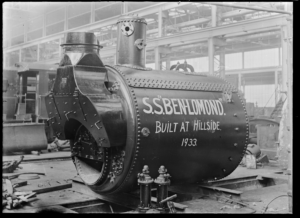 A boiler, made from boiler plate, with bolts visible.[/caption]
The late nineteenth and early twentieth centuries were a wild time for product liability law, and a second meaning of “boiler plate” soon appeared: metal plates with text on them, indicating their manufacturer, that were welded onto boilers, as required by various laws, presumably in the event that the boiler exploded and an investigation needed to be carried out. Boiler plates from as early as 1800 contain patent information, so some kind of intellectual property justification may have been at work as well. It’s not clear whether “boilerplate” as an analogy referred to the steel plates that boilers were made from, or the ones affixed to boilers with text molded into them (for legal reasons).
[caption id="attachment_6353" align="alignnone" width="300"]
A boiler, made from boiler plate, with bolts visible.[/caption]
The late nineteenth and early twentieth centuries were a wild time for product liability law, and a second meaning of “boiler plate” soon appeared: metal plates with text on them, indicating their manufacturer, that were welded onto boilers, as required by various laws, presumably in the event that the boiler exploded and an investigation needed to be carried out. Boiler plates from as early as 1800 contain patent information, so some kind of intellectual property justification may have been at work as well. It’s not clear whether “boilerplate” as an analogy referred to the steel plates that boilers were made from, or the ones affixed to boilers with text molded into them (for legal reasons).
[caption id="attachment_6353" align="alignnone" width="300"]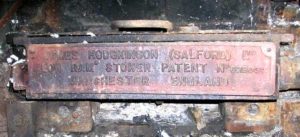 A boiler plate printed with manufacturer and patent information. Photo: Betty Longbottom[/caption]
The texts incorporated by religious and secular ritual (formal prayers, pledges of allegiance, oaths) form yet another category of text copied more or less verbatim, even though the text itself usually does not implore its own reproduction within the words of its content. And extremely nearby in this cluster is the song: a specific linear arrangement of words, reproduced verbatim or nearly so, with the words produced at specific pitch relationships and rhythms. Songs are often used in religious and secular ritual, as well as for play. The musical structure makes it easier to remember a specific linear arrangement of words. It’s much more difficult to memorize a specific linear arrangement of prose. Both songs and other kinds of boilerplate texts often exist in multiple versions, unless some version is canonized by a mechanism that is not vulnerable to competing canonizers.
In my own life, the boilerplate speech I use most frequently is the greeting “morning,” and I suspect that greetings are some of the most successful boilerplate texts in all of language. Even though it is only one word, it is a shortened form of a longer greeting, and it is used on its own only in a specific context to have a particular meaning. It is not a universal aspect of stranger protocol: on a crowded street, for example, it would be a breach of tacit boundaries to greet every person with “morning.” Rather, it is performed when encountering strangers is a relatively rare event (an empty side street at dawn, for instance), so that greeting does not take up too much time and attention from other projects, such as dog walking or running through the neighborhood. The greeting acknowledges the humanity of the encountered stranger, and is usually performed with a smile, indicating basic good will. In situations where encountering others is rare, the order of civil inattention seems to require (or allow) more proactive intimacy between strangers. “Morning” says “I am glad that you are here briefly, for I feel a bit safer with another friendly face around, and I hope I provide the same feeling for you. I will not stop to talk further, for I have my project and I see that you have yours as well, but know that I recognize your personhood and am temporarily a nearby ally. If we should see each other ten more times, perhaps we will even chat a moment.” However, not all strangers are so greeted; they may be excluded because of inattention, uninviting facial expression, sun in one party’s eyes, haughtiness, or some other barrier to this version of the stranger protocol.
So while most text is unique, the subset that is copied over and over is highly useful, and is often used in creative and satisfying ways that would be difficult to achieve with spontaneously-produced language.
A boiler plate printed with manufacturer and patent information. Photo: Betty Longbottom[/caption]
The texts incorporated by religious and secular ritual (formal prayers, pledges of allegiance, oaths) form yet another category of text copied more or less verbatim, even though the text itself usually does not implore its own reproduction within the words of its content. And extremely nearby in this cluster is the song: a specific linear arrangement of words, reproduced verbatim or nearly so, with the words produced at specific pitch relationships and rhythms. Songs are often used in religious and secular ritual, as well as for play. The musical structure makes it easier to remember a specific linear arrangement of words. It’s much more difficult to memorize a specific linear arrangement of prose. Both songs and other kinds of boilerplate texts often exist in multiple versions, unless some version is canonized by a mechanism that is not vulnerable to competing canonizers.
In my own life, the boilerplate speech I use most frequently is the greeting “morning,” and I suspect that greetings are some of the most successful boilerplate texts in all of language. Even though it is only one word, it is a shortened form of a longer greeting, and it is used on its own only in a specific context to have a particular meaning. It is not a universal aspect of stranger protocol: on a crowded street, for example, it would be a breach of tacit boundaries to greet every person with “morning.” Rather, it is performed when encountering strangers is a relatively rare event (an empty side street at dawn, for instance), so that greeting does not take up too much time and attention from other projects, such as dog walking or running through the neighborhood. The greeting acknowledges the humanity of the encountered stranger, and is usually performed with a smile, indicating basic good will. In situations where encountering others is rare, the order of civil inattention seems to require (or allow) more proactive intimacy between strangers. “Morning” says “I am glad that you are here briefly, for I feel a bit safer with another friendly face around, and I hope I provide the same feeling for you. I will not stop to talk further, for I have my project and I see that you have yours as well, but know that I recognize your personhood and am temporarily a nearby ally. If we should see each other ten more times, perhaps we will even chat a moment.” However, not all strangers are so greeted; they may be excluded because of inattention, uninviting facial expression, sun in one party’s eyes, haughtiness, or some other barrier to this version of the stranger protocol.
So while most text is unique, the subset that is copied over and over is highly useful, and is often used in creative and satisfying ways that would be difficult to achieve with spontaneously-produced language.
On Friday, the 2d inst., a boiler of the Mississippi steamer H.R.W. Hill exploded, instantly killing thirty-nine persons. The same day a boiler blew up at New-Haven, fatally injuring three or four persons. The next day the boiler of the tow-boat Baltic exploded in Mobile Bay, killing and fatally injuring several people. On the 24th ult. -- a little over a week ago, a boiler explosion occurred at Lee, and another at Lowell; and the day before there was another at New-Orleans, each one killing its man and injuring others.The author identifies shoddy materials, poor maintenance, lack of inspections, and poor alignment of incentives as the causes of these explosions. A boiler is only as strong as its weakest element, and often that element is one of its plates. [caption id="attachment_6352" align="alignnone" width="300"]
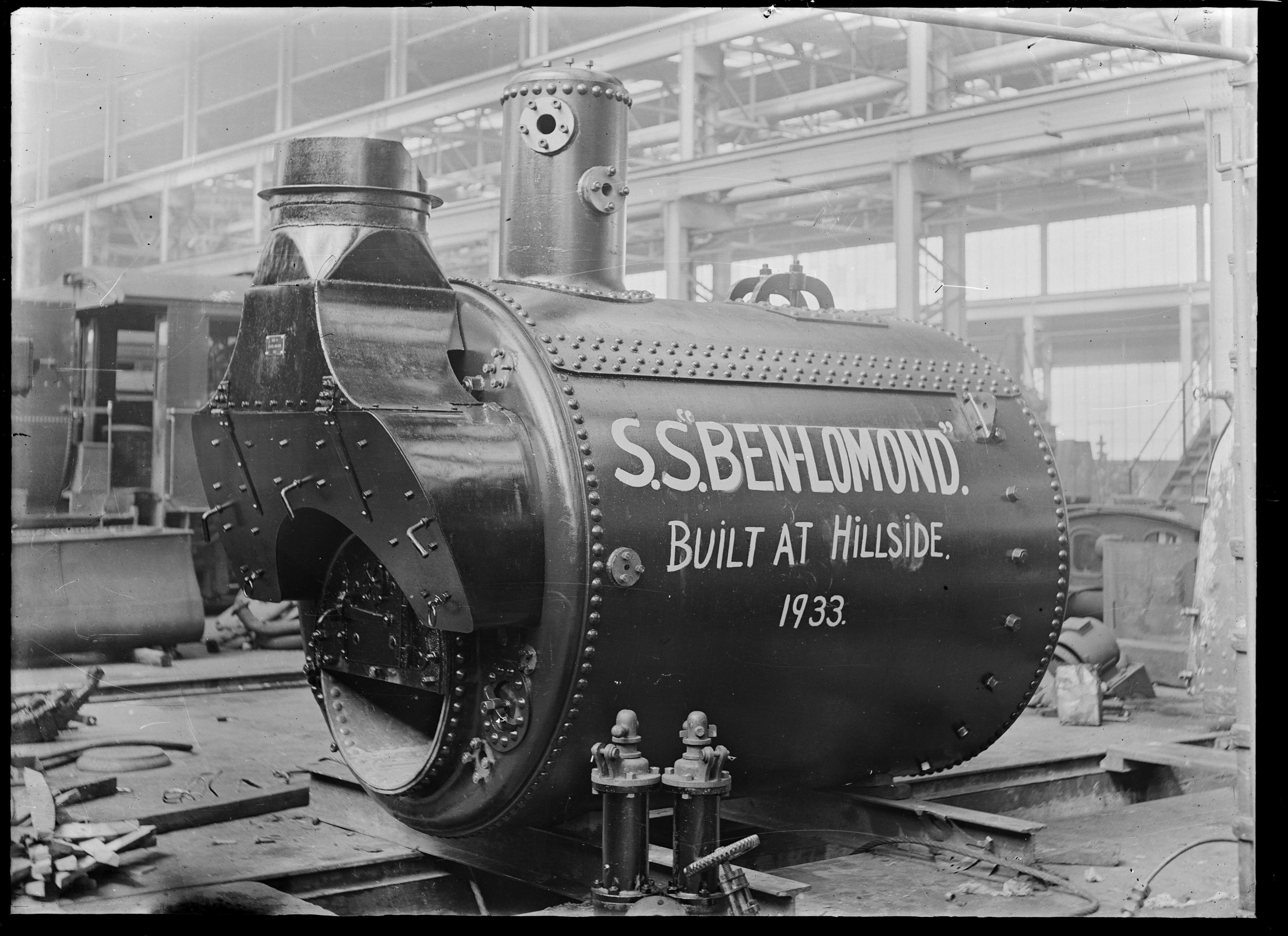 A boiler, made from boiler plate, with bolts visible.[/caption]
The late nineteenth and early twentieth centuries were a wild time for product liability law, and a second meaning of “boiler plate” soon appeared: metal plates with text on them, indicating their manufacturer, that were welded onto boilers, as required by various laws, presumably in the event that the boiler exploded and an investigation needed to be carried out. Boiler plates from as early as 1800 contain patent information, so some kind of intellectual property justification may have been at work as well. It’s not clear whether “boilerplate” as an analogy referred to the steel plates that boilers were made from, or the ones affixed to boilers with text molded into them (for legal reasons).
[caption id="attachment_6353" align="alignnone" width="300"]
A boiler, made from boiler plate, with bolts visible.[/caption]
The late nineteenth and early twentieth centuries were a wild time for product liability law, and a second meaning of “boiler plate” soon appeared: metal plates with text on them, indicating their manufacturer, that were welded onto boilers, as required by various laws, presumably in the event that the boiler exploded and an investigation needed to be carried out. Boiler plates from as early as 1800 contain patent information, so some kind of intellectual property justification may have been at work as well. It’s not clear whether “boilerplate” as an analogy referred to the steel plates that boilers were made from, or the ones affixed to boilers with text molded into them (for legal reasons).
[caption id="attachment_6353" align="alignnone" width="300"]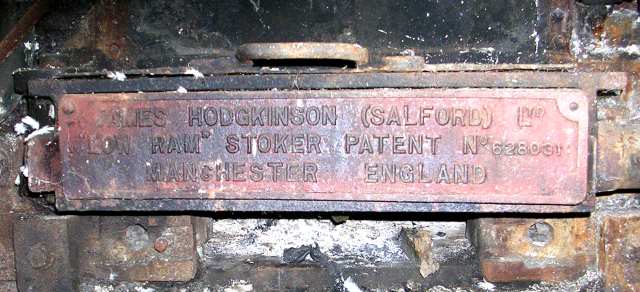 A boiler plate printed with manufacturer and patent information. Photo: Betty Longbottom[/caption]
The texts incorporated by religious and secular ritual (formal prayers, pledges of allegiance, oaths) form yet another category of text copied more or less verbatim, even though the text itself usually does not implore its own reproduction within the words of its content. And extremely nearby in this cluster is the song: a specific linear arrangement of words, reproduced verbatim or nearly so, with the words produced at specific pitch relationships and rhythms. Songs are often used in religious and secular ritual, as well as for play. The musical structure makes it easier to remember a specific linear arrangement of words. It’s much more difficult to memorize a specific linear arrangement of prose. Both songs and other kinds of boilerplate texts often exist in multiple versions, unless some version is canonized by a mechanism that is not vulnerable to competing canonizers.
In my own life, the boilerplate speech I use most frequently is the greeting “morning,” and I suspect that greetings are some of the most successful boilerplate texts in all of language. Even though it is only one word, it is a shortened form of a longer greeting, and it is used on its own only in a specific context to have a particular meaning. It is not a universal aspect of stranger protocol: on a crowded street, for example, it would be a breach of tacit boundaries to greet every person with “morning.” Rather, it is performed when encountering strangers is a relatively rare event (an empty side street at dawn, for instance), so that greeting does not take up too much time and attention from other projects, such as dog walking or running through the neighborhood. The greeting acknowledges the humanity of the encountered stranger, and is usually performed with a smile, indicating basic good will. In situations where encountering others is rare, the order of civil inattention seems to require (or allow) more proactive intimacy between strangers. “Morning” says “I am glad that you are here briefly, for I feel a bit safer with another friendly face around, and I hope I provide the same feeling for you. I will not stop to talk further, for I have my project and I see that you have yours as well, but know that I recognize your personhood and am temporarily a nearby ally. If we should see each other ten more times, perhaps we will even chat a moment.” However, not all strangers are so greeted; they may be excluded because of inattention, uninviting facial expression, sun in one party’s eyes, haughtiness, or some other barrier to this version of the stranger protocol.
So while most text is unique, the subset that is copied over and over is highly useful, and is often used in creative and satisfying ways that would be difficult to achieve with spontaneously-produced language.
A boiler plate printed with manufacturer and patent information. Photo: Betty Longbottom[/caption]
The texts incorporated by religious and secular ritual (formal prayers, pledges of allegiance, oaths) form yet another category of text copied more or less verbatim, even though the text itself usually does not implore its own reproduction within the words of its content. And extremely nearby in this cluster is the song: a specific linear arrangement of words, reproduced verbatim or nearly so, with the words produced at specific pitch relationships and rhythms. Songs are often used in religious and secular ritual, as well as for play. The musical structure makes it easier to remember a specific linear arrangement of words. It’s much more difficult to memorize a specific linear arrangement of prose. Both songs and other kinds of boilerplate texts often exist in multiple versions, unless some version is canonized by a mechanism that is not vulnerable to competing canonizers.
In my own life, the boilerplate speech I use most frequently is the greeting “morning,” and I suspect that greetings are some of the most successful boilerplate texts in all of language. Even though it is only one word, it is a shortened form of a longer greeting, and it is used on its own only in a specific context to have a particular meaning. It is not a universal aspect of stranger protocol: on a crowded street, for example, it would be a breach of tacit boundaries to greet every person with “morning.” Rather, it is performed when encountering strangers is a relatively rare event (an empty side street at dawn, for instance), so that greeting does not take up too much time and attention from other projects, such as dog walking or running through the neighborhood. The greeting acknowledges the humanity of the encountered stranger, and is usually performed with a smile, indicating basic good will. In situations where encountering others is rare, the order of civil inattention seems to require (or allow) more proactive intimacy between strangers. “Morning” says “I am glad that you are here briefly, for I feel a bit safer with another friendly face around, and I hope I provide the same feeling for you. I will not stop to talk further, for I have my project and I see that you have yours as well, but know that I recognize your personhood and am temporarily a nearby ally. If we should see each other ten more times, perhaps we will even chat a moment.” However, not all strangers are so greeted; they may be excluded because of inattention, uninviting facial expression, sun in one party’s eyes, haughtiness, or some other barrier to this version of the stranger protocol.
So while most text is unique, the subset that is copied over and over is highly useful, and is often used in creative and satisfying ways that would be difficult to achieve with spontaneously-produced language.

2 Comments
Good thoughts and history on this common yet under-considered phrase! Reminds me of this particular paragraph from Orwell's "Politics and the English Language", which discusses the use of boilerplate expressions in writing:
> DYING METAPHORS. A newly invented metaphor assists thought by evoking a visual image, while on the other hand a metaphor which is technically ‘dead’ (e. g. iron resolution) has in effect reverted to being an ordinary word and can generally be used without loss of vividness. But in between these two classes there is a huge dump of worn-out metaphors which have lost all evocative power and are merely used because they save people the trouble of inventing phrases for themselves. Examples are: Ring the changes on, take up the cudgel for, toe the line, ride roughshod over, stand shoulder to shoulder with, play into the hands of, no axe to grind, grist to the mill, fishing in troubled waters, on the order of the day, Achilles’ heel, swan song, hotbed. Many of these are used without knowledge of their meaning (what is a ‘rift’, for instance?), and incompatible metaphors are frequently mixed, a sure sign that the writer is not interested in what he is saying. Some metaphors now current have been twisted out of their original meaning without those who use them even being aware of the fact. For example, toe the line is sometimes written as tow the line. Another example is the hammer and the anvil, now always used with the implication that the anvil gets the worst of it. In real life it is always the anvil that breaks the hammer, never the other way about: a writer who stopped to think what he was saying would avoid perverting the original phrase.
Orwell even uses the same metaphor: a common metaphor "dying" implies active-boilerplate-corpus-as-body, with all the implied paraphiers.
Even more curious is to apply this concept onto itself. Has the usage of "boilerplate" itself become a boilerplate expression? Food for thought :)
This reminded me of very cheeky, half unfunny joke from several years ago.
A small village has a population of 75 people. As a tradition, the village has an annual joke-telling festival. Every person in the village is expected to go on stage and tell their best joke. The audience of 74 listens to the joke and laughs. Over time, every person has their "best" joke crystalized and trademarked and the same jokes start repeating themselves every year. So you have Person 1 going up, telling his same trademarked joke from every year and the rest of the 74 people laughing at it wildly. To make the ritual more efficient, the village decides to have the joke tellers appear in the same order, and by extension, numbering their jokes. So now, person 1 goes on stage and simply says "1". The audience then thinks of joke number 1 (that they've heard several times before) and laughs. Next, person 2 goes up and says 2. More laughter!
Now it so happens that a traveler is passing through the village one year when the annual joke-telling festival is underway. Being a student of culture, he sits in with the audience. But he can't tell what's going on...all he is seeing is people going up, uttering a number in predictable order and the audience breaking into laughter uncontrollably in response. This goes on all the way up to no. 75. Not sure of what he is missing, he decides to take part in the event. When number 75 steps down amidst mad laughter, the traveler sneaks up on stage and takes the mic. The audience not knowing what to expect sits up and goes silent. Very tentatively, the traveler says "76". Crickets!
Then, from one pocket of the 75-people audience, someone breaks into loud, unapologetic, honest laughter. The crowd looks at the person and goes "WTF are you laughing at bruv? We don't have a no. 76!" And the man goes, "I know! Finally a new, fresh joke!"