
Deep Laziness
Imagine a person who is very lazy at work, yet whose customers are (along with everyone else concerned) quite satisfied. It could be a slow-talking rural shop proprietor from an old movie, or some kind of Taoist fisherman - perhaps a bit of a buffoon, but definitely deeply content. In order to be this way, he must be reasonably organized: stock must be ordered, and tackle squared away, in order to afford worry-free, deep-breathing laziness.
Consider this imaginary person as a kind of ideal or archetype. Now consider that the universe might have this personality.
There is intense laziness apparent in the natural world (which one might come to understand simply by watching household pets). Christopher Alexander (in The Nature of Order, Volume II, pp. 37-39) notes many disparate examples of natural “laziness” that hint at an underlying principle (in history of science, the “principle of least action”): a soap bubble minimizing surface area, Ohm’s law, the shape of a river’s meander. “Many systems do evolve in the direction that minimizes their potential energy,” he says. “The deeper problem is that we are then faced with the question, Why should the potential energy be minimized?”
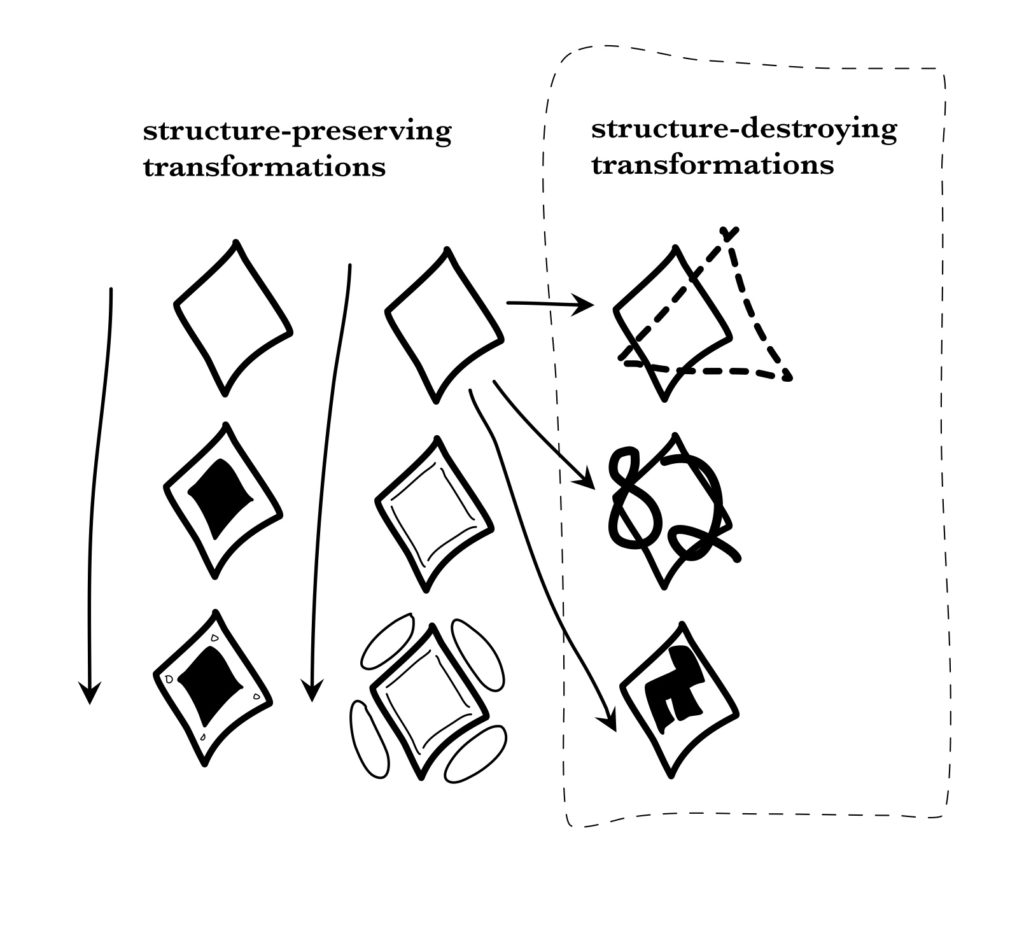 The structure-destroying transformations are recognizable as mess: competing orders don’t allow for a coherent, harmonious whole. They are not peaceful to look at, and further attempts at structure-preserving elaboration will only “preserve” an ugly, messy structure. On the other hand, simple as they are, the structure-preserving transformations have a bit of quiet ease. You can imagine going on like that, adding dots here and lines there, just as needed, until it is quite elaborate. As long as each transformation preserves the underlying structure, it will retain its wholeness and beauty. They are not based on any pre-existing image; rather, they are “easy, natural steps which arise from the context (ibid. p. 439).” Even decay can be structure-preserving, when the decaying structure was produced by this process: decay reveals underlying levels of organization that are attractively harmonious, because they formed the basis for the elaboration of the whole (e.g. bones, shipwrecks).
What is this underlying structure? It is the “field of centers,” made up of “centers,” a Christopher Alexander term I have written about extensively, and about which my thinking changes each time I write about it (hopefully becoming more correct). A center is an aesthetic concept that is somewhere between geometric, phenomenological, and mystical. It is defined recursively - a center is made up of other centers, and in turn makes up other centers (hence the “field of centers” as the primitive). Centers are the basic building blocks of beauty, except that they’re rarely shaped like blocks. If you look at any beautiful thing, a building or a tree or a hand tool, it will possess strong centers. In the diagram above, the diamond is a center, and each embellishment (and the spaces between, when they form good shapes) is a center. Each new whole, after each structure-preserving transformation, is a center. Centers are “things” - shapes, plants, doorways, furniture, faces, eyes, motifs, bounded spaces, boundaries, clouds. The centers form the seeds for the next structure-preserving transformation.
A step-by-step recipe for beauty:
The structure-destroying transformations are recognizable as mess: competing orders don’t allow for a coherent, harmonious whole. They are not peaceful to look at, and further attempts at structure-preserving elaboration will only “preserve” an ugly, messy structure. On the other hand, simple as they are, the structure-preserving transformations have a bit of quiet ease. You can imagine going on like that, adding dots here and lines there, just as needed, until it is quite elaborate. As long as each transformation preserves the underlying structure, it will retain its wholeness and beauty. They are not based on any pre-existing image; rather, they are “easy, natural steps which arise from the context (ibid. p. 439).” Even decay can be structure-preserving, when the decaying structure was produced by this process: decay reveals underlying levels of organization that are attractively harmonious, because they formed the basis for the elaboration of the whole (e.g. bones, shipwrecks).
What is this underlying structure? It is the “field of centers,” made up of “centers,” a Christopher Alexander term I have written about extensively, and about which my thinking changes each time I write about it (hopefully becoming more correct). A center is an aesthetic concept that is somewhere between geometric, phenomenological, and mystical. It is defined recursively - a center is made up of other centers, and in turn makes up other centers (hence the “field of centers” as the primitive). Centers are the basic building blocks of beauty, except that they’re rarely shaped like blocks. If you look at any beautiful thing, a building or a tree or a hand tool, it will possess strong centers. In the diagram above, the diamond is a center, and each embellishment (and the spaces between, when they form good shapes) is a center. Each new whole, after each structure-preserving transformation, is a center. Centers are “things” - shapes, plants, doorways, furniture, faces, eyes, motifs, bounded spaces, boundaries, clouds. The centers form the seeds for the next structure-preserving transformation.
A step-by-step recipe for beauty:
The Theory of Structure-Preserving Transformations
Underneath the universe’s apparent laziness is a deeper laziness: a manner of generation that preserves existing structure. A “structure-preserving transformation” does not impose arbitrary (conscious, legible) order on the system, but takes its cue from the existing structure, and elaborates and strengthens it. One of Christopher Alexander’s terms for this is “the unfolding of wholeness” - but here a picture will do better than words. Below, the diamond shape forms the basis for subsequent transformations. In the two left columns, the diamonds are subjected to transformations that strengthen and emphasize their shape, then to transformations that build off of that new whole, preserving and elaborating the new structure in a lazy but rather effective way. In the column on the right, the diamond is subjected to structure-destroying transformations that impose new, incompatible order and detract from, rather than strengthen, the original structure.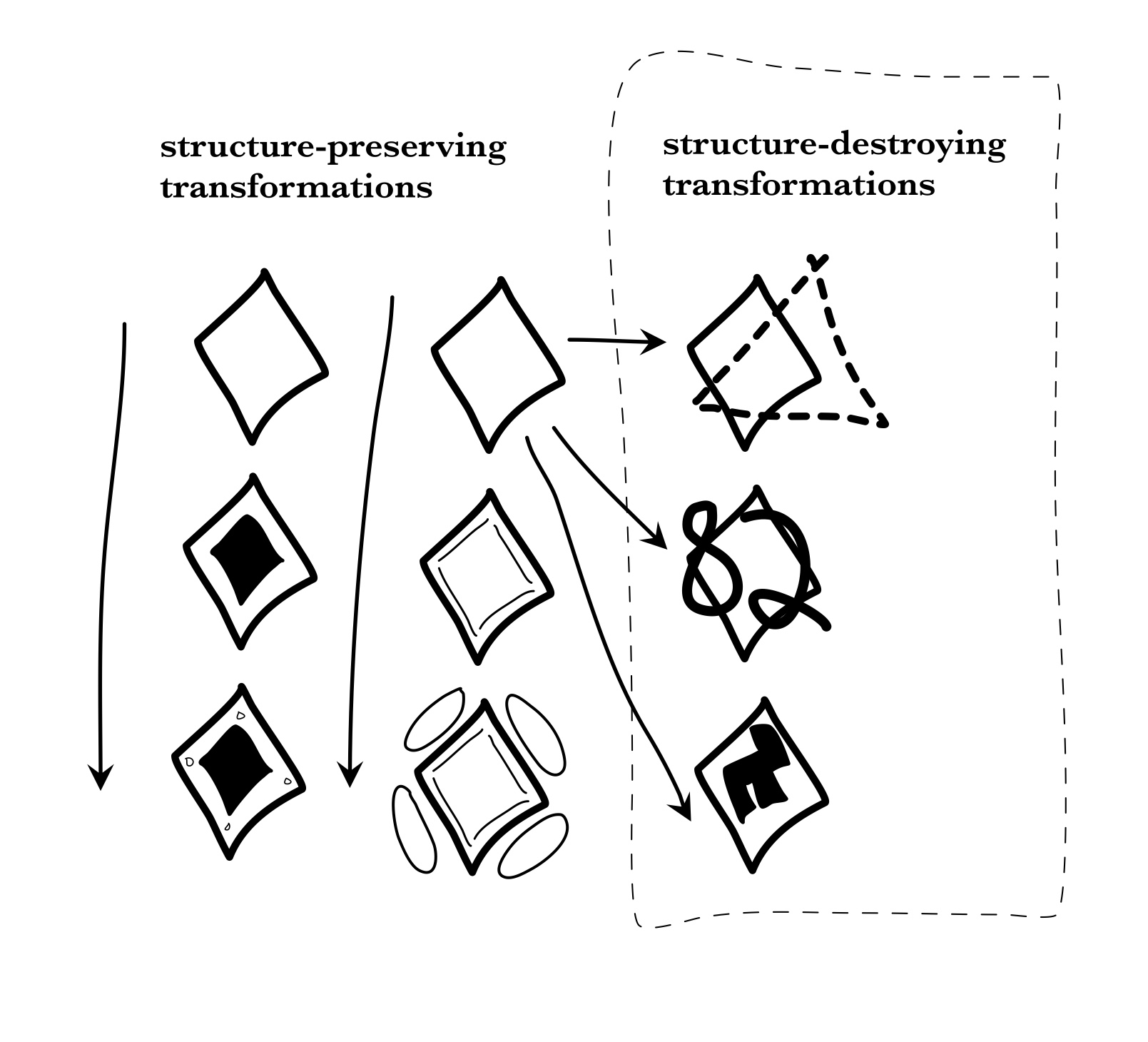 The structure-destroying transformations are recognizable as mess: competing orders don’t allow for a coherent, harmonious whole. They are not peaceful to look at, and further attempts at structure-preserving elaboration will only “preserve” an ugly, messy structure. On the other hand, simple as they are, the structure-preserving transformations have a bit of quiet ease. You can imagine going on like that, adding dots here and lines there, just as needed, until it is quite elaborate. As long as each transformation preserves the underlying structure, it will retain its wholeness and beauty. They are not based on any pre-existing image; rather, they are “easy, natural steps which arise from the context (ibid. p. 439).” Even decay can be structure-preserving, when the decaying structure was produced by this process: decay reveals underlying levels of organization that are attractively harmonious, because they formed the basis for the elaboration of the whole (e.g. bones, shipwrecks).
What is this underlying structure? It is the “field of centers,” made up of “centers,” a Christopher Alexander term I have written about extensively, and about which my thinking changes each time I write about it (hopefully becoming more correct). A center is an aesthetic concept that is somewhere between geometric, phenomenological, and mystical. It is defined recursively - a center is made up of other centers, and in turn makes up other centers (hence the “field of centers” as the primitive). Centers are the basic building blocks of beauty, except that they’re rarely shaped like blocks. If you look at any beautiful thing, a building or a tree or a hand tool, it will possess strong centers. In the diagram above, the diamond is a center, and each embellishment (and the spaces between, when they form good shapes) is a center. Each new whole, after each structure-preserving transformation, is a center. Centers are “things” - shapes, plants, doorways, furniture, faces, eyes, motifs, bounded spaces, boundaries, clouds. The centers form the seeds for the next structure-preserving transformation.
A step-by-step recipe for beauty:
The structure-destroying transformations are recognizable as mess: competing orders don’t allow for a coherent, harmonious whole. They are not peaceful to look at, and further attempts at structure-preserving elaboration will only “preserve” an ugly, messy structure. On the other hand, simple as they are, the structure-preserving transformations have a bit of quiet ease. You can imagine going on like that, adding dots here and lines there, just as needed, until it is quite elaborate. As long as each transformation preserves the underlying structure, it will retain its wholeness and beauty. They are not based on any pre-existing image; rather, they are “easy, natural steps which arise from the context (ibid. p. 439).” Even decay can be structure-preserving, when the decaying structure was produced by this process: decay reveals underlying levels of organization that are attractively harmonious, because they formed the basis for the elaboration of the whole (e.g. bones, shipwrecks).
What is this underlying structure? It is the “field of centers,” made up of “centers,” a Christopher Alexander term I have written about extensively, and about which my thinking changes each time I write about it (hopefully becoming more correct). A center is an aesthetic concept that is somewhere between geometric, phenomenological, and mystical. It is defined recursively - a center is made up of other centers, and in turn makes up other centers (hence the “field of centers” as the primitive). Centers are the basic building blocks of beauty, except that they’re rarely shaped like blocks. If you look at any beautiful thing, a building or a tree or a hand tool, it will possess strong centers. In the diagram above, the diamond is a center, and each embellishment (and the spaces between, when they form good shapes) is a center. Each new whole, after each structure-preserving transformation, is a center. Centers are “things” - shapes, plants, doorways, furniture, faces, eyes, motifs, bounded spaces, boundaries, clouds. The centers form the seeds for the next structure-preserving transformation.
A step-by-step recipe for beauty:
- start with existing centers or create strong ones that harmonize with the environment
- elaborate on this structure in a way that preserves and strengthens it
- elaborate on this NEW structure, which now includes the most recent elaboration
- repeat until done
- repair as above, or allow to decay
15 Comments
Hi Sarah,
It would seem the object you’re looking for to describe recursively nested centers derived from one another is a fractal. Infinite complexity can be created via simple rules that take the existing structure as input to produce a new self similar one at each iteration of the feedback process.
Cool read.
Also at the end I was reminded of this quote from Zen and the Art of Motorcycle Maintenance:
“Mountains should be climbed with as little effort as possible and without desire. The reality of your own nature should determine the speed. If you become restless, speed up. If you become winded, slow down. You climb the mountain in an equilibrium between restlessness and exhaustion. Then, when you're no longer thinking ahead, each footstep isn't just a means to an end but a unique event in itself....To live only for some future goal is shallow. It's the sides of the mountains which sustain life, not the top.”
Christopher Alexander (whom Sarah has studied and written about extensively, as she mentioned in this post) talks about fractals in the works she referenced, actually. It would be pretty hard to miss them, as they are one of the most well-known and tangible instances of the larger pattern she's talking about. They're kind of low-hanging fruit, TBH. If she didn't mention them, I doubt it was because she didn't know about them.
If they are low hanging fruit what hangs higher? What more captures the idea?
See Stewart Brand's definition of a hacker as a "lazy engineer".
SB is also responsible for some part of Christopher Alexander's present fame -- A Pattern Language was prominently listed in one of the later Whole Earth Catalogs.
>Processes governing the built environment have become more structure-destroying over the past century. These processes have no room for iterated elaboration according to emerging structure, and certainly no room for doing so according to how each elaboration feels.
Stretch the sense of structure to include the time dimension. Systems are aharmonious when they institute processes with shorter feedback loops than the outlying centers can meaningfully be in resonance with, after which the entire structure simply can not maintain cohesiveness across its parts.
Can we try an example for clarification? Is it over optimization of parts rather than focusing on the whole (in personal development for eg, time tracking every activity to make every action as efficient as possible and thus messing up the whole life?)
Good read! Sounds like a detailed explanation of what the idea of ‘organic growth’ really entails and the mechanics of that process.
I noticed a key difference between the step-by-step recipe you have higher up and the ordered list that constitutes Christopher Alexander’s generative method: creating centers. That should be a pre-step or at least an alternative step to Finding the Centers: Creating or Generating a Center. Sometimes, you can actually generate centers where none seemingly exist, if you persist with and nourish what might look like random scatter to the non-discerning eye. The random scatter has to have a convincing-enough whiff to be a potential center however, and that is solely up to the perception of the individual.
The best metaphor I can think up is a kaleidoscope, where random tinsel can be curated into a center, if you nourish it right. In the case of a kaleidoscope, the nourishment happens by way of mirrored repetition. But the point is that randomness can be processed into a stable, fertile structure, without overlaying a structure on top of it and without compromising on its essential randomness. The key is to be able to generate a center out of then randomness.
The resultant structure so obtained is a stable one and can be elaborated upon for further generation. At this stage, looking back, you can argue that you basically just ‘found’ a center, but in real time, I suspect trying to generate a center instinctively is sometimes a more fruitful exercise than trying to ‘find’ one that allegedly exists. The difference is subtle, but key.
In daily life, any successful ‘innovation’ as it is commonly understood in the business world today falls in the ‘generating a center’ bucket while any ‘scaling’ activity falls squarely in the ‘finding a center’ bucket.
There really is a lot that you can appreciate from laziness, and the patience that develops from it. I have found success in my own work by blocking stresses, and allowing myself open time to relax and find my own laziness, with lots of added music! I'll turn to my work, pop my on ear headphones in, and allow my mind to relax, and find a comfortable head space to work without pressure. I have chosen to assess behaviors I have had my entire work life that only added stress, and actively adjusted them to work to my advantage.
A deep, underlying apparent laziness to the natural world? A theologically-minded person might even infer that the world was created to enjoy its Creator's Sabbath rest...
This was an enlightening read. Thank you.
I'm impressed you've read The Nature of Order, took me two months to get through all the volumes. It's not always a comfortable thing to read. You can feel the relentless drive and frustration as Alexander pounds away at something he can clearly see but struggles to articulate in ways that other people to see and understand (deep down at the gut level) as well.
It would be an exaggeration to say that I’ve read The Nature of Order - I’ve spent the past two and a half years at least grappling with Book 1, and it’s been the book that I’ve spent the most time with during that time. Some parts I’ve read a dozen times, and I’ve kept trying to distill and write about parts of it. Then a friend asked me about Christopher Alexander’s first amendment suit against Berkeley which I didn’t know anything about, and when I looked into it, Alexander reports that it was about his ability to teach the material specifically in Book 2. So even though I didn’t feel ready for it I started reading that volume, and I was both disturbed and excited that it seemed to be exactly about the mess stuff that I’ve been obsessed with. I know what you mean about the frustration - it’s so hard to communicate!
This article is so good! Best article in the entire internet! (Srs, not kidding). A wonderful mix of reflections about life, philosophy, and mathematics.
this is brilliant // thanks for sharing ... it explains so much