
How to Make History
In the past year, I've found myself repeatedly invoking, in all sorts of conversations, a hierarchy of agency with three levels: labor, making, and action. Here's a visualization. The annotations on the left characterize the kind of agency. The annotations on the right characterize the locus where it is exercised, and the associated human condition.
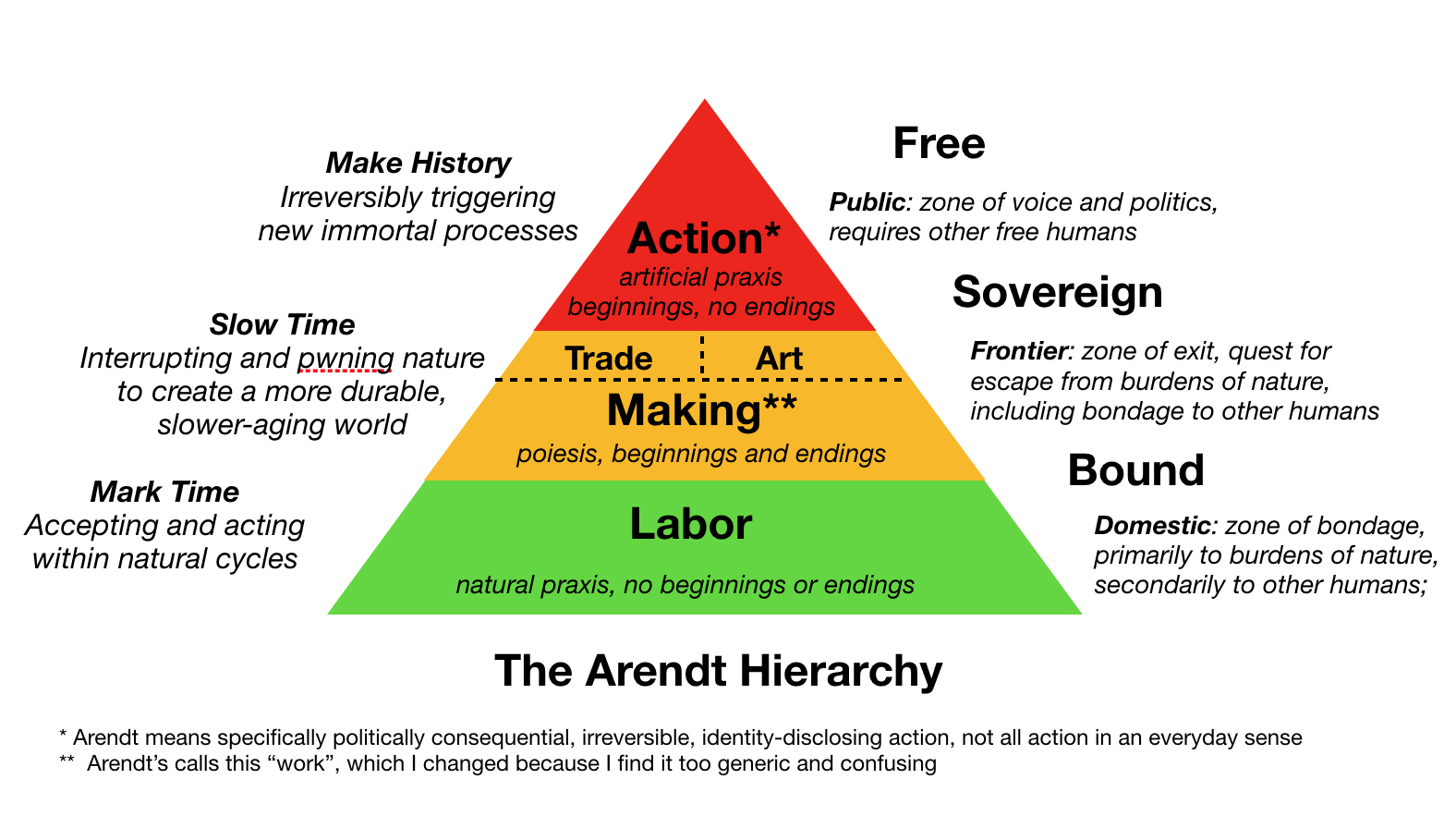 The hierarchy is based on Hannah Arendt's Human Condition, so I've named the visualization the Arendt hierarchy.
A mnemonic to remember the distinctions is mark time or make history. In everything you do, from posting a tweet or buying a coffee to running for President or tackling the Riemann hypothesis, you must choose between two extreme contexts: to either mark time with labor, or make history with action. In between there is a third context, where you can choose to slow time, which includes any sort of making, including art and trade (which is making in the sense of market-making). Naturally, Arendt thought (as do I) that you must choose action and history-making as much as possible. That is what it means to be fully human.
The scheme is non-intuitive, but once you've internalized the concepts, they turn out to be weirdly useful for thinking about what you're doing and why, whether it is futile or meaningful, nihilistic or generative.
The hierarchy is based on Hannah Arendt's Human Condition, so I've named the visualization the Arendt hierarchy.
A mnemonic to remember the distinctions is mark time or make history. In everything you do, from posting a tweet or buying a coffee to running for President or tackling the Riemann hypothesis, you must choose between two extreme contexts: to either mark time with labor, or make history with action. In between there is a third context, where you can choose to slow time, which includes any sort of making, including art and trade (which is making in the sense of market-making). Naturally, Arendt thought (as do I) that you must choose action and history-making as much as possible. That is what it means to be fully human.
The scheme is non-intuitive, but once you've internalized the concepts, they turn out to be weirdly useful for thinking about what you're doing and why, whether it is futile or meaningful, nihilistic or generative.
The hierarchy is based on Hannah Arendt's Human Condition, so I've named the visualization the Arendt hierarchy.
A mnemonic to remember the distinctions is mark time or make history. In everything you do, from posting a tweet or buying a coffee to running for President or tackling the Riemann hypothesis, you must choose between two extreme contexts: to either mark time with labor, or make history with action. In between there is a third context, where you can choose to slow time, which includes any sort of making, including art and trade (which is making in the sense of market-making). Naturally, Arendt thought (as do I) that you must choose action and history-making as much as possible. That is what it means to be fully human.
The scheme is non-intuitive, but once you've internalized the concepts, they turn out to be weirdly useful for thinking about what you're doing and why, whether it is futile or meaningful, nihilistic or generative.
The Three Contexts
Arendt's theory is based on a historical process theory concerning the co-evolution of three contexts of human life: the public (polis), the market (agora), and the private. She also gestures at two additional contexts: the frontier of discovery beyond the public, and the frontier of intimacy beyond the private. A key failing of her otherwise solid theory (which I will try to address) is the inadequacy of her account of these two frontiers. One way to understand the logic of the 3 contexts is through the famous parable of the 3 stone-cutters, popularized by Peter Drucker in the business world. A traveler encounters 3 men cutting stones. He asks them what they're doing. The first says, "I'm making a living," The second says, "I'm doing the best job of stone-cutting in the country." The third says, "I'm building a cathedral." Those three answers correspond to labor, making, and action, and Arendt had a great deal more to say about them than Peter Drucker did (they also correspond to the three levels of the Gervais Principle hierarchy, a connection which may interest some of you).Labor
In the Arendtian account of history, the domestic zone is where you are entirely bound by the burden of life itself. You are what she calls animal laborans, a laboring beast. It almost doesn't matter whether the burden is due to being in a pre-civilized state of nature where life just takes time and absorbs all your energies, or whether you're laboring as a slave within a civilized state so others may enjoy leisure. Whatever the cause, in the laboring zone, you are in a human condition of pure bondage, driven by natural cycles. Fully constrained, consumed, and defined by your labors, and your unalterable connections to other humans. In the domestic zone, even the master of the Greek house, well stocked with women, children, and slaves, is fully constrained. He is only free outside the laboring zone. It is not necessarily an unpleasant state (like the corresponding state of loserdom in the Gervais Principle). Laboring does not necessarily imply a condition of oppression, nor does it necessarily generate agency (the conceptual and historical failures of both conservatism and socialism tend to follow from those two assumptions of necessity). Laboring is at once futile in a Sisyphean sense (it is never done), but necessary (you have to do it). The condition does not offer happiness, but it does offer what Arendt characterizes as bliss: the temporary exhilaration of respite from pain and labor, and the joys of communal bonding in an unalterably shared condition. The essence of Arendtian bliss is: we're all in this together; let's go for happy hour after work. Labor has no beginning, and no end. I think of it as natural praxis: a mode of situated action that is defined by natural constraints. One clear sign that you're in a laboring mode is that money only has transactional value. You earn it, you spend it. It's fuel for the parts of your life process you cannot sustain by yourself. More generally, laboring is a sort of stateless, memoryless condition. Labor is also marked by a certain political invisibility and muteness. Not merely because it is hidden from sight (toilets being the prime example), but because it does not interrupt the cycles of nature, and can therefore blend into the background. This means labor is a mode of behavior that does not disclose the unique identity of humans. It is the essence of shared humanity. You do not appear in public through labor, let alone make history. Laboring humans are fungible as individuals, and only consequential actors with a political voice en masse (whether organized in egalitarian ways as a working class or non-egalitarian ways as a patriarchy, or ethno-nationalist clientelistic identity group).Making
One level up, you get a human condition marked by a higher level of agency, derived from interrupting and pwning natural cycles to create a durable world, and a somewhat enduring respite from some aspects of the laboring life within it. In this zone, which you can loosely associate with the market economy, you are what Arendt calls homo faber, maker-man. Arendt's insight here was realizing that what we seek to create when we create something, is durability (though it might make things disposable elsewhere). Making is a way to trade laboring within the flows of nature for artificial stocks of some sort that allow us to step outside of those flows. This results in a durable, artificial world of accumulating things that wear out slowly with use rather than getting consumed rapidly as fuel. A world that offers enduring relief from laboring, and creates the conditions of surplus where freedom can emerge. Makerdom veers into cluelessness when it deludes itself that durability is timelessness; an out-of-time state of eternity. It is a particularly useful distinction for technologists, who have historically been suspicious of the natural/artificial distinction (it's all the laws of physics, we like to tell ourselves). The idea that artificiality is durability created by interrupting and slowing nature down is a powerful one. Among other things, it explains why capitalism exists at all, how it can foster a false consciousness (the eternalism the clueless are prone to in maker contexts), and why it creates so much premium mediocrity (which in Arendtese would translate to the world being less durable than it pretends to be). Making carries some agency, but not full-human agency. You can aspire at best to sovereignty, not freedom. It is the difference between money as a fuck-you and money as agency exercised among other free humans. Its characteristic emotion (and this is my inference, not Arendt's) is transient satisfaction, a sort of cumulative, addictive big brother to bliss that gets harder and harder to achieve each time. Long-term, however, the infinite regress caused by the means-ends reasoning characteristic of making leads to nihilism (why this happens is too involved to get into, but the basic argument has to do with man, in a solitary/individual sense, becoming the measure of everything, which does not end well; the second stonecutter in the parable assuming that skilled stonecutting is self-evidently a worthwhile thing hints at the contours of the argument; the flip side of the second stonecutter's pure producerist ethos is the nihilistic ethos of the ultimate consumer, which I discussed in The Gollum Effect). Making in Arendt's account is pure poiesis, an imposition of a generative inner order onto the world through instrumental means-ends reasoning, rather than a situation of behavior within the world. It has a beginning: you must choose to interrupt nature and impose some sort of durability on some aspect of reality. It has an end: projects get completed, and products always wear out, and nature reasserts control in the end. In the world of making, money acquires value beyond the transactional: it becomes a store of value, modeling the appreciations and depreciations that come with enforcing a boundary of artificiality and seeking durability. It becomes a unit of account, weaving a seemingly universal calculus of utility through the human condition, becoming a null measure of both man and everything he makes. The essence of Arendtian making is what you might call the curse of wealth: making fuck-you money and finding it to be an unsatisfying condition that leaves you alone facing a void within you, without the psyche to deal with it. The conceptual failures of libertarianism tend to follow from mistaking sovereignty for freedom, individual utility for value, and individual subjectivity as the ultimate measure of everything. Making is not quite as invisible as laboring, but not as visible as action. To appear in the marketplace, the agora, with durable goods to trade, is to be recognized as sort of half-human. You have restricted sort of voice, characterized by voting with your dollars and talking like a brand or a customer. You don't appear in history, but you do provide the stage for it to play out. If you are clueless, you assume the stage is the world, and there forever; that being a good stonecutter can be an end in itself. Your mode of political agency does not make you entirely a faceless part of a collective, but you don't act as a unique individual either. The modern idea of a special-interest group roughly captures the kind of political agency associated with making.Action
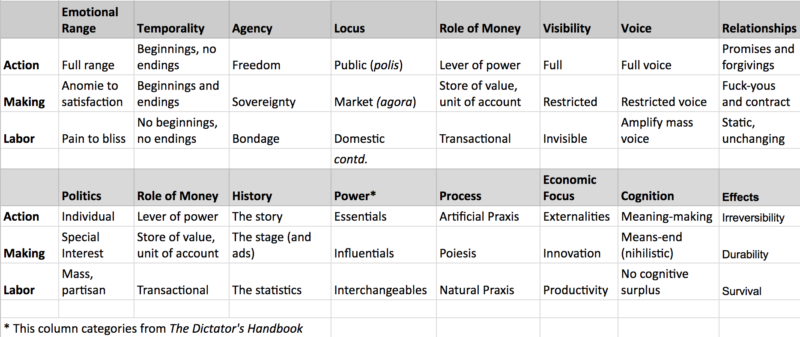
At the top of the pyramid, we have what Arendt considered full-featured humans, enjoying the highest level of agency possible: making history. The locus of action is the public. If labor is about blending into the processes of nature, and making about interrupting and slowing it to create a durable world, action is about free behaviors that make history. Arendt uses the terms poiesis and praxis in somewhat ambiguous ways, so I use the term artificial praxis for the process quality of action. It incorporates the artificial because it plays out in the durable world built by makers (and therefore implicitly incorporates maker-poiesis), but it derives its situatedness (which is what marks it as a kind of praxis) neither from the cycles of nature, nor from the affordances of a durable world, but from the presence of other free minds. To act is to act on other free minds (which have equal agency and can therefore respond unpredictably). The calculus of action is the calculus of processing the unpredictability of free humans. Transgressions, promises, and forgiveness constitute the stuff of action. Money, in the context of action, is primarily an instrument of power. Its textbook "uses" -- as means of exchange, store of value, and unit of account -- have no direct salience to action. In a sense, making is defined by money, and laboring is confined by it, but action is outside of it. As Francis Underwood laments in House of Cards, "Such a waste of talent. He chose money over power. In this town, a mistake nearly everyone makes. Money is the McMansion in Sarasota that starts falling apart after 10 years. Power is the old stone building that stands for centuries. I cannot respect someone who doesn't see the difference." The metaphor is a bad one in Arendt's terms though. Both old stone building and McMansions, by virtue of being comparable in terms of the durability of stuff, belong within the calculus of money. To exercise power in Arendt terms is to see the difference between buildings and people. To act is to begin something without the possibility of meaningful reversal. Do-overs and reworkings are for laboring and making. But you cannot predict or control what happens after you act. Means-ends reasoning fails as a cognitive mode because other free humans are in the loop. You cannot science the shit out of action the way makers can, or game theorize the freedom of others out of the equation as you can with incentives in markets peopled by curiously behaviorist econs chasing utils. You are also not bound to others in unalterable ways the way labor is. The reward for accepting unpredictability is meaning. Unlike the abyss faced by makers, the plurality of other humans who are the object of action don't just stare back. Sometimes they accept your invitation to play on; they join you in continuing the game. To act, in the Arendt sense, is to issue a call to play an infinite game in the James Carse sense (Carsean finite games, obviously, map to maker-theaters). The reward for dealing with others through promises and forgiveness, rather than fuck-yous, is freedom, a richer mode of being than sovereignty. Where laboring does not seek immortality beyond reincorporation into broader natural cycles (ashes to ashes, dust to dust), and making accepts durability (in the case of the human body, longevity) as a substitute, action has the potential for immortality because it has a shot at triggering an infinite game. Because action begins new processes and relies on the actions of other free humans for unpredictable perpetuation, it can potentially trigger generative patterns of events whose course is not tied to the durability of the world. Instead it is tied to the free choices other free humans make about what is worth perpetuating in some form. Action makes history not because it seeks to, but because it is the inevitable consequence of an exercise of freedom. Action fully discloses the actor because unique identities are integral to how it unfolds. Combining Arendt and Carse, you could say that history is merely the set of all infinite game moves so far (a slight generalization of the last definition of history I offered: as everything that has been forgiven so far). Here's a table summarizing some of the essential features of the three modes of being and doing.
9 Comments
Where does blogging fit into? Labor, Making, Action? I suppose 'Making'.
Thanks Venkat. This is good, and I like it.
Partway through, I started having this irritation about how the ‘world’ as you say it, is entirely mediated through interactions with other humans. Survival, money, history, all as related to how they are had relative to the human population. So anthropocentric.
I felt a little better with the introduction of the Intimate Frontier, but still all this constant interacting with my fellow species-mates makes me tired. How about some meaningful interaction with the non-human world?
Quite often when I am in the position of the stonecutter, absorbed in my work, and someone asks me what I am doing, my first reaction is ‘You’re bothering me’.
This is not to denigrate your model, it gives a useful framework, but instead I am suggesting that there are other places too, if only the cracks and corners that get left from the squaring of the circle.
I am using "world" specifically as Arendt uses it in the book: to refer to specifically the human world contained in a built environment of artificial durability.
You are right, I felt that irritation throughout reading the book, but I think it is a legit way to use the word "world" since it is generally used to indicate the sphere of human affairs. We seem to use words like "nature", "cosmos", "earth" to indicate a broader scope.
Venkat: great essay.
Eric, I felt the same way. I read this essay immediately after watching a documentary about David Lynch called ‘The Art Life.’ I’ve been a fan of his for years and the documentary captured him as the archetypal maker. He interacts with the world and family but the moments he describes as essential for him are those of capturing ideas and making. Even though he collaborates extensively, he seems to see those ideas as things - they are the object. He lives in a world that he objectifies and molds. That other can be a piece of wood, or peculiar human facet that he wants to isolate and explore. We can imagine him being as much an actor as a maker. He is in some sense, yet he is not. His work reveals rather than editorializes. Has the mirror he held changed history? It’s possible but it seems rooted in a very personal experience of engagement with the world ‘as a thing’ rather than with people.
The Arendt Hierarchy is anthropocentric and I appreciate it as a frame, but there are many frames and each come with a set of implicit values. As I think back about the documentary in light of the essay, I wonder whether Lynch, in his orientation, is stunted or whether he’s merely working in a different and equally valuable frame.
Maybe householdization and frontierization are the derivatives, so to speak of the overall change from a finite to an infinite game. A name for the "second derivative" would tie in nicely with the need for a new Big History™ era of ever-accelerating interaction. Acceleration as in accelerationism doesn't exactly cut it because the rate of _change_ is less an accurate descriptor than an exponential increase in novelty. Perhaps the Novel Era?
I like the idea of labour marking time, art/products slowing time and actions being more oblivious to time. The newest thing for me was "Fronteirization", being on the margins (more open) and how an interesting personality measure may be how we absorb surprises. I'm not quite sure about the difference between surprise and "suprisal" though. Is there a difference or are they synonyms?
Householdization and frontierization seem to support each other. The former provides the necessary launching pad for greater exploration of the latter, while the latter keeps improving and injecting new meaning into the former.
In other words, I think a truly successful future society will couple together a flow between the two frontiers, using the strengths of each to mediate the weaknesses of the other. If we continue in an arms race between the two, as you describe, we'll likely end up failing.
Psychedelic experiences offer a powerful way to approach the both frontiers of discovery and intimacy. This is not a given of all psychedelic use , but it is a potential of it, and it's ability to create these kind of frontier experiences is where much of its psychological heft comes from.
Traditional and intentional use of classical psychedelics (LSD, mushrooms, mescalin, ayahuasca, ibogaine) especially can offer this. Medium to strong doses create inputs that create a frontier of discovery even in familiar places. It can absolutely be place where the experience is throwing novel and challenging perceptions your way. It can lead to new perspectives about the world, your past, or even to problem solving. The personal, emotional, and often times introspective nature of the experience also creates an intimate frontier. Decades of anecdotal support and now more recently in controlled medical studies demonstrate the profound ways it can create emotional or spiritual connection to the world around you and even ameliorate depression or PTSD.
Even the last couple of paragraphs of your essay sound like a trip report, suggesting that new experiences can connect the human condition to the cosmic experience by "exploring many realities, in an ever-expanding opera of convergence and divergence." Greater and more sophisticated psychedelic culture is surely a tool to create more liberated minds and, in turn, begin to help us solve the many problems facing the human condition.
This framework, while definitely widely applicable, pre-supposes that what we should be optimizing for is output and/or "progress".
Said another way, once you've "made history", what happens?
I'd argue that the sweetness in life is still the warmth of dinner with friends, diving into an ocean wave, your kid making a surprising connection or the colors of a leaf-littered park in autumn. These moments seem to exist outside, and in parallel, to the labor/making /action framework, but they represent an important (and arguably, more durable, accessible, and nourishing) mode of being: paying attention to the beauty and joy that is life happening now.
The greatest, historical inventors may have been miserable.