
From Monkey Neurons to the Meta-Brain
What can one neuron tell us about brain function? It can tell if we are looking at a picture of Jennifer Aniston. Brain surgeon and researcher Itzak Fried, in 2005, was probing a certain brain region in patients with epilepsy to pinpoint the source of their seizures. This is open brain surgery done while the patient is conscious (the brain doesn’t have pain receptors). These patients agreed to additional probing in the interest of science. Fried was showing patients pictures, some of famous people, and kept running into neurons that would fire to multiple representations of the same person or object, and to nothing else (within the limited but large set of images used). "The first time we saw a neuron firing to seven different pictures of Jennifer Aniston--and nothing else--we literally jumped out of our chairs," recalled R. Quian Quiroga, who did subsequent work on the phenomenon with Fried.
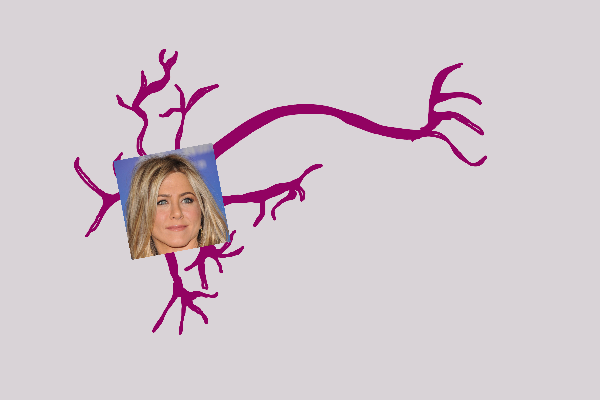 In a study by Quiroga, Fried and others, severe epilepsy patients each had 64 tiny probes implanted in different parts of the brain, to study how the seizures manifested. The patients also agreed to view sets of images while the probes were monitored. A number of invariant responses (the same neuron firing to multiple views of the same person/thing) were found. “In some patients, Jennifer Aniston neurons would also fire to her fellow actresses in Friends, ... But they would never fire to other similar-looking, but otherwise unconnected, actresses” (Nature Magazine). Either way, a connection was made between a concept and a single neuron. Finding connections between a specific neuron and one specific memory has been going on for seven decades, and single neuron stimulation has triggered laughter, remembered childhood scenes or hearing snippets of music, but this association, apparently with the concept of a certain person, instantly became and remains a major focus of brain research.
In a study by Quiroga, Fried and others, severe epilepsy patients each had 64 tiny probes implanted in different parts of the brain, to study how the seizures manifested. The patients also agreed to view sets of images while the probes were monitored. A number of invariant responses (the same neuron firing to multiple views of the same person/thing) were found. “In some patients, Jennifer Aniston neurons would also fire to her fellow actresses in Friends, ... But they would never fire to other similar-looking, but otherwise unconnected, actresses” (Nature Magazine). Either way, a connection was made between a concept and a single neuron. Finding connections between a specific neuron and one specific memory has been going on for seven decades, and single neuron stimulation has triggered laughter, remembered childhood scenes or hearing snippets of music, but this association, apparently with the concept of a certain person, instantly became and remains a major focus of brain research.
Monkey See, Monkey Do?
About 10 year earlier, Italian neuroscientists were studying macaque monkeys with their brains exposed to probing, trying to map body movements to particular motor neurons. They found a neuron that fired whenever the monkey grasped something. But then the same neuron fired at other times, remarkably, when the monkey saw one of the lab workers grasp something. So the monkey watches someone grasp something, and has an inner experience of grasping it himself? And could imagining a hand movement possibly cause motor neurons to fire as if one were actually performing it? The short answer is yes. We know this occurs in dreaming, when studies show our brains generating a lot of starting sequences for action, that are somehow inhibited, unless, that is, a person has a disorder connected with excessive thrashing in bed and even sleepwalking. The other startling thing is for monkeys to be so in touch with another being who happens to have hands, as to spontaneously imagine doing what the other is doing, and in such a neurologically realistic way. We might call this phenomenon motoric empathy. This finding caused a certain amount of giddiness, and visions of a neurological basis for empathy in all its generality. Maybe so, but it’s a very long track or trek, with many skeptics as well as cheerleaders along the way. The finding was replicated in many variations, and analogues were found in human beings. Neurons that fire both when you are doing something, and when the same action is observed, were dubbed "mirror neurons". It sounded, and still sounds, in some accounts, like mirror neurons were a particular unique kind of neuron whose function is to cause or indicate empathy, but as with the “Jennifer Aniston neurons”, it’s more likely that just some neuron in or connected to a brain circuit for producing grasping movements was encountered. Mirror neurons are also used to support the “Simulation Theory” of mindreading in Alvin Goldman’s Simulating Minds: The Philosophy, Psychology, and Neuroscience of Mindreading (2008) . By “mindreading”, also called “theory of mind”, philosophers and cognitive scientists mean our ordinary ability, such as it is, to intuit what other people are thinking; simple things like if Joe and Sally see a ball put in Box A, and while Joe is out of the room, it gets moved to Box B, and Joe reenters the room, and Sally is asked where Joe thinks the ball is, she will say Box A. Testing whether Sally will intuit Joe’s false belief is called a “False belief test”. You might think that we just reason this out; however high functioning adults with autism are prone to get it wrong. This has lead to training people on the autistic spectrum in “mindreading” skills that are automatic for most people. One such man wrote a wise and funny book called The Journal of Best Practices. One “best practice” was “Don’t turn off the radio when my wife is singing along to it. Simulation Theorists say “figuring it out” is too clumsy a tool to explain the speed and accuracy of most people’s “getting” what others must think, or know, or not know. At the height of the mirror neuron excitement, Goldman and Vittorio Gallese (One of the original discoverers of mirror neurons) wrote “Mirror neurons and the simulation theory of mind-reading” Trends in Cognitive Science, 1998 Dec 1;2(12):493-501. I had the opportunity to ask Goldman "Why monkeys" and he thought, well that's just what they happened to be studying. But 25 years after the first discovery, we have hundreds of follow-up studies of monkeys and some of humans, and no other branches of the animal kingdom. Has even more than one species of monkey been studied extensively? I’m not sure. But recent experiments have shown mirror neuron activity in marmosets, whose common ancestry with Macaques goes back 30-40 million years. This suggests a very old adaptation common to all monkeys. I’ll go out on a limb and bet that monkeys are something of a special case, and predict that close studies of monkeys traveling in groups from tree to tree (see video) will show that if monkey A is following monkey B, A will generally copy B's way of grabbing the next branch. We might also find that the most agile monkeys take the lead in traveling. Jumping from a branch across several feet and catching hold of another branch high in a tree is a tricky business. I don't know anything about the speed with which macaques or other monkeys roam among trees, but to move quickly in a group might be highly dependent on this ability. It could be a key to the evolutionary success of monkeys, by which they leave behind many predators. Chimpanzees are a striking exception. In most accounts of them hunting for food, they are hunting monkeys Are monkeys very good at imitating in general? According to Goldman, his coauthor Gallese, who studied them in labs, said "No". This suggests that monkeys’ motoric empathy might be little used except in treetop locomotion, so perhaps we should call it limited motoric empathy. On the other hand, a Science Magazine article, “Capuchin Monkeys Display Affiliation Toward Humans Who Imitate Them” notes that “wild capuchin groups routinely synchronize their behavior; for example, for travel, feeding, and predator defense”. Where am I going with this? This article, based on various scientific and philosophical works and my own thinking, suggests a path from simple motoric empathy to empathy in the broadest sense, and beyond that to what Philippe Rochat, cited in Sarah Perry’s The Essence of Peopling, calls “Others in mind” - having, in our minds, a continuous presence of models of others, as illustrated by this image from The Essence of Peopling: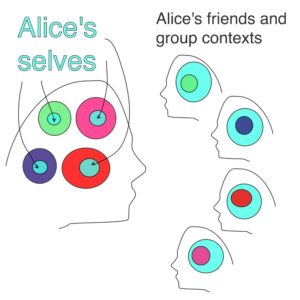
Action parsing in monkeys and humans
The skill of “reading” physical actions, not necessarily for imitating, is called “action parsing” (or action processing), a theme touched on repeatedly in The Shape of Thought: How Mental Adaptations Evolve (Evolution and Cognition) by H. Clark Barrett, and is a major topic for both neuroscientists and AI researchers. If we really mastered it, we could just show a task to a robot, rather than programming it. This has begun to happen, but it's taken a long time, and many iterations of Moore's Law. Our closest relatives, chimpanzees seem to have a high level of action parsing because they are very good at picking up techniques from one another, including rudimentary tool use, and do so much more quickly and with fewer trials than monkeys. Domesticated chimps living with humans have been able to learn sign language to a significant degree, and they seem to do a lot of communicating through hand gestures in the wild. High expressions of how humans use action-parsing might be watching and performing a choreographed dance, or those comic routines in which one person pretends to be the mirror image of another. Recognition that one is being imitated is more widespread than being able to imitate competently, according to the article noted above: “Capuchin Monkeys Display Affiliation Toward Humans Who Imitate Them”. This makes sense as to imitate requires “reading” another’s action while action parsing might go on passively it there is no motive to imitate. Or consider the degree of action parsing evident in this description of a hunting party from Sarah Perry's essay What Is Ritual?One day, deep within the forest, Agaso, then about 13 years of age, found himself with rare good shot at a cuscus in a nearby tree. But he only had inferior arrows. Without the slightest comment or solicitation, the straightest, sharpest arrow of the group moved so swiftly and so stealthily straight into his hand, I could not see from whence it came. At that same moment, Karako, seeing that the shot would be improved by pulling on a twig to gently move an obstructing branch, was without a word already doing so, in perfect synchrony with Agaso's drawing of the bow, i.e., just fast enough to fully clear Agaso's aim by millimeters at the moment his bow was fully drawn, just slow enough not to spook the cuscus. Agaso, knowing this would be the case made no effort to lean to side for an unobstructed shot, or to even slightly shift his stance. Usumu similarly synchronized into the action stream, without even watching Agaso draw his bow, began moving up the tree a fraction of a second before the bowstring twanged.Quoted from E. Richard Sorenson, Preconquest Consciousness While there must be action parsing, much more seems necessary for what the article aptly calls “group proprioception”, or the several boys moving like one body.
Infants train selves to be social
Much of the explanation, I believe, is summarized in 8 pages in “The Ultra Social Animal” European Journal of Social Psychology (Apr 2014) by Michael Tomasello, the briefest and most accessible overview of a vast set of research and analysis. “The Ultra Social Animal” (tUSA) among other things, illustrates and analyzes some non-obvious aspects of how children engage in cooperative tasks. If the task produces a reward that can be shared, children insist on fair division, and sharing only among those involved in the production; quite unlike chimps who simply grab and what they get depends mostly on how close they are to the prize, and if some bystanders are close to the prize and get some, they are no more resented than are participants. Commitments seem to be phenomenally real to older children. “When 3-year-olds need to break away from a joint commitment with a partner, they even ‘take leave’ through some form of implicit or explicit communication—as a way of acknowledging and asking to be excused for breaking the commitment” (tUSA, p189) This suggests that being a "we" in such a joint endeavor might involve a special mental state Another aspect noted is that often children operating in different roles are conscious enough of the others that they can switch roles with little or no evident lag in competence. Tomasello suggests we have a “bird’s eye view” of social situations. Could some conscious or unconscious part of our minds have such a view? Could it have anything to do with out of body experiences, in which one looks down at oneself and one’s surroundings? Sarah Perry, in Cartographic Compression cites cognitive scientist Lera Boroditsky’s time among speakers of the Australian aboriginal Kuuk Thaayorre language. This language incorporates what roughly amount to compass points, and a person is expected to have a sense of one’s orientation to them at all times. Boroditsky failed miserably at this at first, but thenAfter about a week of being there, I was walking along, and all of a sudden I noticed that in my head there was an extra little window, like in a video game. And in that console window was a bird’s-eye view of the landscape that I was walking on, and I was a little red dot that was traversing that landscape.Boroditsky shared the cognitive change she experienced with a native speaker of the language, who commented, “well of course – how else would you do it?” It is noted casually that a third of human languages have such a feature. There are approximately 6,000 identified languages, most of them spoken by small wilderness-dwelling tribes as in Australia, Papua New Guinea, and the Amazon, so this may be predominantly a feature of such cultures. Tomasello’s “bird’s eye view” doesn’t of course call for such a literal phenomenon as an inset screen, but if the latter is even possible, the former is made more plausible. According to Tomasello’s research, and summarized in tUSA infants begin, as early as 9 months old, to initiate their own preparation for being good collaborators. Well before the 2nd year, infants begin to seek out "protoconversations". Perhaps you've experienced this with a stranger's baby in a supermarket checkout line. The baby smiles tentatively; you smile back, and the baby smiles broadly. You may initiate some surprising but not too alarming gesture, which you then repeat the baby comes to anticipate and it is done over and over to laughs like a sort of little game. Somewhat later, infants want to point out interesting sights to familiar adults, with the clearly desired result of a shared emotive attitude, of surprise, laughter, or maybe sometimes worry ("Uh Oh", being one of the first things children learn to say). In his book Origins of Human Communication (2008), Tomasello provides these examples of parents’ diary observations of infants' pointing in the context of everyday social interactions.
- At age 11 months, J points to the closed window when he wants it open.
- At age 11.5 months, J points to the door as Dad is making preparations to leave.
- At age 11.5 months, after Mom had poured water into J's glass at the dinner table; a few minutes later J points to his glass to request that she pour him some more.
- At age 13.5 months, while Mom is looking for a missing refrigerator magnet, L points to a basket of fruit where it is (hidden under the fruit).
- I am in a cheese shop in Italy, and I ask for "parmegiano." (sic) The proprietor asks me something I do not understand, but guessing -- and not having the appropriate word -- I twiddle my fingers as if sprinkling grated cheese onto my pasta.
- I am at the front of the lecture hall, getting ready to give a lecture. A friend in the audience fiddles with her shirt button, frowning at me, and sure enough when I look down mine is unbuttoned.
- The airport security guard motions his hand in a circular motion to tell me to turn around so he can scan my back.
2 Comments
> "After about a week of being there, I was walking along, and all of a sudden I noticed that in my head there was an extra little window, like in a video game. And in that console window was a bird’s-eye view of the landscape that I was walking on, and I was a little red dot that was traversing that landscape."
What I'm always curious about is – how does having played video games influence this? Like, more broadly, how do our experiences with various technologies shape our imagination? I sometimes literally visualize my thoughts as browser tabs, and I wonder how I'd have visualized them if I'd never encountered computers. Maybe books and folders?
Maybe for the anthropologist, but not, I'm pretty sure, for her wilderness dwelling interlocuters. In describing the "little window, like in a video game" she must have had to transpose it into their terms, essentially seeing from her normal POV while simultaneously looking looking down at herself in the landscape. Interesting that you'd visualize your thoughts as browser tabs. I have multiple simultaneous thoughts but couldn't describe any such way of framing them framing them. They just swim in a soup in my brain.