
Idiots Scaring Themselves in the Dark
Getting lost is a special experience; usually you are not lost. On ordinary days when you are oriented (not lost), a hidden process is happening in the background: you are constantly checking your mental maps against your environment, and finding them to accord well. This constant background process creates the positive sensation of average-everydayness, mundanity, homeliness. You know where you are.
Then things start looking weird. Conflicts between the mental map and the environment start setting off alarm bells. Very gradually, you realize you are lost. You deny it for as long as you can, perhaps acting stupidly and getting yourself more lost. Then it hits you.
Laurence Gonzales (Deep Survival) describes the mental processes involved in getting lost in the wilderness, illustrated by the experience of firefighter and recreational hiker Ken Killip:
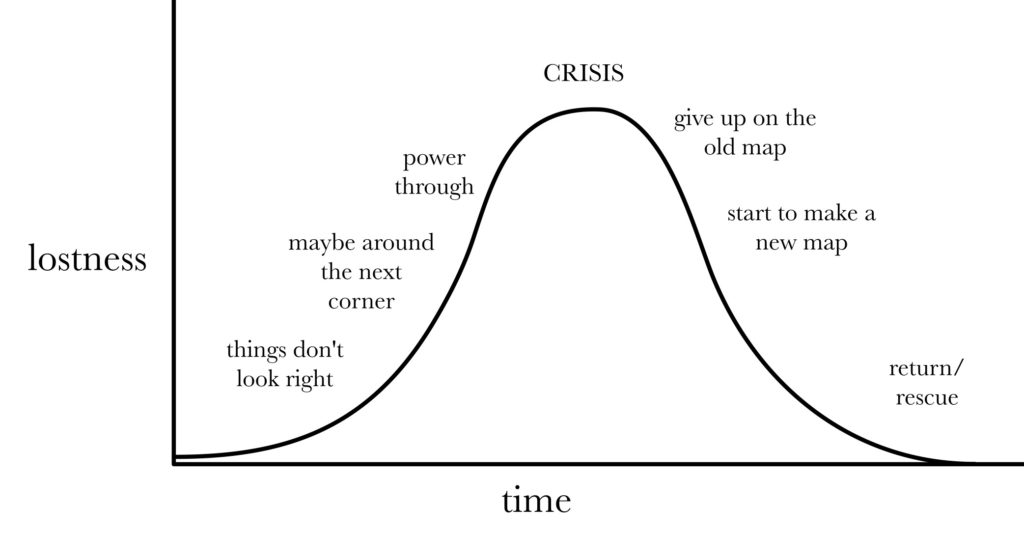 The Lostness Curve (Uncanny Mountain)[/caption]
We could say that lostness and orientation (or average-everydayness) are cartographic emotions - affective states related to the correspondence (or mismatch) of mental map to geographical environment. It is also correct to say that they are "epistemic emotions" - positive and negative emotions related to information foraging, such as curiosity, boredom, insight, confusion, and humor, as described in Inside Jokes. To be lost is to be motivated to make a map. To be oriented is to not be motivated toward map-making.
To be extremely lost, in the wilderness, is terrifying. Being mildly lost is much more tolerable. When we visit a new place, there is pleasure in filling out a cursory mental map with rich details. Episodes of disorientation and anxiety become rarer, fading into the feeling of being at home.
Running up Mount Lukens in the San Gabriel Mountains outside Los Angeles for the first time, alone, my happy mood suddenly turned spooky. I had a perfectly fine mental map (I was running on a fire road and knew exactly where I was). Was I being watched by a predator? I knew there were mountain lions in the area, but I also knew that mountain lion attacks are rare, mountain lions being nocturnal. Finally, I realized what it was: I had rounded a bend that offered a very wide view - of a completely uninhabited area. There was complete silence except for the wind. The city, which had up to now constantly been in view, was entirely occluded. I was alone.
I would qualify this experience as "mild lostness" - separation from the objects that make up my sense of the normal and safe, without losing my geographic mental map. I felt relief when I got through the spooky section and could see the city again. But the spookiness did not dissuade me from running the route many times afterward. I looked forward to the lonely, empty section the next time, but its spookiness gradually faded. I got used to it, and made it part of my (mental) territory.
Lostness is only aversive at its extremes. In less extreme cases, it can be ambivalent, even exciting. Children play disorientation-reorientation games for fun - hide and seek, blindfold games, spinning around until everything looks different. An account of lostness that assumed it was only a negative emotion would be missing something.
Further, it is possible to practice navigating not only a geographical area, but the emotion of lostness itself. Laurence Gonzales notes that when he himself got seriously lost in the wilderness, he'd had a great deal of experience in wilderness backpacking, but no experience at actually being lost. Being lost is dangerous, but mild forms of lostness might prepare us emotionally to handle serious lostness. Better yet, mild lostness indicates presence in new territory - a tempting source of information, as well as a potential source of danger.
The Lostness Curve (Uncanny Mountain)[/caption]
We could say that lostness and orientation (or average-everydayness) are cartographic emotions - affective states related to the correspondence (or mismatch) of mental map to geographical environment. It is also correct to say that they are "epistemic emotions" - positive and negative emotions related to information foraging, such as curiosity, boredom, insight, confusion, and humor, as described in Inside Jokes. To be lost is to be motivated to make a map. To be oriented is to not be motivated toward map-making.
To be extremely lost, in the wilderness, is terrifying. Being mildly lost is much more tolerable. When we visit a new place, there is pleasure in filling out a cursory mental map with rich details. Episodes of disorientation and anxiety become rarer, fading into the feeling of being at home.
Running up Mount Lukens in the San Gabriel Mountains outside Los Angeles for the first time, alone, my happy mood suddenly turned spooky. I had a perfectly fine mental map (I was running on a fire road and knew exactly where I was). Was I being watched by a predator? I knew there were mountain lions in the area, but I also knew that mountain lion attacks are rare, mountain lions being nocturnal. Finally, I realized what it was: I had rounded a bend that offered a very wide view - of a completely uninhabited area. There was complete silence except for the wind. The city, which had up to now constantly been in view, was entirely occluded. I was alone.
I would qualify this experience as "mild lostness" - separation from the objects that make up my sense of the normal and safe, without losing my geographic mental map. I felt relief when I got through the spooky section and could see the city again. But the spookiness did not dissuade me from running the route many times afterward. I looked forward to the lonely, empty section the next time, but its spookiness gradually faded. I got used to it, and made it part of my (mental) territory.
Lostness is only aversive at its extremes. In less extreme cases, it can be ambivalent, even exciting. Children play disorientation-reorientation games for fun - hide and seek, blindfold games, spinning around until everything looks different. An account of lostness that assumed it was only a negative emotion would be missing something.
Further, it is possible to practice navigating not only a geographical area, but the emotion of lostness itself. Laurence Gonzales notes that when he himself got seriously lost in the wilderness, he'd had a great deal of experience in wilderness backpacking, but no experience at actually being lost. Being lost is dangerous, but mild forms of lostness might prepare us emotionally to handle serious lostness. Better yet, mild lostness indicates presence in new territory - a tempting source of information, as well as a potential source of danger.
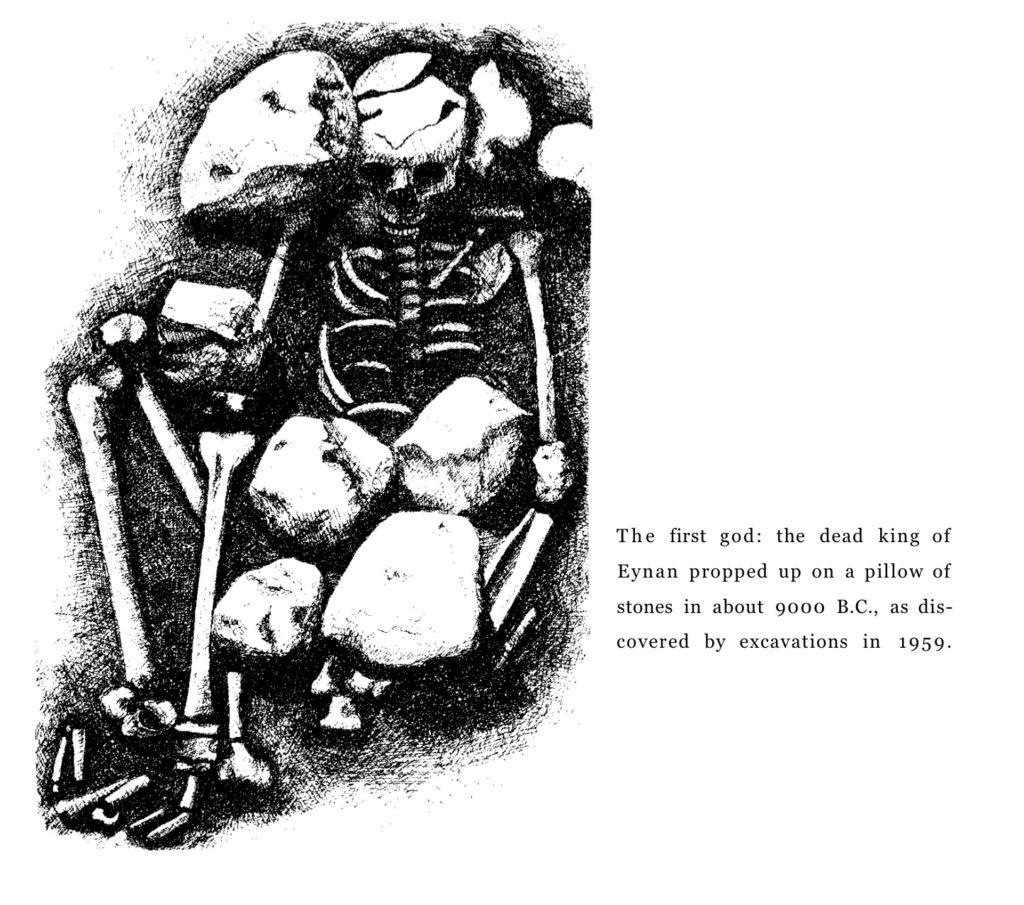 Nooooooooooope[/caption]
Jaynes explains:
Nooooooooooope[/caption]
Jaynes explains:
...with reason pretty much out of the picture and emotion driving hard toward survival strategies, Killip started down the wrong drainage as darkness and rain fell around him. It was the absence of a mental map of the place in which he found himself that caused the amygdala to begin sending danger signals. People recognize as good such places as the location of food, water, and members of the opposite sex. That's a primary task of adaptation and survival. People also recognize dangerous places. And it makes perfect sense that a dangerous place to be is one for which you have no mental map, for then you'd be unable to find food, water, or a mate. Killip's seemingly irrational behavior [not making a fire, not using garbage bags for a tent, falling down a steep slope and severely injuring himself] makes sense when viewed from the brain's point of view. The fact of not having a mental map, of trying to create one in an environment where the sensory input made no sense, is interpreted as an emergency and triggers a physical (i.e., emotional) response. In the emergency of being no place, Killip's action makes sense to the organism, even though it seems illogical. The organism needed him to hurry up and try to get some place quickly, a place that matched his mental map, a place that would provide access to the essentials of survival. This impulse explains Syrotuck's observation that people panic when they become lost. It gives a working definition of being lost: the inability to make the mental map match the environment. [p. 149-150, emphasis mine.]Lost and not-lost are not discrete states. The process of getting lost (and getting found again) looks something like this: [caption id="attachment_5871" align="alignnone" width="500"]
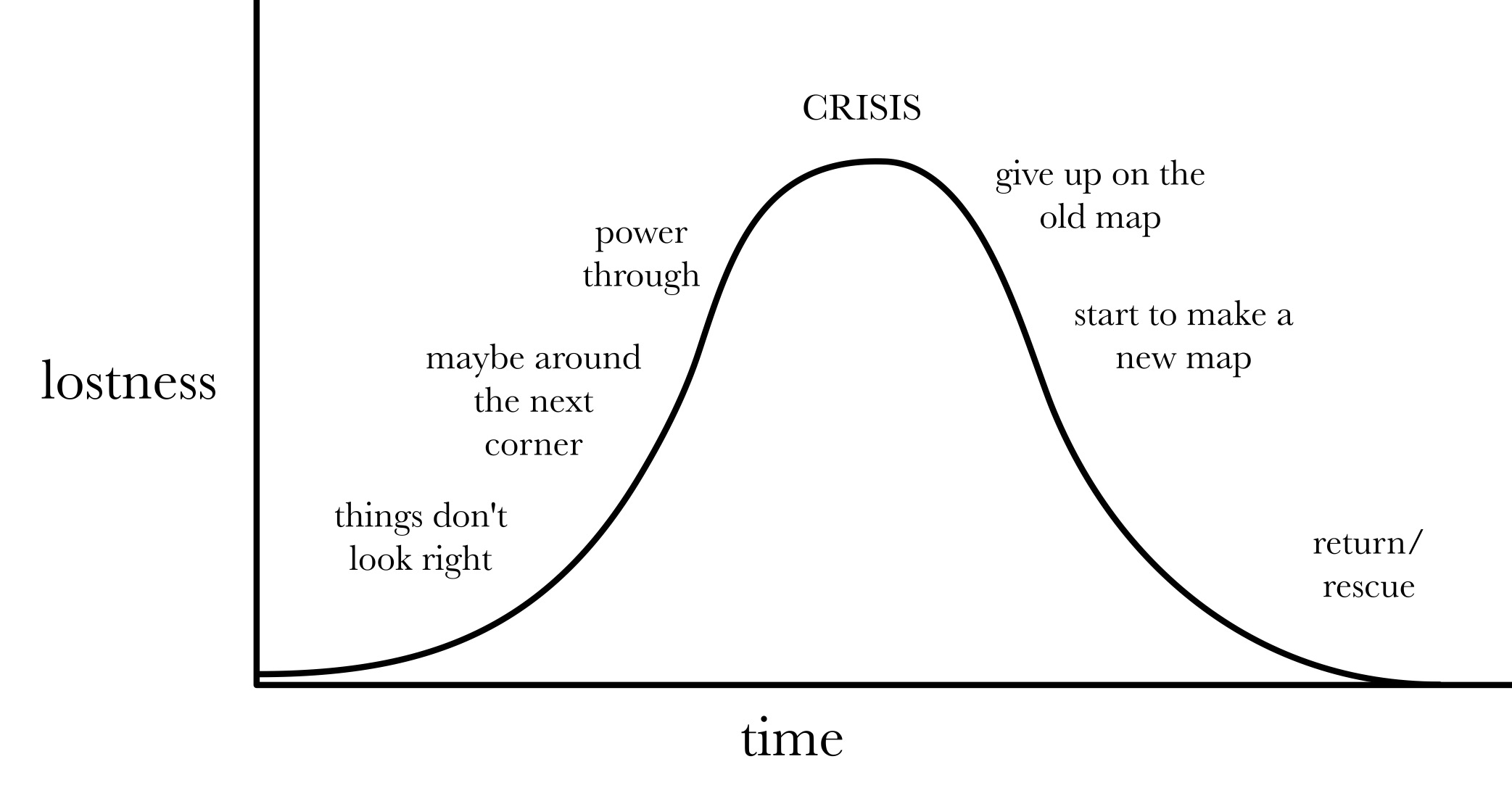 The Lostness Curve (Uncanny Mountain)[/caption]
We could say that lostness and orientation (or average-everydayness) are cartographic emotions - affective states related to the correspondence (or mismatch) of mental map to geographical environment. It is also correct to say that they are "epistemic emotions" - positive and negative emotions related to information foraging, such as curiosity, boredom, insight, confusion, and humor, as described in Inside Jokes. To be lost is to be motivated to make a map. To be oriented is to not be motivated toward map-making.
To be extremely lost, in the wilderness, is terrifying. Being mildly lost is much more tolerable. When we visit a new place, there is pleasure in filling out a cursory mental map with rich details. Episodes of disorientation and anxiety become rarer, fading into the feeling of being at home.
Running up Mount Lukens in the San Gabriel Mountains outside Los Angeles for the first time, alone, my happy mood suddenly turned spooky. I had a perfectly fine mental map (I was running on a fire road and knew exactly where I was). Was I being watched by a predator? I knew there were mountain lions in the area, but I also knew that mountain lion attacks are rare, mountain lions being nocturnal. Finally, I realized what it was: I had rounded a bend that offered a very wide view - of a completely uninhabited area. There was complete silence except for the wind. The city, which had up to now constantly been in view, was entirely occluded. I was alone.
I would qualify this experience as "mild lostness" - separation from the objects that make up my sense of the normal and safe, without losing my geographic mental map. I felt relief when I got through the spooky section and could see the city again. But the spookiness did not dissuade me from running the route many times afterward. I looked forward to the lonely, empty section the next time, but its spookiness gradually faded. I got used to it, and made it part of my (mental) territory.
Lostness is only aversive at its extremes. In less extreme cases, it can be ambivalent, even exciting. Children play disorientation-reorientation games for fun - hide and seek, blindfold games, spinning around until everything looks different. An account of lostness that assumed it was only a negative emotion would be missing something.
Further, it is possible to practice navigating not only a geographical area, but the emotion of lostness itself. Laurence Gonzales notes that when he himself got seriously lost in the wilderness, he'd had a great deal of experience in wilderness backpacking, but no experience at actually being lost. Being lost is dangerous, but mild forms of lostness might prepare us emotionally to handle serious lostness. Better yet, mild lostness indicates presence in new territory - a tempting source of information, as well as a potential source of danger.
The Lostness Curve (Uncanny Mountain)[/caption]
We could say that lostness and orientation (or average-everydayness) are cartographic emotions - affective states related to the correspondence (or mismatch) of mental map to geographical environment. It is also correct to say that they are "epistemic emotions" - positive and negative emotions related to information foraging, such as curiosity, boredom, insight, confusion, and humor, as described in Inside Jokes. To be lost is to be motivated to make a map. To be oriented is to not be motivated toward map-making.
To be extremely lost, in the wilderness, is terrifying. Being mildly lost is much more tolerable. When we visit a new place, there is pleasure in filling out a cursory mental map with rich details. Episodes of disorientation and anxiety become rarer, fading into the feeling of being at home.
Running up Mount Lukens in the San Gabriel Mountains outside Los Angeles for the first time, alone, my happy mood suddenly turned spooky. I had a perfectly fine mental map (I was running on a fire road and knew exactly where I was). Was I being watched by a predator? I knew there were mountain lions in the area, but I also knew that mountain lion attacks are rare, mountain lions being nocturnal. Finally, I realized what it was: I had rounded a bend that offered a very wide view - of a completely uninhabited area. There was complete silence except for the wind. The city, which had up to now constantly been in view, was entirely occluded. I was alone.
I would qualify this experience as "mild lostness" - separation from the objects that make up my sense of the normal and safe, without losing my geographic mental map. I felt relief when I got through the spooky section and could see the city again. But the spookiness did not dissuade me from running the route many times afterward. I looked forward to the lonely, empty section the next time, but its spookiness gradually faded. I got used to it, and made it part of my (mental) territory.
Lostness is only aversive at its extremes. In less extreme cases, it can be ambivalent, even exciting. Children play disorientation-reorientation games for fun - hide and seek, blindfold games, spinning around until everything looks different. An account of lostness that assumed it was only a negative emotion would be missing something.
Further, it is possible to practice navigating not only a geographical area, but the emotion of lostness itself. Laurence Gonzales notes that when he himself got seriously lost in the wilderness, he'd had a great deal of experience in wilderness backpacking, but no experience at actually being lost. Being lost is dangerous, but mild forms of lostness might prepare us emotionally to handle serious lostness. Better yet, mild lostness indicates presence in new territory - a tempting source of information, as well as a potential source of danger.
The Uncanny
All this is prelude to the really interesting mental state: the uncanny. This is the emotion of eeriness, spookiness, creepiness. It is associated with the "uncanny valley" - the alleged eeriness of things that look almost, but not quite, human. The uncanny is not simply fear. Well-understood dangers do not generally produce spooky or eerie feelings. However frightening they may be, they are not uncanny. Think of human attackers, large animal predators, a car swerving into you, diving off of a high place - frightening, but not creepy. The prototypical instance of the uncanny (from Ernst Jentsch, On the Psychology of the Uncanny, 1906) is the confusion between animate and inanimate beings: the creepy living doll, the puppet (or corpse) that gets up and talks, the person who is secretly replaced by an automaton. (This does not represent the entire extent of uncanny items; it's just a particularly effective one.) Jentsch says:Among all the psychical uncertainties that can become a cause for the uncanny feeling to arise, there is one in particular that is able to develop a fairly regular, powerful and very general effect: namely, doubt as to whether an apparently living being really is animate and, conversely, doubt as to whether a lifeless object may not in fact be animate – and more precisely, when this doubt only makes itself felt obscurely in one’s consciousness. The mood lasts until these doubts are resolved and then usually makes way for another kind of feeling. [Emphasis mine.]Why do we get creeped out in this way? Burleigh (2009) lists several distinct theories explaining the experience in etiological terms:
- Cheater detection - the sensation of the uncanny is a response to the presence of sociopaths or bad actors
- Disease avoidance - the sensation of the uncanny is a response to the appearance and behavior of diseased people, to prevent pathogen transmission
- Mate selection - the sensation of the uncanny prevents the selection of a poor-quality mate
- Fear of death - objects that are death-reminders are perceived as uncanny; the terror of death is so great that any thought of death must be avoided
- Ordinary fear - the uncanny is just regular fear
- A combination of emotions - the experience of the uncanny is a complex emotion rather than a single emotion
- Cognitive dissonance - uncanny items are simultaneously perceived to belong to multiple mutually exclusive categories
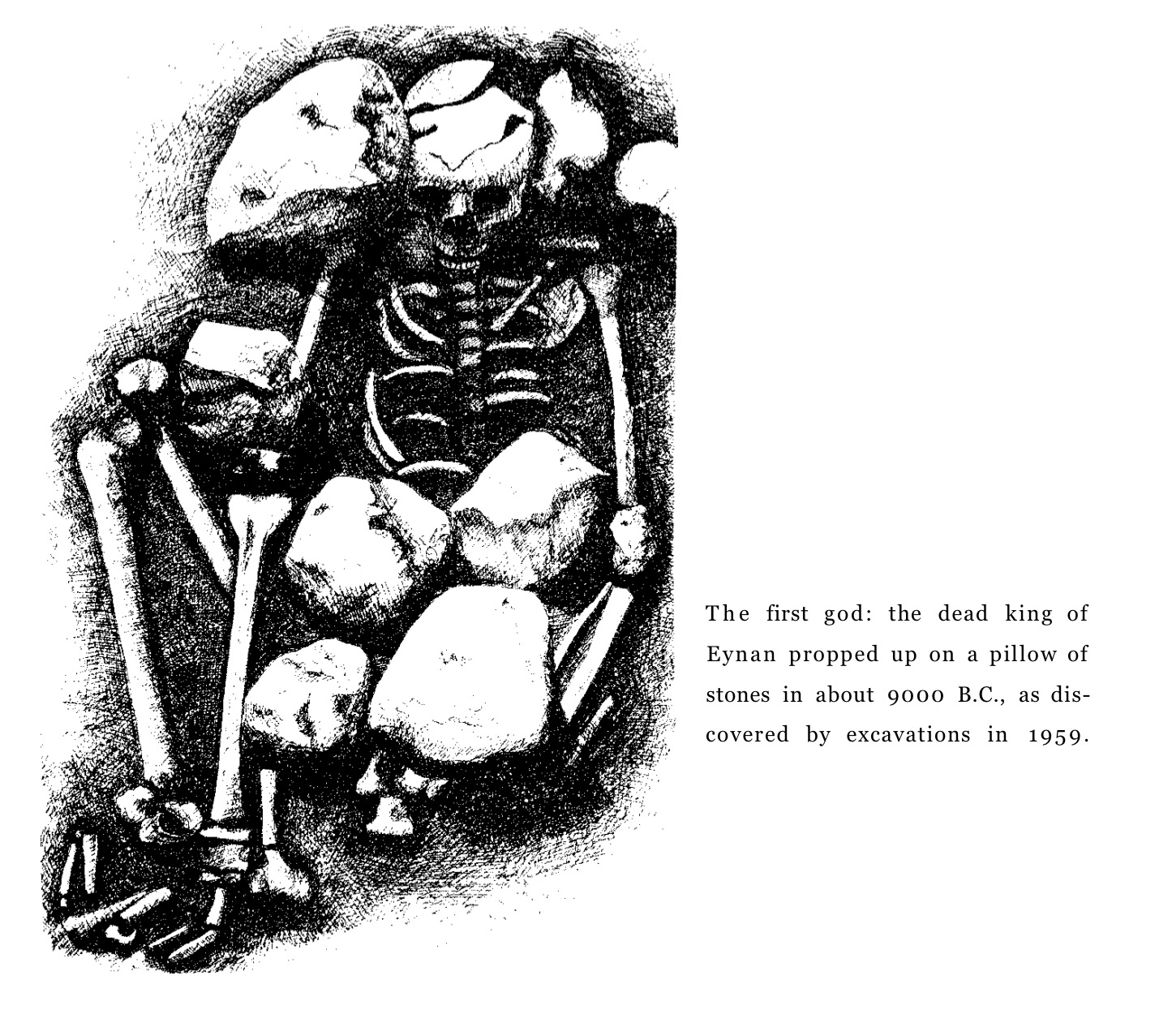 Nooooooooooope[/caption]
Jaynes explains:
Nooooooooooope[/caption]
Jaynes explains:
I am suggesting that the dead king, thus propped up on his pillow of stones, was in the hallucinations of his people still giving forth his commands, and that the red-painted parapet and its top tier of a hearth were a response to the decomposition of the body, and that, for a time at least, the very place, even the smoke from its holy fire, rising into visibility from furlongs around, was, like the gray mists of the Aegean for Achilles, a source of hallucinations and of the commands that controlled the Mesolithic world of Eynan.The idea of an animate talking skull, on its own, was by that time no longer creepy to me. But the suggestion that normal human brains, thousands of years ago, regularly produced the illusion that skulls were talking was enough to unsettle me. I was so creeped out that I couldn't read any more that night, and I didn't want to even leave the book open to that page - I had to bookmark it, close it, and set it out of sight. But the uncanny sensation attracted me to the book as much as it repelled me. I am so familiar with it now that I can barely summon any sense of eeriness. The uncanny gets worn out. Just as we say there is a learning curve, there is a spookiness curve - one very similar to the lostness curve above. The initially uncanny object or experience ceases to produce the uncanny sensation once it is understood, just as a very interesting object or text loses its interest as it becomes familiar, and a very funny joke ceases to be funny once you've heard it. The mental states change, because they are epistemic emotions that function to incentivize careful learning. How better to fix holes in your worldview than through focus on the interesting and the uncanny? If you are brave enough, that is.
4 Comments
Interesting article. One that makes you understand a little bit better the magic of the brain. Thanx
This also explains why so many horror movies are ruined by revealing the scary monster.
"Sometimes I fear that there’s no uncanny left for me."
I hope not! That would indeed be sad. More essays please :) they are consistently enjoyable.
But I definitely understand the numbing feeling getting worn in with exposure, and an
example of a teenage Sarah Perry with Julian Jaynes' talking skulls is a good way to
exemplify the point.
I think there's some overlap between the uncanny and Paul Graham's notion of "Surprise" in his essay "The Age of the Essay" http://www.paulgraham.com/essay.html
He says that the interestingness of an essay is directly proportional to how much Surprise it delivers: “Interfaces, as Geoffrey James has said, should follow the principle of least astonishment. A button that looks like it will make a machine stop should make it stop, not speed up. Essays should do the opposite. Essays should aim for maximum surprise.”
Surprises contradict what you thought you knew, hopefully in a healthy way, like a detox veg bowl. When reading an essay, Surprises might be times when the readers do a double-take, or laugh (because of cognitive dissonance?), or have a moment of relishing a memenug. This seems similar to the uncanny, which is "strangely familiar in a way that creates cognitive dissonance between a piece that attracts and a piece that repulses."
idk. vague associations...
Once in a while, I take a 1 or 2 hours nap in the afternoon, and sometimes as I wake up from that nap, I feel lost, that is temporally and spatially lost. I do not know where I am and what year, month, day, hour it is. It is not a frightening experience, but a confusing and discomforting experience. Those do not last hours, just a few second, maybe more. I would think that most of us have experienced the same thing once in a while. What I found fascinating is that the very first thing I do when waking up is to seek to know where I am spatially and temporally. I seek for, seek to look from my ‘maps’. Once those maps are ‘found’ or reactivated, I can look at, look at where I am spatially and temporally. I seek to know what specific time it is, and where I am specifically. May 1st, 2017, 2:48 pm. Montreal, Canada. And so, the first thing I do, is to look for to look from, from my maps, only afterward can I look at specifics. Those specifics are obviously related to my maps which are also culturally bounded. Maps are learned, maps are integrated. I look from the totality of my maps, and look at some specific aspect of those maps, May 1, 2017, 2:48 pm Montreal, Canada is a specific aspect of those maps, it belongs to those same maps. Those maps are learned, they are more or less functional illusions, which have more or less value and validity in relation to contexts.
Western civilization way of looking from and at time is not an absolute, it is a way of seeing, a theory, a way by which we try to make some sense of the world. That by which we look from (theories, maps) acts as orienting centers, without which, we feel lost. But where are we really? Without those ways of seeing, where are we? Without our more or less functional illusions, where are we?
What I look from is what I look at! What I look from shape a what I look at. We look from the whole or totality of our maps, but look at some specificity of those same maps. And so to look from and to look at are two different ways to talk about the same thing. One is a ‘whole’ (inclusive) way and the other a specific (exclusive) way. Our maps are kind of the wider context out of which specific meaning flow out.
Conflicts are between what we look from and what we look at (between sets/clashes of perspectives and in between a single set or perspective). What we look from gathers with what we look at in an ongoing way, when it does not tension arises. We fear a gap, a split within, a crack within our ways of seeing. By losing our world made up of words viewpoints and views, we lose ‘the’ orienting center; we feel lost! Some call it the abyss of despair. One of the things that I have realized over is just how much we cling to our world made up of words, to our more or less functional illusions. I do think that those acts as a contra-buffer, some kind of universal perpetual denial mechanism. It would seem that in truth, we are not something, someone, somewhere, sometime. What happens if we were to drop those orienting centers, if we were to drop our more or less functional illusions? What would be left? Truth, of course! But who wants it? Were we to drop all more or less functional illusions, you as a witness remains, that you are remains, awareness remains as awareness.
Without our more or less functional illusions, where are we? Without orienting centers to functionally (albeit being illusory) inform you where, who, what, why, what remains? Truth no?