
The Amazing, Shrinking Org Chart
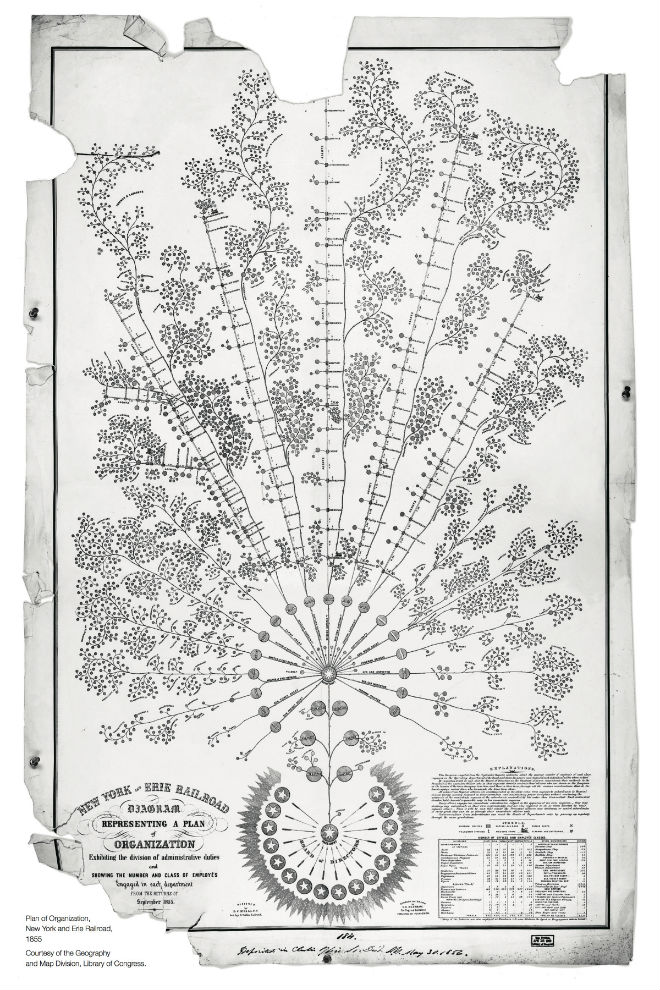
About a year ago, an 1855 org chart of the New York and Erie railroad was cascaded worldwide by the VP of the Infographics Department of the Internet. There was a good deal of admiration as well as lamentation. Apparently we no longer care enough about our corporations to create beautiful depictions of their anatomy, ars gratia artis. Whatever else the shortcomings of mid-nineteenth century corporate management (they had a tendency to start wars and gun down workers in pursuit of their Missions and Visions among other things, and you had to be a quick-draw gunfighter to earn a Harvard MBA in those days), they clearly cared.
[caption id="attachment_4859" align="aligncenter" width="200"]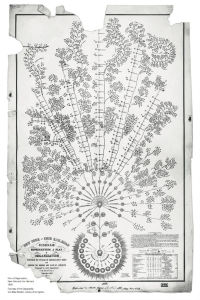 Library of Congress (via McKinsey)[/caption]
By contrast, a modern set of org charts is usually a showcase of apathetic PowerPoint banality. In fact, you rarely ever see a big global view anymore. Just little local views that could, in principle, be patched together into a global view, but in practice never are. Often, even CEOs only have a coarse, low-resolution view of the whole, with blocks representing entire huge divisions of thousands of humans and billions in capital assets. There is usually no operational capability for drilling down into finer points where the situation demands it (Proctor and Gamble, apparently, is an exception). Most senior executives -- VP and above in organizations of 1500 or more people say -- are in the position of surgeons operating on the basis of having played the kids' game Operation rather than on the basis of medical training and tools like MRI machines.
There's a very good excuse for this though: the pace of organizational and environmental change today turns static maps into garbage very quickly. The part of the organization that is both possible and useful to represent using an org chart has been rapidly shrinking.
What, if anything, should be done about it?
The org chart has been the main orientation tool for corporate life for at least 160 years, going by the map I opened with. Probably longer. Certainly too long.
But we rarely stop to consider what exactly an org-chart is, conceptually.
The org chart is a visualization of a theatrical web of masks and power. We acknowledge the element of theater by calling each box a role. In your classical corporation, each box flows via a solid upward arrow into a unique superior box.
The whole is a natural human social network pulled upward into a hierarchy by the bootstraps of the founder. Unlike a network, a hierarchy has a notion of up, defined and enforced by the converging flow of solid arrows towards an apex of power. A strict hierarchy also admits a notion of inside/outside, defined and enforced by means of a set of deliberately broken or weakened natural information flow links: a boundary. The process makes the underlying social reality simpler and more legible of course, but not entirely, or even primarily, in service of function. A good deal of the process is about imposing anxiety-alleviating platonic structural beauty.
So to summarize, a hierarchy as represented in an org chart transforms its raw social-graph input in three ways:
Library of Congress (via McKinsey)[/caption]
By contrast, a modern set of org charts is usually a showcase of apathetic PowerPoint banality. In fact, you rarely ever see a big global view anymore. Just little local views that could, in principle, be patched together into a global view, but in practice never are. Often, even CEOs only have a coarse, low-resolution view of the whole, with blocks representing entire huge divisions of thousands of humans and billions in capital assets. There is usually no operational capability for drilling down into finer points where the situation demands it (Proctor and Gamble, apparently, is an exception). Most senior executives -- VP and above in organizations of 1500 or more people say -- are in the position of surgeons operating on the basis of having played the kids' game Operation rather than on the basis of medical training and tools like MRI machines.
There's a very good excuse for this though: the pace of organizational and environmental change today turns static maps into garbage very quickly. The part of the organization that is both possible and useful to represent using an org chart has been rapidly shrinking.
What, if anything, should be done about it?
The org chart has been the main orientation tool for corporate life for at least 160 years, going by the map I opened with. Probably longer. Certainly too long.
But we rarely stop to consider what exactly an org-chart is, conceptually.
The org chart is a visualization of a theatrical web of masks and power. We acknowledge the element of theater by calling each box a role. In your classical corporation, each box flows via a solid upward arrow into a unique superior box.
The whole is a natural human social network pulled upward into a hierarchy by the bootstraps of the founder. Unlike a network, a hierarchy has a notion of up, defined and enforced by the converging flow of solid arrows towards an apex of power. A strict hierarchy also admits a notion of inside/outside, defined and enforced by means of a set of deliberately broken or weakened natural information flow links: a boundary. The process makes the underlying social reality simpler and more legible of course, but not entirely, or even primarily, in service of function. A good deal of the process is about imposing anxiety-alleviating platonic structural beauty.
So to summarize, a hierarchy as represented in an org chart transforms its raw social-graph input in three ways:
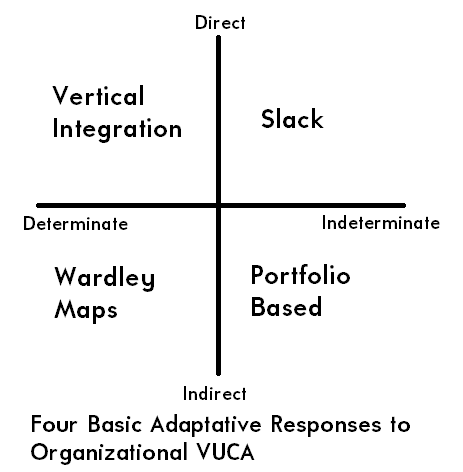 To complete the heaven/hell metaphor, the top right is obviously heaven, where righteous people like me live, and the off-diagonal quadrants are two kinds of purgatory.
Kidding aside, this is a serious 2x2, and there's no particular reason to orient it this way. Among them, the four responses cover 90% of response patterns I've seen across organizations (not counting zombie corporations that have gone catatonic through repeated failure to transform).
The x-axis ranges from fundamentally determinate approaches (those that aspire to a complete and canonical understanding of reality, in the hedgehog sense) to fundamentally indeterminate approaches (those that attempt to work with a plurality of partial models without privileging any particular one, in the fox sense).
My use of the terms determinate/indeterminate is roughly the same as in Thiel's famous 2x2 of optimism/pessimism, determinate/indeterminate (the same heaven/purgatory/hell joke works there: Thiel is in the purgatory of determinate optimism, suspicious of the heaven of indeterminate optimism).
The y-axis may be non-intuitive to some of you. I am borrowing the terminology from adaptive control theory. In adaptive control (the engineering discipline behind things like adaptive cruise control in cars), there are two basic ways to engineer adaptation when you anticipate constantly changing operating conditions.
To complete the heaven/hell metaphor, the top right is obviously heaven, where righteous people like me live, and the off-diagonal quadrants are two kinds of purgatory.
Kidding aside, this is a serious 2x2, and there's no particular reason to orient it this way. Among them, the four responses cover 90% of response patterns I've seen across organizations (not counting zombie corporations that have gone catatonic through repeated failure to transform).
The x-axis ranges from fundamentally determinate approaches (those that aspire to a complete and canonical understanding of reality, in the hedgehog sense) to fundamentally indeterminate approaches (those that attempt to work with a plurality of partial models without privileging any particular one, in the fox sense).
My use of the terms determinate/indeterminate is roughly the same as in Thiel's famous 2x2 of optimism/pessimism, determinate/indeterminate (the same heaven/purgatory/hell joke works there: Thiel is in the purgatory of determinate optimism, suspicious of the heaven of indeterminate optimism).
The y-axis may be non-intuitive to some of you. I am borrowing the terminology from adaptive control theory. In adaptive control (the engineering discipline behind things like adaptive cruise control in cars), there are two basic ways to engineer adaptation when you anticipate constantly changing operating conditions.
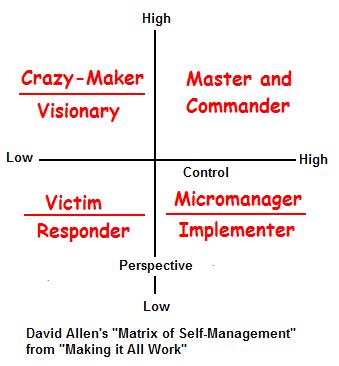 Whatever your chosen pattern of adaptive organizational response to organizational VUCA, the test of whether it works is whether it puts you in the top right quadrant of high perspective and high control. The master-and-commander zone, where you can, as David once put it (iirc), "steer with a light touch with one hand, with a glass of wine in the other."
High perspective is not the same as accurate and detailed situation awareness (though David Allen's GTD is a way of getting there via accurate and detailed situation awareness). From conversations with David, I've come to think of perspective as a state of successfully managed stress and anxiety.
If perspective is valuable for extending the range in which you can safely operate, it is because the real problem is not ignorance, but dealing with the anxiety and stress of not knowing. Of course, ignorance can kill, but more often, inability to manage anxiety and stress will kill you first.
Having a perspective means you have identified and occupied a point of view that allows you to stay calm and in control of your emotions despite VUCA. You do not need to impose order and calm in order to function.
Statements like in the long-term, we're all dead and don't sweat the small stuff are indicators of perspective states that are appropriate for specific situations. The serenity prayer is another example of a high perspective state.
High perspective can exist despite extreme and perhaps insurmountable ambiguity in the environment and uncertainty about what to do. And it can be achieved without burying your head in the sand and going into denial (blindness is not a perspective).
High perspective, high control is the cognitive stance associated with high effectiveness. Whatever your adaptation strategy and tools, it means you have self-awareness about your capabilities, and are mentally prepared to deal with chaos without flinching or resorting to knee-jerk emotional responses.
Structure and Strategy Reconsidered
The increasing importance of direct-and-indeterminate models of adaptation and associated tools signal a secular, rather than cyclic, shift in the economic environment.
This is one reason this whole direction of thinking has been an active research and consulting interest of mine in the last couple of years. Within my modest means, I've been rethinking Alfred Chandler's structure-follows-strategy thesis for the emerging era of stream-like organizations.
The (largely invisible) rise of management philosophies grounded in acceptance of ambiguity and uncertainty rather than determinate control is not just a wild gonzo "phase" the new economy is going through, to be replaced by a more measured and "mature" phase in 2025 and a New Organization Man era. Like a stream transitioning from laminar to turbulent flow, we've moved to a qualitatively different economic environment, and there's really no going back.
The collapse of organization charts in our thinking reflects a deeper collapse of the underlying imagined organizational realities. The organization chart is shrinking because we are slowly recognizing what has always been true: there is much less "organization" to chart than we'd like.
Whatever your chosen pattern of adaptive organizational response to organizational VUCA, the test of whether it works is whether it puts you in the top right quadrant of high perspective and high control. The master-and-commander zone, where you can, as David once put it (iirc), "steer with a light touch with one hand, with a glass of wine in the other."
High perspective is not the same as accurate and detailed situation awareness (though David Allen's GTD is a way of getting there via accurate and detailed situation awareness). From conversations with David, I've come to think of perspective as a state of successfully managed stress and anxiety.
If perspective is valuable for extending the range in which you can safely operate, it is because the real problem is not ignorance, but dealing with the anxiety and stress of not knowing. Of course, ignorance can kill, but more often, inability to manage anxiety and stress will kill you first.
Having a perspective means you have identified and occupied a point of view that allows you to stay calm and in control of your emotions despite VUCA. You do not need to impose order and calm in order to function.
Statements like in the long-term, we're all dead and don't sweat the small stuff are indicators of perspective states that are appropriate for specific situations. The serenity prayer is another example of a high perspective state.
High perspective can exist despite extreme and perhaps insurmountable ambiguity in the environment and uncertainty about what to do. And it can be achieved without burying your head in the sand and going into denial (blindness is not a perspective).
High perspective, high control is the cognitive stance associated with high effectiveness. Whatever your adaptation strategy and tools, it means you have self-awareness about your capabilities, and are mentally prepared to deal with chaos without flinching or resorting to knee-jerk emotional responses.
Structure and Strategy Reconsidered
The increasing importance of direct-and-indeterminate models of adaptation and associated tools signal a secular, rather than cyclic, shift in the economic environment.
This is one reason this whole direction of thinking has been an active research and consulting interest of mine in the last couple of years. Within my modest means, I've been rethinking Alfred Chandler's structure-follows-strategy thesis for the emerging era of stream-like organizations.
The (largely invisible) rise of management philosophies grounded in acceptance of ambiguity and uncertainty rather than determinate control is not just a wild gonzo "phase" the new economy is going through, to be replaced by a more measured and "mature" phase in 2025 and a New Organization Man era. Like a stream transitioning from laminar to turbulent flow, we've moved to a qualitatively different economic environment, and there's really no going back.
The collapse of organization charts in our thinking reflects a deeper collapse of the underlying imagined organizational realities. The organization chart is shrinking because we are slowly recognizing what has always been true: there is much less "organization" to chart than we'd like.
 Library of Congress (via McKinsey)[/caption]
By contrast, a modern set of org charts is usually a showcase of apathetic PowerPoint banality. In fact, you rarely ever see a big global view anymore. Just little local views that could, in principle, be patched together into a global view, but in practice never are. Often, even CEOs only have a coarse, low-resolution view of the whole, with blocks representing entire huge divisions of thousands of humans and billions in capital assets. There is usually no operational capability for drilling down into finer points where the situation demands it (Proctor and Gamble, apparently, is an exception). Most senior executives -- VP and above in organizations of 1500 or more people say -- are in the position of surgeons operating on the basis of having played the kids' game Operation rather than on the basis of medical training and tools like MRI machines.
There's a very good excuse for this though: the pace of organizational and environmental change today turns static maps into garbage very quickly. The part of the organization that is both possible and useful to represent using an org chart has been rapidly shrinking.
What, if anything, should be done about it?
The org chart has been the main orientation tool for corporate life for at least 160 years, going by the map I opened with. Probably longer. Certainly too long.
But we rarely stop to consider what exactly an org-chart is, conceptually.
The org chart is a visualization of a theatrical web of masks and power. We acknowledge the element of theater by calling each box a role. In your classical corporation, each box flows via a solid upward arrow into a unique superior box.
The whole is a natural human social network pulled upward into a hierarchy by the bootstraps of the founder. Unlike a network, a hierarchy has a notion of up, defined and enforced by the converging flow of solid arrows towards an apex of power. A strict hierarchy also admits a notion of inside/outside, defined and enforced by means of a set of deliberately broken or weakened natural information flow links: a boundary. The process makes the underlying social reality simpler and more legible of course, but not entirely, or even primarily, in service of function. A good deal of the process is about imposing anxiety-alleviating platonic structural beauty.
So to summarize, a hierarchy as represented in an org chart transforms its raw social-graph input in three ways:
Library of Congress (via McKinsey)[/caption]
By contrast, a modern set of org charts is usually a showcase of apathetic PowerPoint banality. In fact, you rarely ever see a big global view anymore. Just little local views that could, in principle, be patched together into a global view, but in practice never are. Often, even CEOs only have a coarse, low-resolution view of the whole, with blocks representing entire huge divisions of thousands of humans and billions in capital assets. There is usually no operational capability for drilling down into finer points where the situation demands it (Proctor and Gamble, apparently, is an exception). Most senior executives -- VP and above in organizations of 1500 or more people say -- are in the position of surgeons operating on the basis of having played the kids' game Operation rather than on the basis of medical training and tools like MRI machines.
There's a very good excuse for this though: the pace of organizational and environmental change today turns static maps into garbage very quickly. The part of the organization that is both possible and useful to represent using an org chart has been rapidly shrinking.
What, if anything, should be done about it?
The org chart has been the main orientation tool for corporate life for at least 160 years, going by the map I opened with. Probably longer. Certainly too long.
But we rarely stop to consider what exactly an org-chart is, conceptually.
The org chart is a visualization of a theatrical web of masks and power. We acknowledge the element of theater by calling each box a role. In your classical corporation, each box flows via a solid upward arrow into a unique superior box.
The whole is a natural human social network pulled upward into a hierarchy by the bootstraps of the founder. Unlike a network, a hierarchy has a notion of up, defined and enforced by the converging flow of solid arrows towards an apex of power. A strict hierarchy also admits a notion of inside/outside, defined and enforced by means of a set of deliberately broken or weakened natural information flow links: a boundary. The process makes the underlying social reality simpler and more legible of course, but not entirely, or even primarily, in service of function. A good deal of the process is about imposing anxiety-alleviating platonic structural beauty.
So to summarize, a hierarchy as represented in an org chart transforms its raw social-graph input in three ways:
- It embodies a function that results in orientedness ("up") and boundedness ("inside")
- It is more legible; you can read more meaning into it
- It is more aesthetically pleasing when viewed from the top or outside
To complete the heaven/hell metaphor, the top right is obviously heaven, where righteous people like me live, and the off-diagonal quadrants are two kinds of purgatory.
Kidding aside, this is a serious 2x2, and there's no particular reason to orient it this way. Among them, the four responses cover 90% of response patterns I've seen across organizations (not counting zombie corporations that have gone catatonic through repeated failure to transform).
The x-axis ranges from fundamentally determinate approaches (those that aspire to a complete and canonical understanding of reality, in the hedgehog sense) to fundamentally indeterminate approaches (those that attempt to work with a plurality of partial models without privileging any particular one, in the fox sense).
My use of the terms determinate/indeterminate is roughly the same as in Thiel's famous 2x2 of optimism/pessimism, determinate/indeterminate (the same heaven/purgatory/hell joke works there: Thiel is in the purgatory of determinate optimism, suspicious of the heaven of indeterminate optimism).
The y-axis may be non-intuitive to some of you. I am borrowing the terminology from adaptive control theory. In adaptive control (the engineering discipline behind things like adaptive cruise control in cars), there are two basic ways to engineer adaptation when you anticipate constantly changing operating conditions.
- In direct adaptive control, you try to come up with control architectures that feed directly off (noisy, messy) feedback and environmental signals to detect changed conditions and reconfigure the control mechanism.
- In indirect adaptive control, you come up with an explicit model of the system, and use feedback and environmental signals to "identify" the parameters of the model (using model-fitting techniques). You then reconfigure the controller by pretending that the model is reality.
These ambiguities, redundancies and deficiencies remind us of those which doctor Franz Kuhn attributes to a certain Chinese encyclopaedia entitled 'Celestial Empire of benevolent Knowledge'. In its remote pages it is written that the animals are divided into: (a) belonging to the emperor, (b) embalmed, (c) tame, (d) sucking pigs, (e) sirens, (f) fabulous, (g) stray dogs, (h) included in the present classification, (i) frenzied, (j) innumerable, (k) drawn with a very fine camelhair brush, (l) et cetera, (m) having just broken the water pitcher, (n) that from a long way off look like flies.
(Aside, anybody want to create and run a performance-art slack site in honor of Borges, with these channel names?) This is not the ontology-folksonomy distinction. Both top-down ontologies and folksonomies are org-chart-like constructs, meant for appreciation. But this is not chaos either. The distinction here is the distinction between a model of a finished building and an inventory of an active construction site for that building. One contains things like columns and doorways. The other contains things like excavators and cranes. Because they focusing on flux/change and creative destruction, the tools of stream corporations highlight its nature as a constantly under-reconstruction entity. Whether through indirect or direct adaptation, under VUCA, the control structure embodied by a non-zombie corporation is being constantly reconfigured. Without opinionated workflow tools that "believe" in the corresponding adaptation model, this degenerates into ineffective thrashing. The sign is decreasing rather than increasing mastery of emotional churn and stress (note that I didn't say reduction of emotional churn and stress; that is a sign of disconnection and disorientation: going zombie). When immersed in a stream, your view of the global environment is something like an evolving gestalt of emotion and tempo, rather than a mental model you can articulate or document. You may be able to answer questions like Is the organization healthy? How should we respond to this development? and Is morale high? without being able to answer questions like What's the overall structure of this organization? One way to think of this condition is this: you have perspective and control, even if you don't have an intellectually satisfying and global understanding of your situation. Perspective as Managed Anxiety In my last big post on corporations a few years ago, I argued that we're past Peak Attention and slowly climbing the slope of Peak Perspective. The shift to the flux/stream metaphor is one sign of that broader shift. When you embrace direct-indeterminate adaptation and immersive orientations, you gradually become capable of operating under increasing VUCA conditions, far past the point at which extrinsic orientation aids fail. Under such extreme conditions, your backstop is not objective knowledge but subjective perspective. So what is perspective? A 2x2 gets at the answer. Specifically, David Allen's 2x2 of perspective and control, which I offered as an example of a good one in How to Draw and Judge Quadrant Diagrams:
Whatever your chosen pattern of adaptive organizational response to organizational VUCA, the test of whether it works is whether it puts you in the top right quadrant of high perspective and high control. The master-and-commander zone, where you can, as David once put it (iirc), "steer with a light touch with one hand, with a glass of wine in the other."
High perspective is not the same as accurate and detailed situation awareness (though David Allen's GTD is a way of getting there via accurate and detailed situation awareness). From conversations with David, I've come to think of perspective as a state of successfully managed stress and anxiety.
If perspective is valuable for extending the range in which you can safely operate, it is because the real problem is not ignorance, but dealing with the anxiety and stress of not knowing. Of course, ignorance can kill, but more often, inability to manage anxiety and stress will kill you first.
Having a perspective means you have identified and occupied a point of view that allows you to stay calm and in control of your emotions despite VUCA. You do not need to impose order and calm in order to function.
Statements like in the long-term, we're all dead and don't sweat the small stuff are indicators of perspective states that are appropriate for specific situations. The serenity prayer is another example of a high perspective state.
High perspective can exist despite extreme and perhaps insurmountable ambiguity in the environment and uncertainty about what to do. And it can be achieved without burying your head in the sand and going into denial (blindness is not a perspective).
High perspective, high control is the cognitive stance associated with high effectiveness. Whatever your adaptation strategy and tools, it means you have self-awareness about your capabilities, and are mentally prepared to deal with chaos without flinching or resorting to knee-jerk emotional responses.
Structure and Strategy Reconsidered
The increasing importance of direct-and-indeterminate models of adaptation and associated tools signal a secular, rather than cyclic, shift in the economic environment.
This is one reason this whole direction of thinking has been an active research and consulting interest of mine in the last couple of years. Within my modest means, I've been rethinking Alfred Chandler's structure-follows-strategy thesis for the emerging era of stream-like organizations.
The (largely invisible) rise of management philosophies grounded in acceptance of ambiguity and uncertainty rather than determinate control is not just a wild gonzo "phase" the new economy is going through, to be replaced by a more measured and "mature" phase in 2025 and a New Organization Man era. Like a stream transitioning from laminar to turbulent flow, we've moved to a qualitatively different economic environment, and there's really no going back.
The collapse of organization charts in our thinking reflects a deeper collapse of the underlying imagined organizational realities. The organization chart is shrinking because we are slowly recognizing what has always been true: there is much less "organization" to chart than we'd like.
11 Comments
Kind of like falling in love. We can map out the horomonal and bio-electric stimulus response mechanisms. But that is not telling the real story. To know it, you have to experience it. Undefinable, but definitely knowable. Can we be happy and productive in a world that we do not fully understand? Yes, most definitely.
In the future, I suppose layoffs will become bleed-offs. Reorgs will become reroutings of flows.
I just imagined how Kim Yong Un plays with Slack and tries to eliminate his uncle from history through bleed-offs but somehow there is now a big hole or gap which crosses some of the conversations like an object of dark matter. It's like the embedding of trauma and bad faith into the digital world with ghostly traces which show up occasionally. So out of the hand I'd say the idea won't work too well but I'm not quite an expert on matters of the future or Stalinist undoing of history.
I'm also not sure the right answer to VUCA is to become more market-like in the organization. It's not a stupid idea, only redundant because there are already the markets.
This isn't really market-like so much as a convergent evolution of markets and organizations. We're already headed that way with flexible freelancing infrastructure that supports relationships which are complex functions of market and organizational. Even with something as simple as an hourly billing/monthly invoicing model you get a sense of how the loose affiliation model differs from both the strong-link org-chart relationship and the transient-link market model.
The bleed-off/reflow type dynamic already emerged with furloughs and cyclic employment patterns in labor in the 70s. It's just gotten more stream-like with every passing decade. Uber-style on-demand labor flows are perhaps the best example at the moment. It's not an employment relationship, it's not a market relationship. It's something flexible in between.
The link behind "metaphors of organization" goes nowhere.
Feel free to delete this if you want, as it contributes no actual insight ;)
Fixed :) Your comment retained for posterity as evidence of my sloppiness.
I suspect in most med to large organizations people don't even do the work ascribed to the "roles" in each box in the org chart. Some people work, some people don't. The ones that don't usually get the productive ones to do their work for them. Org charts don't show this and higher ups don't want to do random audits to find out who is working and who is not, it's easier to pretend everyone is following the plan.
The biggest, least prepared institutions sitting around ignoring this at the moment are Universities, of course. I'm trying to frame a way of thinking about what will happen (is happening) to them—because this seems like as good a way to frame it as I've seen—but there's just such a huge inertial mass of how Universities think about themselves that I can't re-frame them very well. And of course (for the innocent reader) this is me talking, so I'm not considering how to compete or transform or fix Universities; just wondering how the collapse will unfold, and how to help the people who will be shed as it happens, who have been so thoroughly indoctrinated into the lower-left sector of 2x2 hell....
Yes. It's quite astounding.
But they are also among the most well-protected economic entities in civilization, so not surprising. They are built to survive the rise and fall of nations.
So we are told. But not, I'm afraid, of economic paradigms. Modern American technical universities aren't even as old as public school.
Do you mean the Morrill Land-Grant era U's (1850s) or vocational/trade type schools? Public schooling really went mainstream by around 1910 iirc.
But I'm mainly thinking global, not just US.
Are you relying on gut filings instead of concrete data, when designing a user flow?
Achieve the highest conversion with:
dataex.co