
Let's Play! Narrative Discovery vs. Expert Guides
If you’ve been watching South Park’s recent episodes, you might have noticed YouTube commentator PewDiePie making a few cameos here and there near the top corners of your screen. South Park is typically known for its brutal treatment of celebrity and public figures, but surprisingly, PewDiePie was portrayed in a very favorable light this time around: as the protagonist that saves Christmas and the future of entertainment as a whole. (No spoilers here, just watch the episode for yourself.)
For those unfamiliar with PewDiePie’s work, most of his videos consist of “Let’s Play” videos, where he literally sits at his computer in his bedroom, playing video games in real-time as he makes commentary and jokes to go along with it. Most of the dialogue is unscripted and improvised, with him simply reacting to the things that happen on screen.
[caption id="attachment_4870" align="aligncenter" width="512"]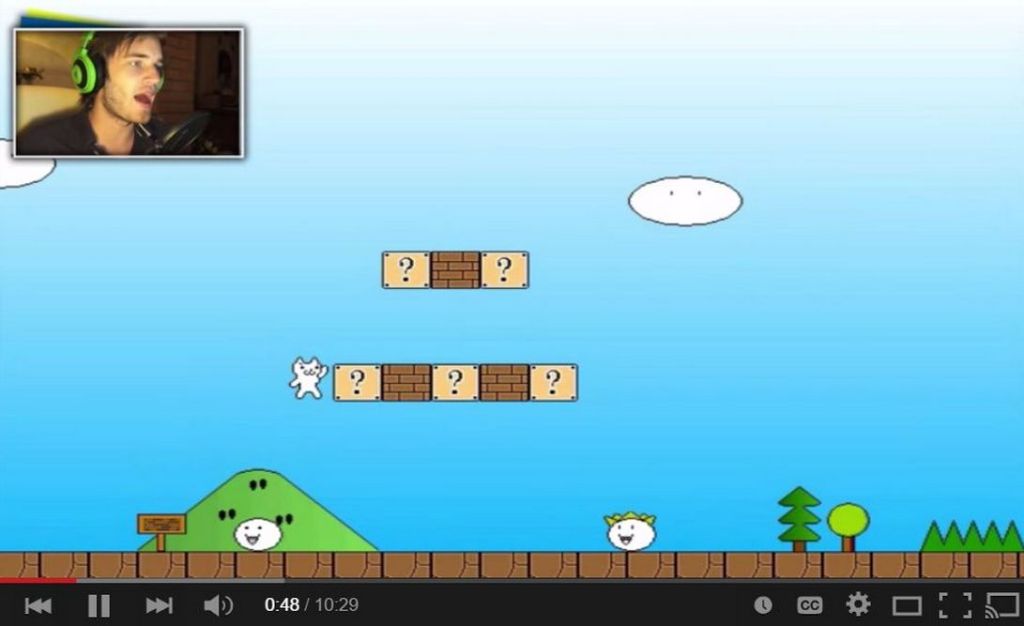 “What the fuck is that? What the fuck?” ~[PewDiePie, pretty much every episode][/caption]Regardless of your opinion of PewDiePie himself, Let’s Play videos are more than just a passing fad: it’s arguably the new paradigm of how game commentary will work from here on out. It has been wholeheartedly embraced by the indie gaming community and the younger generations of our time, even as critics continue to label the medium as being dumbed down and superfluous. Commentators may occasionally overreact or throw some acting in there for good measure, but the fact that these videos are filmed in real-time helps to keep the experience of it authentic and genuine -- something that tends to be missing in today’s sarcasm and irony-ridden cultural environments. (Personally I prefer watching Markiplier’s channel, just as a matter of personal taste.) A good portion of game commentaries are admittedly geared towards juvenile and slapstick humor, but there’s something cathartic and reaffirming about watching these videos as they progress through the game at their own pace.
Let’s Play videos originally started out as “walkthrough” videos that were hosted on YouTube, designed to help gamers through the more difficult, challenging, or confusing parts of various gaming platforms. These practices, however, eventually evolved into something more: players started to inject their own commentary, reactions, and criticisms to the videos as they played, with their personalities and opinions becoming part of the entertainment itself. Even videos of underdeveloped and poorly made games could be made entertaining with the right kinds of reactions, right kinds of jokes, right kinds of comments.
Let’s Play commentators will be the first to admit that they’re aren’t the best of gamers out there by any stretch of the imagination. They’re usually skilled enough to progress through the game at a moderate pace, but they’re certainly not going to be playing in any professional e-sports leagues, earning high scores on leaderboards, or breaking any timed playthrough records any time soon. Commentators often play games “in the blind”, with no knowledge of the mechanics, narratives, and techniques of the game prior to its play. They make mistakes, get frustrated, lose their way, get confused, lose their temper, and, most importantly, frequently fail at what they’ve set out to do. People watch Let’s Play videos because they can identify with the gamers’ struggle to understand what’s going on, connecting with them on a personal and emotional level.
Walkthrough videos are the utilitarian gifts of obsessive gamers who play through each game over and over until they manage to find all of the secrets, power-ups, techniques and paths available. They know exactly what’s going to happen at every turn, and know exactly how to react and deal with everything the game happens to throw at them. These videos are the idealized Platonic versions of gameplay, formulated and recorded after hours of practice and perfection, highlighting the most efficient ways possible of beating the game with 100% completion. Showing people “the way” in such a manner may be considered a form of generosity, perhaps, but is there really any point in striving for this type of efficiency at the expense of narrative development and discovery?
The vast majority of social media platforms of today could probably be categorized as being formally “competitive” by most standards of gaming. Companies don’t actively seek to pit people against one another, but more often than not their incentive systems are designed to encourage peer-to-peer comparisons as their primary mode of engagement. The acquisition of signaling mechanisms (points, awards, achievements) as means of proving one’s worth, validated through the statuses of others, relative to one’s self. Some signals may exist in the real world, others may be inventions of online identity systems, but more often than not users are forced to play an endless game of competitive signaling with everyone they happen to come into contact with.
In gaming, these are issues that the industry faces every day, especially when dealing with multiplayer systems and communities. Competitive signaling may increase the shelf-life of game titles for a little while, but in it of itself is never really enough to sustain its momentum indefinitely. The gaming industry’s solution to the problem is relatively simple: add more narrative content as means of extending the player’s sense of wonder and discovery. (Add-ons, DLCs, mods, alternative playthroughs, etc.) Coming up with new titles and new content is the only way game companies can hope to survive for the long term, because they can’t really rely on having one platform to sustain themselves indefinitely.
Most social platforms, however, lack the kind of overarching narratives to make these types of extensions possible. The strategy of adding more features to existing sites tends to fall flat because its developments are mostly detached from coherent narrative designs, rarely amounting to more than the mere sum of its parts. There are ways, however, of extending the longevity of platform systems by focusing on the lesser known areas of the user’s “journey” into newly built worlds.
The User’s Journey
Gamification expert Yu-kai Chou explains the experience of video game players as a 4 step process -- Discovery, Onboarding, Scaffolding, and End-Game. Broadly speaking:
“What the fuck is that? What the fuck?” ~[PewDiePie, pretty much every episode][/caption]Regardless of your opinion of PewDiePie himself, Let’s Play videos are more than just a passing fad: it’s arguably the new paradigm of how game commentary will work from here on out. It has been wholeheartedly embraced by the indie gaming community and the younger generations of our time, even as critics continue to label the medium as being dumbed down and superfluous. Commentators may occasionally overreact or throw some acting in there for good measure, but the fact that these videos are filmed in real-time helps to keep the experience of it authentic and genuine -- something that tends to be missing in today’s sarcasm and irony-ridden cultural environments. (Personally I prefer watching Markiplier’s channel, just as a matter of personal taste.) A good portion of game commentaries are admittedly geared towards juvenile and slapstick humor, but there’s something cathartic and reaffirming about watching these videos as they progress through the game at their own pace.
Let’s Play videos originally started out as “walkthrough” videos that were hosted on YouTube, designed to help gamers through the more difficult, challenging, or confusing parts of various gaming platforms. These practices, however, eventually evolved into something more: players started to inject their own commentary, reactions, and criticisms to the videos as they played, with their personalities and opinions becoming part of the entertainment itself. Even videos of underdeveloped and poorly made games could be made entertaining with the right kinds of reactions, right kinds of jokes, right kinds of comments.
Let’s Play commentators will be the first to admit that they’re aren’t the best of gamers out there by any stretch of the imagination. They’re usually skilled enough to progress through the game at a moderate pace, but they’re certainly not going to be playing in any professional e-sports leagues, earning high scores on leaderboards, or breaking any timed playthrough records any time soon. Commentators often play games “in the blind”, with no knowledge of the mechanics, narratives, and techniques of the game prior to its play. They make mistakes, get frustrated, lose their way, get confused, lose their temper, and, most importantly, frequently fail at what they’ve set out to do. People watch Let’s Play videos because they can identify with the gamers’ struggle to understand what’s going on, connecting with them on a personal and emotional level.
Walkthrough videos are the utilitarian gifts of obsessive gamers who play through each game over and over until they manage to find all of the secrets, power-ups, techniques and paths available. They know exactly what’s going to happen at every turn, and know exactly how to react and deal with everything the game happens to throw at them. These videos are the idealized Platonic versions of gameplay, formulated and recorded after hours of practice and perfection, highlighting the most efficient ways possible of beating the game with 100% completion. Showing people “the way” in such a manner may be considered a form of generosity, perhaps, but is there really any point in striving for this type of efficiency at the expense of narrative development and discovery?
The vast majority of social media platforms of today could probably be categorized as being formally “competitive” by most standards of gaming. Companies don’t actively seek to pit people against one another, but more often than not their incentive systems are designed to encourage peer-to-peer comparisons as their primary mode of engagement. The acquisition of signaling mechanisms (points, awards, achievements) as means of proving one’s worth, validated through the statuses of others, relative to one’s self. Some signals may exist in the real world, others may be inventions of online identity systems, but more often than not users are forced to play an endless game of competitive signaling with everyone they happen to come into contact with.
In gaming, these are issues that the industry faces every day, especially when dealing with multiplayer systems and communities. Competitive signaling may increase the shelf-life of game titles for a little while, but in it of itself is never really enough to sustain its momentum indefinitely. The gaming industry’s solution to the problem is relatively simple: add more narrative content as means of extending the player’s sense of wonder and discovery. (Add-ons, DLCs, mods, alternative playthroughs, etc.) Coming up with new titles and new content is the only way game companies can hope to survive for the long term, because they can’t really rely on having one platform to sustain themselves indefinitely.
Most social platforms, however, lack the kind of overarching narratives to make these types of extensions possible. The strategy of adding more features to existing sites tends to fall flat because its developments are mostly detached from coherent narrative designs, rarely amounting to more than the mere sum of its parts. There are ways, however, of extending the longevity of platform systems by focusing on the lesser known areas of the user’s “journey” into newly built worlds.
The User’s Journey
Gamification expert Yu-kai Chou explains the experience of video game players as a 4 step process -- Discovery, Onboarding, Scaffolding, and End-Game. Broadly speaking:
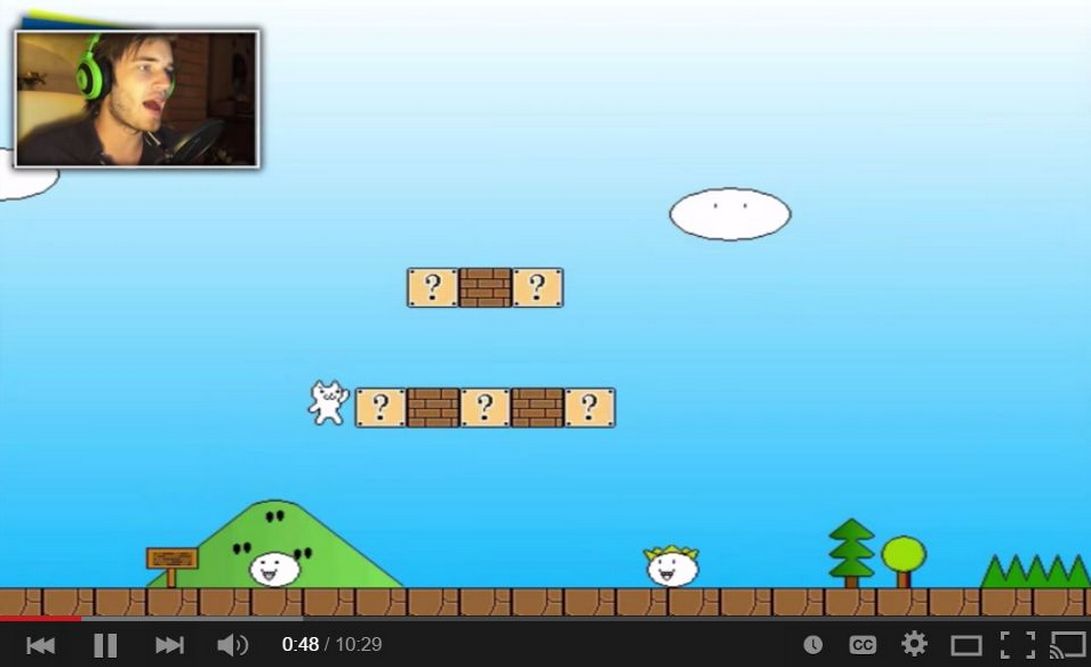 “What the fuck is that? What the fuck?” ~[PewDiePie, pretty much every episode][/caption]Regardless of your opinion of PewDiePie himself, Let’s Play videos are more than just a passing fad: it’s arguably the new paradigm of how game commentary will work from here on out. It has been wholeheartedly embraced by the indie gaming community and the younger generations of our time, even as critics continue to label the medium as being dumbed down and superfluous. Commentators may occasionally overreact or throw some acting in there for good measure, but the fact that these videos are filmed in real-time helps to keep the experience of it authentic and genuine -- something that tends to be missing in today’s sarcasm and irony-ridden cultural environments. (Personally I prefer watching Markiplier’s channel, just as a matter of personal taste.) A good portion of game commentaries are admittedly geared towards juvenile and slapstick humor, but there’s something cathartic and reaffirming about watching these videos as they progress through the game at their own pace.
Let’s Play videos originally started out as “walkthrough” videos that were hosted on YouTube, designed to help gamers through the more difficult, challenging, or confusing parts of various gaming platforms. These practices, however, eventually evolved into something more: players started to inject their own commentary, reactions, and criticisms to the videos as they played, with their personalities and opinions becoming part of the entertainment itself. Even videos of underdeveloped and poorly made games could be made entertaining with the right kinds of reactions, right kinds of jokes, right kinds of comments.
Let’s Play commentators will be the first to admit that they’re aren’t the best of gamers out there by any stretch of the imagination. They’re usually skilled enough to progress through the game at a moderate pace, but they’re certainly not going to be playing in any professional e-sports leagues, earning high scores on leaderboards, or breaking any timed playthrough records any time soon. Commentators often play games “in the blind”, with no knowledge of the mechanics, narratives, and techniques of the game prior to its play. They make mistakes, get frustrated, lose their way, get confused, lose their temper, and, most importantly, frequently fail at what they’ve set out to do. People watch Let’s Play videos because they can identify with the gamers’ struggle to understand what’s going on, connecting with them on a personal and emotional level.
Walkthrough videos are the utilitarian gifts of obsessive gamers who play through each game over and over until they manage to find all of the secrets, power-ups, techniques and paths available. They know exactly what’s going to happen at every turn, and know exactly how to react and deal with everything the game happens to throw at them. These videos are the idealized Platonic versions of gameplay, formulated and recorded after hours of practice and perfection, highlighting the most efficient ways possible of beating the game with 100% completion. Showing people “the way” in such a manner may be considered a form of generosity, perhaps, but is there really any point in striving for this type of efficiency at the expense of narrative development and discovery?
The vast majority of social media platforms of today could probably be categorized as being formally “competitive” by most standards of gaming. Companies don’t actively seek to pit people against one another, but more often than not their incentive systems are designed to encourage peer-to-peer comparisons as their primary mode of engagement. The acquisition of signaling mechanisms (points, awards, achievements) as means of proving one’s worth, validated through the statuses of others, relative to one’s self. Some signals may exist in the real world, others may be inventions of online identity systems, but more often than not users are forced to play an endless game of competitive signaling with everyone they happen to come into contact with.
In gaming, these are issues that the industry faces every day, especially when dealing with multiplayer systems and communities. Competitive signaling may increase the shelf-life of game titles for a little while, but in it of itself is never really enough to sustain its momentum indefinitely. The gaming industry’s solution to the problem is relatively simple: add more narrative content as means of extending the player’s sense of wonder and discovery. (Add-ons, DLCs, mods, alternative playthroughs, etc.) Coming up with new titles and new content is the only way game companies can hope to survive for the long term, because they can’t really rely on having one platform to sustain themselves indefinitely.
Most social platforms, however, lack the kind of overarching narratives to make these types of extensions possible. The strategy of adding more features to existing sites tends to fall flat because its developments are mostly detached from coherent narrative designs, rarely amounting to more than the mere sum of its parts. There are ways, however, of extending the longevity of platform systems by focusing on the lesser known areas of the user’s “journey” into newly built worlds.
The User’s Journey
Gamification expert Yu-kai Chou explains the experience of video game players as a 4 step process -- Discovery, Onboarding, Scaffolding, and End-Game. Broadly speaking:
“What the fuck is that? What the fuck?” ~[PewDiePie, pretty much every episode][/caption]Regardless of your opinion of PewDiePie himself, Let’s Play videos are more than just a passing fad: it’s arguably the new paradigm of how game commentary will work from here on out. It has been wholeheartedly embraced by the indie gaming community and the younger generations of our time, even as critics continue to label the medium as being dumbed down and superfluous. Commentators may occasionally overreact or throw some acting in there for good measure, but the fact that these videos are filmed in real-time helps to keep the experience of it authentic and genuine -- something that tends to be missing in today’s sarcasm and irony-ridden cultural environments. (Personally I prefer watching Markiplier’s channel, just as a matter of personal taste.) A good portion of game commentaries are admittedly geared towards juvenile and slapstick humor, but there’s something cathartic and reaffirming about watching these videos as they progress through the game at their own pace.
Let’s Play videos originally started out as “walkthrough” videos that were hosted on YouTube, designed to help gamers through the more difficult, challenging, or confusing parts of various gaming platforms. These practices, however, eventually evolved into something more: players started to inject their own commentary, reactions, and criticisms to the videos as they played, with their personalities and opinions becoming part of the entertainment itself. Even videos of underdeveloped and poorly made games could be made entertaining with the right kinds of reactions, right kinds of jokes, right kinds of comments.
Let’s Play commentators will be the first to admit that they’re aren’t the best of gamers out there by any stretch of the imagination. They’re usually skilled enough to progress through the game at a moderate pace, but they’re certainly not going to be playing in any professional e-sports leagues, earning high scores on leaderboards, or breaking any timed playthrough records any time soon. Commentators often play games “in the blind”, with no knowledge of the mechanics, narratives, and techniques of the game prior to its play. They make mistakes, get frustrated, lose their way, get confused, lose their temper, and, most importantly, frequently fail at what they’ve set out to do. People watch Let’s Play videos because they can identify with the gamers’ struggle to understand what’s going on, connecting with them on a personal and emotional level.
Walkthrough videos are the utilitarian gifts of obsessive gamers who play through each game over and over until they manage to find all of the secrets, power-ups, techniques and paths available. They know exactly what’s going to happen at every turn, and know exactly how to react and deal with everything the game happens to throw at them. These videos are the idealized Platonic versions of gameplay, formulated and recorded after hours of practice and perfection, highlighting the most efficient ways possible of beating the game with 100% completion. Showing people “the way” in such a manner may be considered a form of generosity, perhaps, but is there really any point in striving for this type of efficiency at the expense of narrative development and discovery?
The vast majority of social media platforms of today could probably be categorized as being formally “competitive” by most standards of gaming. Companies don’t actively seek to pit people against one another, but more often than not their incentive systems are designed to encourage peer-to-peer comparisons as their primary mode of engagement. The acquisition of signaling mechanisms (points, awards, achievements) as means of proving one’s worth, validated through the statuses of others, relative to one’s self. Some signals may exist in the real world, others may be inventions of online identity systems, but more often than not users are forced to play an endless game of competitive signaling with everyone they happen to come into contact with.
In gaming, these are issues that the industry faces every day, especially when dealing with multiplayer systems and communities. Competitive signaling may increase the shelf-life of game titles for a little while, but in it of itself is never really enough to sustain its momentum indefinitely. The gaming industry’s solution to the problem is relatively simple: add more narrative content as means of extending the player’s sense of wonder and discovery. (Add-ons, DLCs, mods, alternative playthroughs, etc.) Coming up with new titles and new content is the only way game companies can hope to survive for the long term, because they can’t really rely on having one platform to sustain themselves indefinitely.
Most social platforms, however, lack the kind of overarching narratives to make these types of extensions possible. The strategy of adding more features to existing sites tends to fall flat because its developments are mostly detached from coherent narrative designs, rarely amounting to more than the mere sum of its parts. There are ways, however, of extending the longevity of platform systems by focusing on the lesser known areas of the user’s “journey” into newly built worlds.
The User’s Journey
Gamification expert Yu-kai Chou explains the experience of video game players as a 4 step process -- Discovery, Onboarding, Scaffolding, and End-Game. Broadly speaking:
- Discovery is the marketing and outreach effort that goes into trying to get people to take a chance on your site.
- Onboarding is the process of educating and training the user to use your site more effectively.
- Scaffolding is the phase where the user tries to accomplish as many objectives as possible, earning victories and achievements.
- The End Game is where the user feels as if they’ve accomplished as much as they could within the game system, turning to other means of keeping themselves entertained.
7 Comments
"The Gamergate fiasco didn’t really help to improve the image of gamers, either."
Stopped reading right there
Holden writes:
> “The Gamergate fiasco didn’t really help to improve the image of gamers, either.”
> Stopped reading right there
Because...? Seems a reasonable statement to me.
> Because…? Seems a reasonable statement to me.
The mainstream narrative (as in the media) about gamergate has focused on the harassment. While a lot of gamers, and people supporting gamergate say it is about the journalistic problems the media has about games.
So only mentioning the anti-gamergate side of thing kinda shows the bias. Of the author of this article.
At least that is what I assume holden meant.
Personally I think gamergate is fucked up, but most pro-gamergate people seem pretty cordial. (at least from the times I looked at the #gamergate hashtag). While a few journalists have been pretty dismissive of concerns gamergate people had. And kept focusing over and over again on the harassment. And never on the other subjects gamergate is supposed to be about. They keep saying "Gamergate says it is not about harassment of women, but it clearly is". While anti-gamergate men also are harassed (at least, that is what the guy behind feminist frequency said).
Note: Anti-gamergate means: people who say gamers harras mostly women. And gamergate is about harassing and scaring away female devs and gamers. And all the talk about journalistic ethics is just a smoke screen.
Pro-gamergate means: people who say that is only a minor thing that happened. And they are mostly mad about journalists not staying neutral (fucking female game developers). And the harassment against women is either made up (the developer of depression quest for example is said to have either blamed the wrong people for harassment, or faked the harassment (according to admins behind wizardchan)).
Both sides have conflicting evidence, strange coincidences that contradict their own stories. Stories that don't match up with the time-lines. (For example, the positive reviews of depression quest happened before she slept with the guys). Massive hypocrisy etc.
And I personally think that a lot of the arguments are started by professional trolls on both sides. But I think that a lot after I read 'trust me I'm lying, confessions of a media manipulator'.
Im more on the pro-gamergate side myself. So that is my bias. But mostly because of the whole 'white woman in trouble' thing. The media bias that tends to 'white knight'. And because a male developer who was false accused of sexual harassment was crucified by the same journalists now calling for an end to sexism (Most of them never retracted the original posts, or did any research (It was clearly a false accusation)). Which shows the hypocrisy of the journalists imho. Same with the whole blocklist on twitter thing. (If you are following a known pro gamergater, or are a pro gamergater, you can be put into an automatic block list. Which is horrible censorship and social ostracization. And it has already automatically blocked a few people it should not have).
And most damning of all imho, is that most blogs have severely updated and changed their ethics standards after gamergate. While also condemning the whole gamergate thing as not relevant. And declaring 'gamers' dead. (Articles of which where released at the same time).
For most of this I could find sources btw. But it is a lot of work to do now. So if you want some. Say so.
And as a non native speaker, sorry for any errors I made. Can be hard to type these long replies in a small reply box.
Sorry this has gotten so long.
Well, I should let you know that I do have sympathy for the gaming community -- it's the fastest growing and grossing industry in entertainment right now, but I do think that a big reason why gaming culture tends to be portrayed negatively has a lot to do with Hollywood trying to exert its turf in a cultural landscape that's about to go through a dramatic change. Let's Play videos, in my opinion, represents a pretty significant shift in the cultural landscape because the celebrities it's produced has finally breached mainstream consciousness.
But regardless of who's side you on, it's a real stretch to call the recent GG happenings a "success" by any reasonable standard, and I do think that most people (even sympathetic ones) do agree with that statement. Who's fault it is and value judgments aside, trying to fight Hollywood bias using the methods that they have used so far, imo, won't really get the results that they might be looking for. But that's probably for another topic altogether.
Ow I agree. It is certainly a debacle. And it has not worked out well for the games side.
I think only the trolls won this one.
I agreed with your article. Was only attempting to clarify the whole gamergate thing. It can be hard to find both sides of the story. As for example even wikipedia has squarely chosen the side of antigamergate. So it can be hard to understand why your minor remark could make people angry.
Well, he got most of the way through, so that's not too bad.
The para that ends with the gamergate reference is odd, though. Although solo gaming is regarded as nerdy/anti-social, team games are often regarded as even more so - nobody is cast as anti-social for playing Tetris or Super Mario, but World of Warcraft or EVE Online attract far more negative stereotypes. It seems more likely to me that the increased social approval of "Let's play" is that it fits into our established notions of performance art - we have a performer and an audience, and performers are generally accorded high status.
I think this highlights a deeper point - things that we describe as anti-social are often not anti-social at all, but either differently or incompetently social. We regard a WoW clan as a poor facsimile of real teamwork and camaraderie, so we denigrate the people who take part in it, despite the fact that it is very obviously a social activity. A Let's Player is seen as social because they're performing a generally admired role - performer - even though it's not especially social in the sense of being collaborative, interactive or inclusive. Weirdly, we give people who have an audience more respect than we give people who have a team.
Yeah, good point -- that was a portion I probably could've gone into more but decided to focus more on the other ideas there.
Multiplayer games *seem* like they might be more "social" on the surface, but they share the same issue with single player games -- that they're detached from a consistent narrative that can be felt on a more universal level. Watching the SuperBowl is "social" because everyone in the nation is watching the same game. Having your own adventures with your friends on WoW is considered "anti-social" because the events that unfold during the process doesn't go beyond your circle of friends. It's kind of like having a secret club of your own, where your experiences are only available to people in your immediate circle. Kind of cool in a lot of ways, but also kind of detached.
But if you look at competitive gaming (League of Legends, for example), then you'll see similar kinds of patterns happening there as you might see in sports games. In Taiwan, playing LoL is considered a fairly normal, social thing for kids to do with their friends. But it's the universalization of the experience (albiet a representative one) that allows it to gain its legitimacy in that way.
I do think that Let's Players