
The Future of Tipping
A couple of weeks ago, I was introduced to the bitcoin-based tipping service for Twitter, ChangeTip, by Leslie John Dilley. It is a fascinating thing to experiment with, and you should try it out if you're interested in bitcoin. What makes it particularly interesting is that you can define your own pseudo-currency units called "monikers". The result is a deceptively simple-seeming UX that not only lowers online tipping friction dramatically, but nails the psychology of tipping in a very powerful way. You simply mention who you want to tip in a tweet, and how much (using either a standard unit or a personalized moniker), and cc @ChangeTip. The service then sends out a tweet inviting the recepient to collect. The second tweet looks like this (notice how the 2nd and 3rd examples in the image are using personalized monikers; "bits" in the first one is one of the standard system-wide monikers):
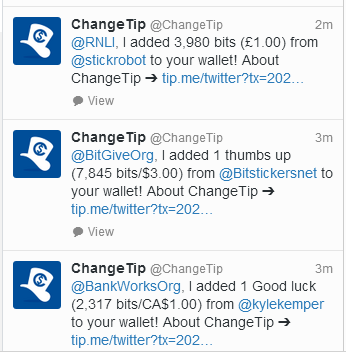 Besides making you feel all important because you get to name your own currency, it is interesting because it helps you shape the social perceptions that ride along with a tip. One of my personal monikers, for instance, is "refactorings" where a refactoring is worth one penny. If I tip somebody 100 refactorings on Twitter, it means they get a dollar if they choose to collect, and if they know me, they also know that they're getting it because one of their tweets helped me see something in a new way.
The idea of shaping the perceived meaning of a transaction is a hugely important one I think, and opens up very interesting new territories for economics. One of its effects might well be to increase the importance of tipping and decrease the importance of "meaningless" basal transactions. This is an interesting development because one of my assumptions so far has been that digital transactions break tipping cultures.
I have now changed my mind to the polar opposite view: going digital will eventually strengthen tipping culture to the point where the tipping economy might even become bigger than the basal transactional economy.
The reason we're not yet seeing this happen is because the old economy understands tipping in a far weaker way, which does break when moved online. An example is Starbucks. Here's how their app does tipping.
Besides making you feel all important because you get to name your own currency, it is interesting because it helps you shape the social perceptions that ride along with a tip. One of my personal monikers, for instance, is "refactorings" where a refactoring is worth one penny. If I tip somebody 100 refactorings on Twitter, it means they get a dollar if they choose to collect, and if they know me, they also know that they're getting it because one of their tweets helped me see something in a new way.
The idea of shaping the perceived meaning of a transaction is a hugely important one I think, and opens up very interesting new territories for economics. One of its effects might well be to increase the importance of tipping and decrease the importance of "meaningless" basal transactions. This is an interesting development because one of my assumptions so far has been that digital transactions break tipping cultures.
I have now changed my mind to the polar opposite view: going digital will eventually strengthen tipping culture to the point where the tipping economy might even become bigger than the basal transactional economy.
The reason we're not yet seeing this happen is because the old economy understands tipping in a far weaker way, which does break when moved online. An example is Starbucks. Here's how their app does tipping.
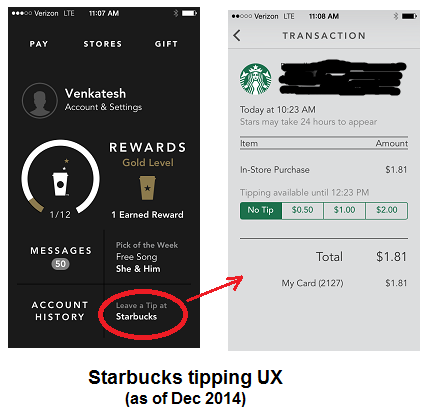 After years of not supporting tipping, they caved and allowed cash tipping at the counter. A little later, they caved further and the Starbucks app began supporting tipping (I can't recall when). But the design is so broken -- by intention I suspect -- that you have to conclude they don't wan't you to tip. I am a case in point. I am generally a good tipper at coffee shops where I pay cash, but not at Starbucks or other places that offer pre-loaded card or app schemes. I like cashless transactions so I adopt such things instantly. But the tipping experience invariably breaks.
I am not even a UX guy, and even I can think of 10 ways to make the Starbucks design way more natural so I tip at the same or higher levels than at indie cafes.
Here's the problem with the app in brief. Notice how the tipping is not part of the payment workflow at all. In the first version, the tipping option was so buried, I didn't even spot it when it was first introduced. In this version, it's more visible, but you have to do it separately, within two hours of the transaction, but as a separate action. So they want you to move away from the counter in space and time and do it later. But I don't think this is a perverse dark pattern. They have legitimate reasons to introduce friction in the tipping. Maybe they are even rationalizing it as a way to make lines move faster.
My claim: this is an example demonstrating that porting cash-based tipping cultures to the world of digital transactions -- cash-free and wallet-free -- breaks tipping. But doing tipping right in a digital-native way can have the opposite effect: making tipping culture far bigger and much more complex than it is today. The key to this possibility is that done right, the perceptions that ride along with tips can be programmed by you or the receiver in a dynamic way, instead of being a static function of the prevailing normative tipping culture.
Cash Tipping Culture
Now, I am going out on a limb here, but I'll speculate that I am not the exception. I suspect very few people use the tipping mechanism in the Starbucks app, relative to tipping frequency/amount in cash transactions.
The reason is obvious: most of the time, you want tips noticed and perhaps acknowledged with a thank-you or a nod. This is why you want it to be as naturally and frictionlessly integrated into the payment experience as possible. Tipping is not an anonymous-charity kind of transaction for most of us. It is a transaction that serves multiple intertwined purposes: goodwill, gratitude for exceptional service, relationship maintenance, and occasionally, charity/gift motives.
The purposes of tipping are much more strongly shaped by the context than the giver/receiver perceptions and intentions. Individual intentions aside, in the United States, there are six tipping contexts in a hard-edged economic sense.
After years of not supporting tipping, they caved and allowed cash tipping at the counter. A little later, they caved further and the Starbucks app began supporting tipping (I can't recall when). But the design is so broken -- by intention I suspect -- that you have to conclude they don't wan't you to tip. I am a case in point. I am generally a good tipper at coffee shops where I pay cash, but not at Starbucks or other places that offer pre-loaded card or app schemes. I like cashless transactions so I adopt such things instantly. But the tipping experience invariably breaks.
I am not even a UX guy, and even I can think of 10 ways to make the Starbucks design way more natural so I tip at the same or higher levels than at indie cafes.
Here's the problem with the app in brief. Notice how the tipping is not part of the payment workflow at all. In the first version, the tipping option was so buried, I didn't even spot it when it was first introduced. In this version, it's more visible, but you have to do it separately, within two hours of the transaction, but as a separate action. So they want you to move away from the counter in space and time and do it later. But I don't think this is a perverse dark pattern. They have legitimate reasons to introduce friction in the tipping. Maybe they are even rationalizing it as a way to make lines move faster.
My claim: this is an example demonstrating that porting cash-based tipping cultures to the world of digital transactions -- cash-free and wallet-free -- breaks tipping. But doing tipping right in a digital-native way can have the opposite effect: making tipping culture far bigger and much more complex than it is today. The key to this possibility is that done right, the perceptions that ride along with tips can be programmed by you or the receiver in a dynamic way, instead of being a static function of the prevailing normative tipping culture.
Cash Tipping Culture
Now, I am going out on a limb here, but I'll speculate that I am not the exception. I suspect very few people use the tipping mechanism in the Starbucks app, relative to tipping frequency/amount in cash transactions.
The reason is obvious: most of the time, you want tips noticed and perhaps acknowledged with a thank-you or a nod. This is why you want it to be as naturally and frictionlessly integrated into the payment experience as possible. Tipping is not an anonymous-charity kind of transaction for most of us. It is a transaction that serves multiple intertwined purposes: goodwill, gratitude for exceptional service, relationship maintenance, and occasionally, charity/gift motives.
The purposes of tipping are much more strongly shaped by the context than the giver/receiver perceptions and intentions. Individual intentions aside, in the United States, there are six tipping contexts in a hard-edged economic sense.
Besides making you feel all important because you get to name your own currency, it is interesting because it helps you shape the social perceptions that ride along with a tip. One of my personal monikers, for instance, is "refactorings" where a refactoring is worth one penny. If I tip somebody 100 refactorings on Twitter, it means they get a dollar if they choose to collect, and if they know me, they also know that they're getting it because one of their tweets helped me see something in a new way.
The idea of shaping the perceived meaning of a transaction is a hugely important one I think, and opens up very interesting new territories for economics. One of its effects might well be to increase the importance of tipping and decrease the importance of "meaningless" basal transactions. This is an interesting development because one of my assumptions so far has been that digital transactions break tipping cultures.
I have now changed my mind to the polar opposite view: going digital will eventually strengthen tipping culture to the point where the tipping economy might even become bigger than the basal transactional economy.
The reason we're not yet seeing this happen is because the old economy understands tipping in a far weaker way, which does break when moved online. An example is Starbucks. Here's how their app does tipping.
After years of not supporting tipping, they caved and allowed cash tipping at the counter. A little later, they caved further and the Starbucks app began supporting tipping (I can't recall when). But the design is so broken -- by intention I suspect -- that you have to conclude they don't wan't you to tip. I am a case in point. I am generally a good tipper at coffee shops where I pay cash, but not at Starbucks or other places that offer pre-loaded card or app schemes. I like cashless transactions so I adopt such things instantly. But the tipping experience invariably breaks.
I am not even a UX guy, and even I can think of 10 ways to make the Starbucks design way more natural so I tip at the same or higher levels than at indie cafes.
Here's the problem with the app in brief. Notice how the tipping is not part of the payment workflow at all. In the first version, the tipping option was so buried, I didn't even spot it when it was first introduced. In this version, it's more visible, but you have to do it separately, within two hours of the transaction, but as a separate action. So they want you to move away from the counter in space and time and do it later. But I don't think this is a perverse dark pattern. They have legitimate reasons to introduce friction in the tipping. Maybe they are even rationalizing it as a way to make lines move faster.
My claim: this is an example demonstrating that porting cash-based tipping cultures to the world of digital transactions -- cash-free and wallet-free -- breaks tipping. But doing tipping right in a digital-native way can have the opposite effect: making tipping culture far bigger and much more complex than it is today. The key to this possibility is that done right, the perceptions that ride along with tips can be programmed by you or the receiver in a dynamic way, instead of being a static function of the prevailing normative tipping culture.
Cash Tipping Culture
Now, I am going out on a limb here, but I'll speculate that I am not the exception. I suspect very few people use the tipping mechanism in the Starbucks app, relative to tipping frequency/amount in cash transactions.
The reason is obvious: most of the time, you want tips noticed and perhaps acknowledged with a thank-you or a nod. This is why you want it to be as naturally and frictionlessly integrated into the payment experience as possible. Tipping is not an anonymous-charity kind of transaction for most of us. It is a transaction that serves multiple intertwined purposes: goodwill, gratitude for exceptional service, relationship maintenance, and occasionally, charity/gift motives.
The purposes of tipping are much more strongly shaped by the context than the giver/receiver perceptions and intentions. Individual intentions aside, in the United States, there are six tipping contexts in a hard-edged economic sense.
- Where tipping is factored into the microeconomics, like a restaurant that underwrites a minimum wage but expects waitstaff to make the bulk of their income on tips. Here you want to tip for the same reason you want to pay at a grocery store -- not doing so is a kind of theft of somebody's income under that social arrangement.
- Where tipping is expected, like a restaurant, but not as strongly factored into the economics (it creates a bonus rather than a living wage, say), you want to make sure you're seen to tip so you aren't thought of as an asshole. Not tipping here is a kind of free-riding on the tipping of others.
- Where tipping is in a sort of gray zone of expectation, like in coffee shops with a counter-jar. If you're a regular, you want to tip to reinforce a positive relationship (and prevent retaliatory bad service on future visits), but it's not completely expected.
- Where tipping is not expected, and people are surprised if you do tip, but will not refuse.
- Where tipping is not expected, and will be refused if you try to offer.
- Where tipping is not expected, and will not only be refused, but seen as an offense if you try to offer (perceived as insulting or assuming bribe-ability for instance). Possibly even a criminal offense.
- When the business and the service provider are the same, such as in the case of a family coffee shop, the person you relate to and the entity you are transacting with are the same.
- When the business and service provider are personally related, such as a restaurant where the waitstaff can talk to the owner about tipping policy. Here your main transaction is with one entity, and your tipping transaction is with another, but both are locally situated individuals, strongly related and can negotiate things. The owners may also participate in service occasionally.
- When the main transaction is with a distant, impersonal corporation and the tipping transaction is with a person, you have messiness.
9 Comments
+20 learnings
+20 concurs
I'm on board!
Tips is actually our MVP for payments at YS. Think changetip natively integrated into Twitter but with all user and non-user accounts having btc "storage". Using email, once it's claimed, we can pay the storage to the "email account" using a daily or weekly cron. Can account for this off blockchain and run our own consumer-2-consumer payments engine.
Lots of things can be built on top.
Changetip needs a payout functionality so both sides of the market have near instant liquidation.
Re: your restaurant example, here in Melbourne we have a vegetarian restaurant called Lentil As Anything where you pay as you feel - fairly analogous to your tipping-only restaurant. They have signs up suggesting what a break-even donation, a good donation, a generous donation are etc. It's been in business for years.
It would be interesting to know the mean and standard deviation of contributions.
This reminds me of a semi-related area that I have a huge interest in -- namely, crowdfunding and other audience support tools. There are a lot of different models for how media creators can raise money from their audiences, including Kickstarter, Patreon, Gumroad, Flattr, and many others. (I recently wrote a long guide to the different options.)
There are some standout brands (like Kickstarter), but different platforms take very different approaches. For instance, Patreon essentially facilitates "subscription tipping," where people send recurring donations to their favorite artists, as opposed to Kickstarter's one-time-only project-based model.
Example 2: Flattr is more integrated with social media platforms, and tries to help people reward their favorite creators based on how many things they like or favorite from that creator -- e.g. if you heart something on Instagram then that creator will receive some of your Flattr budget.
Example 3: Gumroad is essentially a digital merchandise platform that people can use to sell ebooks, etc.
These examples are all pretty different. But my sense is that there is a killer model out there -- something even better than Kickstarter, which is currently the headliner -- and that the model will include subscription tipping in some form. It's hard to say what that will look like, though.
Anecdotal evidence:
http://jayporter.com/dispatches/observations-from-a-tipless-restaurant-part-1-overview/
and some research:
http://tippingresearch.com/uploads/managing_tips.pdf
suggest that tipping is both weakly motivated by actual service quality and has a very weak (if any) effect on that service quality... at least, in base-pay institutions such as restaurants.
It may be that tipping is not only, as you suggest, possibly more likely to function effectively in base-free transactions, but is, additionally, actually counterproductive in base-paid transactions. This may be the case especially for those tipping to bribe, but also for those tipping out of guilt or solidarity - anyone who expects their tip to have any effect on the tipped person. In other words, tipping and paying are oil and water. (Or perhaps salt and water?)
Is the only way someone could enter this individual-currency all-tip economy you describe by completely forgoing any work-for-pay or sale of products? Further, is the extreme prediction that this all-tip economy is not possible so long as *anyone* is still working in a pay economy?
Either way, I wonder what the interactions between people living as all-pay workers and those living in the land of all-tips will be like.
This is an awesome article. Definitely doing to give it a few reads. Thanks for all the consideration. You should probably integrate your tipping information on here so I can tip you from here! :)
-Victoria
I may do so at some point in the future.
a great tip, indeed!- since tip is given ( in stock market parlance ) for someone to make money
Adding this Aeon article here for reference.
Aeon on Tipping