
How to Fall Off the Wagon
Self-help ideas generally belong to one of three schools of thought, whether the originators realize it or not: values-first, goals-first or process-first. Norman Vincent Peale (Power of Positive Thinking, 1952), Wayne W. Dyer (Erroneous Zones, 1976) and David Allen (GTD, 2002) are the authors of the pioneering mainstream classics of each sub-genre. Those dates are significant: the schools evolved and matured in that order, each building on the last to some extent.
In the process of exploring the question, "what's the best way to fall off the wagon in each school?" I accidentally created a visualization that turned out to capture a grand-unified-theory of self-improvement. Well, at least a unification of the parts that interest me personally. I knew triangles would eventually be of actual use in my visualization tool-kit.
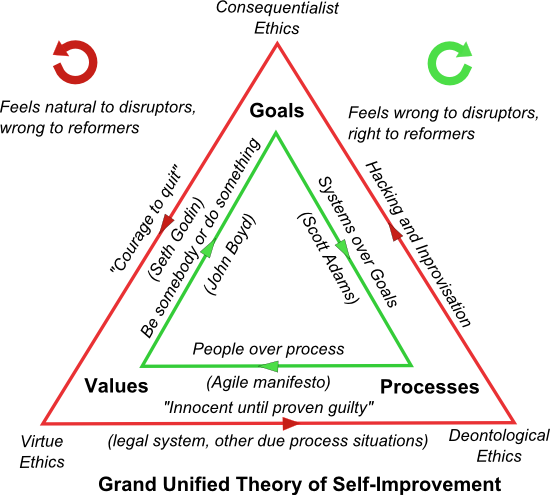 Note that self-help types have a tendency to use people and values interchangeably. It is a very revealing conflation that I might explore someday, but for the moment assume that they are the same thing: that people can be reduced to their virtues and vices. They similarly conflate habits and processes, which is also a revealing conflation I might explore some day. In a business/organizational context, goals and values are generally called visions and missions, but that's irrelevant for this post.
The arrows represent destabilizing forces that act on each of the three schools. The green triangle of arrows, going clockwise, represents a pattern of falling off the wagon that feels natural to reformers (those who work within a prevailing social order) and wrong to disruptors (those who work from outside). The red triangle of arrows, going anticlockwise, represents a pattern of falling off the wagon that feels natural to disruptors and wrong to reformers. Equivalently, disruptors are exit people (leaving a social order is a primary problem-solving technique), reformers are voice people (driving reform within a social order is a primary problem-solving technique). If you're not familiar with the exit versus voice model, check out the Wikipedia page.
Hidden in the diagram, there is actually a pragmatic right answer to the question in the title: continuously, and in a circular fashion. The only question that remains is this: clockwise or anticlockwise? Reformers fall around clockwise, disruptors fall around anticlockwise.
Three Kinds of Stuckness
Let's clarify a couple of things first.
First, in case it isn't obvious, we're talking about non-trivial long-term goals here, the kind that require you to form and sustain habits and create appropriate systems and processes in your life. Not shorter-term one-offs which simply require figuring out a plan (a logical sequence of actions, all of which can be reliably performed, like making travel arrangements for a business trip; of course, if you're a travel planner, that can be an area where long-term goals are meaningful).
Second, falling off the wagon is a good thing. It's getting back on quickly that's at the heart of effectiveness. Clinging to one vertex with ferocious tenacity is the pathology. If you're not iterating through goals, values and processes continuously, that's the definition of being stuck.
Each vertex of the triangle represents a kind of degeneracy, and falling off the wagon is actually a preferred way of getting unstuck repeatedly.
Note that self-help types have a tendency to use people and values interchangeably. It is a very revealing conflation that I might explore someday, but for the moment assume that they are the same thing: that people can be reduced to their virtues and vices. They similarly conflate habits and processes, which is also a revealing conflation I might explore some day. In a business/organizational context, goals and values are generally called visions and missions, but that's irrelevant for this post.
The arrows represent destabilizing forces that act on each of the three schools. The green triangle of arrows, going clockwise, represents a pattern of falling off the wagon that feels natural to reformers (those who work within a prevailing social order) and wrong to disruptors (those who work from outside). The red triangle of arrows, going anticlockwise, represents a pattern of falling off the wagon that feels natural to disruptors and wrong to reformers. Equivalently, disruptors are exit people (leaving a social order is a primary problem-solving technique), reformers are voice people (driving reform within a social order is a primary problem-solving technique). If you're not familiar with the exit versus voice model, check out the Wikipedia page.
Hidden in the diagram, there is actually a pragmatic right answer to the question in the title: continuously, and in a circular fashion. The only question that remains is this: clockwise or anticlockwise? Reformers fall around clockwise, disruptors fall around anticlockwise.
Three Kinds of Stuckness
Let's clarify a couple of things first.
First, in case it isn't obvious, we're talking about non-trivial long-term goals here, the kind that require you to form and sustain habits and create appropriate systems and processes in your life. Not shorter-term one-offs which simply require figuring out a plan (a logical sequence of actions, all of which can be reliably performed, like making travel arrangements for a business trip; of course, if you're a travel planner, that can be an area where long-term goals are meaningful).
Second, falling off the wagon is a good thing. It's getting back on quickly that's at the heart of effectiveness. Clinging to one vertex with ferocious tenacity is the pathology. If you're not iterating through goals, values and processes continuously, that's the definition of being stuck.
Each vertex of the triangle represents a kind of degeneracy, and falling off the wagon is actually a preferred way of getting unstuck repeatedly.
Note that self-help types have a tendency to use people and values interchangeably. It is a very revealing conflation that I might explore someday, but for the moment assume that they are the same thing: that people can be reduced to their virtues and vices. They similarly conflate habits and processes, which is also a revealing conflation I might explore some day. In a business/organizational context, goals and values are generally called visions and missions, but that's irrelevant for this post.
The arrows represent destabilizing forces that act on each of the three schools. The green triangle of arrows, going clockwise, represents a pattern of falling off the wagon that feels natural to reformers (those who work within a prevailing social order) and wrong to disruptors (those who work from outside). The red triangle of arrows, going anticlockwise, represents a pattern of falling off the wagon that feels natural to disruptors and wrong to reformers. Equivalently, disruptors are exit people (leaving a social order is a primary problem-solving technique), reformers are voice people (driving reform within a social order is a primary problem-solving technique). If you're not familiar with the exit versus voice model, check out the Wikipedia page.
Hidden in the diagram, there is actually a pragmatic right answer to the question in the title: continuously, and in a circular fashion. The only question that remains is this: clockwise or anticlockwise? Reformers fall around clockwise, disruptors fall around anticlockwise.
Three Kinds of Stuckness
Let's clarify a couple of things first.
First, in case it isn't obvious, we're talking about non-trivial long-term goals here, the kind that require you to form and sustain habits and create appropriate systems and processes in your life. Not shorter-term one-offs which simply require figuring out a plan (a logical sequence of actions, all of which can be reliably performed, like making travel arrangements for a business trip; of course, if you're a travel planner, that can be an area where long-term goals are meaningful).
Second, falling off the wagon is a good thing. It's getting back on quickly that's at the heart of effectiveness. Clinging to one vertex with ferocious tenacity is the pathology. If you're not iterating through goals, values and processes continuously, that's the definition of being stuck.
Each vertex of the triangle represents a kind of degeneracy, and falling off the wagon is actually a preferred way of getting unstuck repeatedly.
- Goals-first people are idealists. They tend to get fixated on long-term goals that they are neither able to give up, nor work towards. This is the degeneracy of utopianism. To get unstuck, they need to either get moving (clockwise) or quit (anticlockwise).
- Process-first people are doers. They tend to get stuck on degenerate processes that have stopped working. This is the degeneracy of blind ritualism. To get unstuck, they need to either question the process in light of values (clockwise) or break the process in service of goals (anticlockwise) .
- Values-first people are emulators. They tend to get stuck on identity issues where there is no leader offering a clear model of virtues to emulate. This is the degeneracy of leaderlessness. To get unstuck, they need to either find a new leader (clockwise) or sacralize certain new processes, in lieu of a leader (anticlockwise).
- Analysis (values-based inquiry) followed by...
- Synthesis (goals-based reform program) followed by...
- Implementation (the creation of new habits from revised goals).
- Synthesis (improvising a new practice) followed by...
- Conflict (between explicit old values and implicit ones in new practice) followed by exit and...
- Precedent-setting (embodying new values in systematized new practices).
If you are equally at home at any of the three vertices, and capable of falling either clockwise or anticlockwise according to the needs of the situation, you're playing a simplistic video game of some sort. Real life is never that easy and uniformly challenging.
Though there are people with lives that seem to have both clockwise and anticlockwise chapters (John Boyd would be an example, but even he was ultimately identifiable as more reformer than disruptor), most have clearly dominant styles of functioning.
So for much of the population, I think there is inevitably a preferred home vertex and a preferred direction of falling. That's your personality. Obviously, there's six archetypes here, corresponding to six basic orientations to self-improvement.
I normally make up archetype terms with negative connotations for fun, but for a change, I'll try to pick relatively neutral terms that allow for both negative and positive manifestations. Each can be a hero or a villain depending on the context and situation. Each gets stuck in a unique way (remember how I defined being stuck: trying to return to your home vertex when you should be rolling with the fall).
- Investigator: Process-oriented reformer, figures out what is broken. They get stuck at habits.
- Holy warrior: Values-oriented reformer, figures out what to do about broken things. They get stuck crying wolf.
- Operator: Goal-oriented reformer, figures out how to do it. They get stuck defending the indefensible.
- Hacker: Habit-oriented disruptor, breaks things to get something done. They get stuck in chaos.
- Contrarian: Goal-oriented disruptor, fights to prove that the hacked thing is better than the original. They get stuck at visions.
- Legalist: Values-oriented disruptor, makes the broken thing a beautiful thing. They get stuck in traditionalism.
- If you hate process reform like six-sigma DMAIC, you're a contrarian, your nemesis is the investigator
- If you hate fervent ideological debates, you're a hacker, your nemesis is the holy warrior
- If you hate legal reasoning and careful precedent setting, you're an operator and your nemesis is the legalist
- If you hate breaking processes to get things done, you're a holy warrior and your nemesis is the hacker
- If you hate conflict over resources, you're an investigator and your nemesis is the contrarian
- If you hate designing new systems and processes, you're a legalist and your nemesis is the operator
- The evil twin of the contrarian is the legalist
- The evil twin of the hacker is the contrarian
- The evil twin of the legalist is the hacker
- The evil twin of the investigator is the holy warrior
- The evil twin of the holy warrior is the operator
- The evil twin of the operator is the investigator
- ...the investigator is the morally challenging detective story that leads to greater wisdom
- ...the holy warrior is the messianic story ending in martyrdom
- ...the operator is the surviving a collapse and returning stronger than before
- ...the hacker is the reluctant hero's tale, who leads a rebellion because nobody else will
- ...the contrarian is the tale of disillusionment and loss of paradise
- ...the legalist is the tale of the leaderless ronin who realizes that he himself is in fact the leader he's been looking for
- The frenemy of the investigator is the hacker
- The frenemy of the holy warrior is the legalist
- The frenemy of the operator is the contrarian
31 Comments
I am decidely a legalist, which is probably why I found this essay to be a tour de force and some of your best work. That's a bit ironic, given that it's a systemization of personality and I ought therefore to loathe it. But I find the explanatory power of your system compelling. In some ways it operates a bit like the Sufi enneagram. Much food for thought. Thanks.
Brilliant abstraction. Reminded me of two other frameworks: Kling's Three Languages of Politics, and Sulliway's Born to Rebel contrasting eldest vs youngest children.
Er, Sulloway
Haven't heard of the first one, but the birth-order stuff has always seemed vaguely shady to me. It's just too convenient and clean. Reality of sibling life is much messier.
Great food for thought, Venkat! Thanks!
I've been wrestling with the implications of this system, and with seeing how I situate within it.
Within a work context, I think I may have tended to be a Holy Warrior (The fact that I've done battle with Hackers so often is the crucial clue for that), but I identify with disruptor tendencies in some other ways. If something can't be fixed, I bail and try something new.
On the philosophical ethics front, I've tended to think of myself as a consequentialist with caveats (in situations where you have very little control of outcomes, holding yourself responsible for those outcomes is pathological; I notice that hardcore consequentialists seem to be unusually confident that their efforts have the intended effect).
I've also avoided aligning with virtue ethics (I loathe Aristotle), but you have me wondering if in fact that is my natural home.
I consider the fact that I have to think about this so much to situate myself a point in favour of this system: if self-identification is facile, then a system would lack depth and not offer an opportunity for learning about yourself.
I think the ambiguity is a fundamental feature. Unless you test under a minimum level of stress, you won't be able to tell whether you're left or right handed for instance... for sufficiently simple manipulation tasks, both hands will be able to do it equally well. Increase the dexterity and strength required, and handedness becomes evident. What I am not certain of is whether it is nature or nurture.
TBH, I think virtue ethics is made out to be far more complex than it is. It's not really a distinct ethical system so much as a mirroring system. It's a post-hoc justification for following/emulating people you admire and distancing yourself behaviorally from people you hold in contempt. As practised today, it is not really Aristotlean in form, it's more Christian (even in non-Christian incarnations).
Virtue ethics can be incorporated into either consequentialist reasoning (which turns into ethical reasoning) or deontological practice (which turns it into a particular kind of fatalist habit that does not lend itself to effective/ineffective testing, since like Job in the Bible, you'll reason that God has his reasons for the pattern of rewards/punishments your virtuous habits are bringing).
The hero-worship angle you are focusing on for virtue ethics, though I can see how it fits, makes me even more uncomfortable than the Aristotle connection. ;-) At least Aristotle (as the ultimate philosopher of the status quo) makes sense in the context of prevailing Hellenistic cultural values.
For me, it really is abstract values, distinct from goals. For example, I value diversity and will take steps to add in people with different perspectives (or take a different perspective) if I feel that the prevailing direction is a group-think monoculture.
You certainly can use individual icons as short-hand embodiments of one or more values (my own equivalent is "Taoist Sage"), but assigning a real individual to the role seems dangerous to me. (But maybe I'm anticipating your post about conflating values and people...)
That's roughly what I meant. The legalist archetype is in fact about constructing an artificial leader so to speak ("rule of law") by replacing models with oracular prescribing systems. For atomic values like "diversity" things are easy. But you need more complex reasoning OR more subtle habits to handle values that are in conflict. This is what I was exploring in my Economics of Pricelessness post: how you compute with different values in play.
But these are so demanding that I suspect most people follow models who instilled the values. To honest people, raised to value honesty by Dad, it really does turn into searching the big-data-set of anecdotal memories of "what Dad did" to handle decisions. This is especially true around exception handling. You are honest the way Dad was, and you might cheat/lie in small ways roughly comparable to how/when Dad did it.
Exceptions are an important thing, and that's where human models are very efficient, since they represent not just a model of values, but a whole huge library of exception-handling precedents that don't directly follow from the values via axiomatic deduction. This has some similarity to legal precedent setting, but is much less systematic. It's mostly metis, and often unjustified/arbitrary/superstition.
For example, Dad's model of honesty might be: "You must be absolutely honest in your dealings, but it's okay to screw over Muslims for small amounts because they're all dishonest thieves anyway and are stealing from us all the time." (One of my close childhood friend's dad actually said something similar, which I am changing around a bit to anonymize).
I'm good at complex reasoning and subtle habits, so maybe that is my problem... ;-)
My "hero" is my own best self.
I understand the emulation model of virtue ethics you are proposing, but Christian ethics (at least in the Catholic tradition) are firmly rooted in Aristotlian ethics as mediated by the 13th century philosopher/theologian Thomas Aquinas. In that scheme, each particular virtue is moderate behavior that avoids the extremes of either an excess or deficiency of the corresponding vicious behavior. For example, temperate eating is neither the overindulgence of gluttony nor the finicky delicacy often displayed by anorexics. The fact that the Church used saints as models of virtue was more a pedagogical choice in the face of widespread illiteracy than a means of reducing abstract concepts to concrete examples.
Perhaps the flaw in Thomistic ethics, similar to the blind spot of classical economists, is that it assumes that most humans resort to their rational faculties before making an act of the will, discounting the role of emotions in human choice.
But "pedagogical choice" is at the *heart* of the matter with popular self-improvement lit and popular religiosity isn't it?
iirc Back when religion was strong, everyday people read the gospels, and heard sermons typically exploring parables/sayings in the gospels. Not Aquinas?
I am not as familiar with Christian tradition in practice, but in Hinduism, there's a reason the Ramayana and Mahabharata (esp. the Gita in the latter and the Bhagwat Purana) are the core of everyday religion. It's only the scholars who discuss Vedanta. Similarly in Buddhism, the "eightfold path" is backend theory. The heart of practice is the Jataka tales.
Islam is probably the most truly abstract of the virtue-ethical religious systems, but even there, I think the hadiths are more used in everyday life than the koran itself.
East Asian traditions tend to be based strongly in ancestor worship/tales of monks on the one hand, and extreme practice on the other.
So broad thesis: the scholastic tradition around virtue ethics does not matter except to scholars. It's a "teaching birds to fly" domain of theory. For the "birds" it seems like the emulation version of virtue ethics is the primary source, not just a pedagogical reduction of the theory. The theory in fact can be viewed as an abstraction that arises from the phenomenology in the emulation version. That would at least be the Talebian interpretation (possibly also the Austrian-school view of the origins of the law?)
I think it might be dangerous to lump all religious phenomena under the values pole. Religions are complex, and usually have all three modes: process = ritual, values = saints, goals = get to heaven, nirvana, moksha, etc.
To use the Universal Church of Apple (the most successful religion of our time) as an example:
values: What would Steve Jobs do?
process: WDC product announcements
goals: Be the first to own the newest version of your favorite gizmo.
I'm sure other more obscure religions would have equivalent things...
It was my understanding that Aristotlean ethics are rather *explicitly* defined in relation to the actions of subjectively "great" men (Pericles being the quoted example). Quoting Nicomachean ethics [0]:
"Regarding practical wisdom we shall get at the truth by considering who are the persons we credit with it. Now it is thought to be the mark of a man of practical wisdom to be able to deliberate well about what is good and expedient for *himself*, not in some particular respect, (e.g. about what sorts of thing conduce to health or to strength), but about what sorts of thing conduce to the good life in general...
[...] Now no one deliberates about things that are invariable, nor about things that it is impossible for him to do. Therefore, since scientific knowledge involves demonstration, but there is no demonstration of things whose first principles are variable [...], and since it is impossible to deliberate about things that are of necessity, practical wisdom cannot be scientific knowledge nor art; not science because that which can be done is capable of being otherwise, not art because action and making are different kinds of thing...
[...] For while making has an end other than itself, action cannot; for good action itself is its end. It is for this reason that we think Pericles and men like him have practical wisdom, viz. because they can see what is good for themselves and what is good for men in general; we consider that those can do this who are good at managing households or states."
===
In my case, I exhibit strong Holy Warrior failure patterns in my life, with the addition of one strong and pronounced "out" -- I have a very strong aversion to martyrdom, so when my reformist tendencies stockpile enough martyr emotion over time, the levee breaks, ushering in a large and loud exit to the next value system. The cowpath has been paved enough that I've incorporated these exits into my narrative routine (I'm a Kierkegaardian Christian, if that helps).
I of course take issue with the fact that virtue-ethics-by-emulation lacks complexity or intrigue in nature. The act of determining which virtues to emulate or not, of which 7 billion people, in relation to my own personal pathology, and in real time, opens a universe of complexity which is more than enough to occupy my natural cognitive surplus.
For me, emulation is rooted in a deep respect for the maddening complexity of asymptotic moral calculus, plus a convenient way to pursue action and personal pleasures while dumping responsibility on the next being higher on the power chain.
===
One interesting question to leave you with: What happens when a strong virtue ethicist picks her upstream evil twin (IE, the person considering *them* as their evil twin) to emulate?
[0] http://classics.mit.edu/Aristotle/nicomachaen.6.vi.html
This may not be the place to get into the fine points of Aristotle, but the passages you quote don't have the force of suggesting that we _imitate_ those great men, but rather that we consider men great who have those virtues. Great men make their own ethics. Lesser men may follow them, but that is what makes them lesser men.
That is an expression of pretty typical Hellenistic cultural values, and just as an aside, one can argue that Nietzsche was trying to revive some of that ethical spirit.
My objection to the imitative angle is in some ways an anticipation that Venkat might be inclined to see the values pole as the home of the Clueless. ;-)
Obviously, I don't think that is so.
You got that right Marc -- I frankly do see the virtue ethics pole as the home of the Clueless for the most part, since "great men" are rare and likely to themselves be goal or habit driven rather than by a sense of their own virtues/vices.
Since I'm quite certain I'm neither a Clueless, nor a Loser ;-), let me submit that I think all three Gervais levels can exist at each pole.
Take goals. Someone can be goal oriented and faithfully pursue the goals that society sets out for them (Clueless), whine that the goals society sets out for them are stupid, or a sham (Loser), or choose their own goals, while still aware of society's goals, and perhaps mascarading their own as those. (Sociopath).
Equally, with values: follow society's, reject society's (or think society's are hypocritical), or make your own.
You can see the pattern for process. ;-)
I might argue that your reformer/disruptor cycle might be the path through the chain. (Not sure if it is up a level at each pole, or at each full circuit around the triangle.)
Of course. I am talking about statistical proportions. I think there's a higher proportion of Clueless at the values vertex than at the other two.
I'm going to disagree again (and in fact I think it strengthens your personality model to decouple Gervais from it is so simplistically).
My experience is that Clueless are spread across the poles. For example, a process clueless is a mid-level bureaucrat, a value clueless is a charity true believer, and a goal clueless is a unself-reflecting sales guy.
:)
This is the most useful one of your posts has been for me in quite some time. More exploration of these ideas in the future would be great.
What!! It's useful? I'll have to try and avoid that in future posts :)
If you use each side of a triangle to represent a persona, so they each have a home vector leading from their home vertex, you get an interesting visualisation of how the personas come into conflict with their nemesis at their second vertex and how their evil twins continue their disruptions or reforms. This could be a useful representation for the more explicitly personality-oriented version of the model.
Since we aren't operating in a sociopoliticoeconomic vacuum, there are asymmetric forces affecting the dynamics between the personae, resulting in the narratives you have described. But I wonder what this model recommends on the individual, group, and societal levels. Is it preferable to always be able to let go of a goal/process/value so as to get unstuck and keep moving, or to be able to reverse direction and switch between reform and disruption? Both have their costs, but at least groups and societies have the option of changing leadership and personnel to cope with such changes I suppose.
Hey Venkatesh,
Great post. Yes, sort of overblown/complex at first but after a few readthroughs I think it's really interesting and useful. I too am a contrarian and a disruptor and can confirm that the outcomes aren't great for us. My ex-girlfriend as absolutely an opposite and we completely had an incredible/awful cycle going, which seems like the romantic equivalent of a frenemy.
I frequently get stuck at visions too, which is why I think it's really interesting that when I tell my friends that I'm starting really great new processes, I'm super excited and they seem to not get how big it is for me. I'd be interested if you could name the various states of stuckness -- for contrarian disruptors it has to be depression haha.
So where do we go from here? You seem to say that going around and around the circle is the way to do it. I agree. Life is a process not checking off goals and then resting as I've been in the habit of thinking. Here's hoping that my new processes successfully transition to productive hacking/improvisation and a successful company. I'm sure I'll get stuck again at disillusionment/exit-oriented accomplishment again but hopefully the next cycle is more fruitful.
Basically, what I'm saying is, will you be my new leader? God damnit, I've done this so many times in my life, deifying people in hopes that they will solve all my problems and make so many plans I never complete.
Nick
This is my favorite Ribbonfarm post so far this year. It's concrete, applicable, and indirectly makes your recent series of posts on the saint/trader personas less ethereal.
It took a few readings to synthesize the concepts and apply them to myself, but I'm left puzzling over a few questions. I most strongly identify with a goal-oriented reformer, and it indeed seems to me that there have been times I've been stuck defending the indefensible. But since the difficult part of the "operator" journey is from process to values, are you suggesting that it is old values that operators tend to defend, preventing a cycle and reverting back to the goal stage? Or is it that operators have difficulty departing from the processes they previously designed?
I'd guess true operators are compromisers and have trouble being sincere enough about values to look at functioning processes in light of implicit values as a way to improve them. Satisficers have trouble turning into optimizers basically.
Hmm, that's one possibility, but I would suggest a minor alteration: since operators are the kind of people who always want to set a goal and then do something productive toward that goal, they sometines get stuck defending inefficient processes/methods they set down in pursuit of that goal, or keep making goals and processes without realizing that a reexamination of their values is necessary. When they finally do (or are forced to see by a holy warrior or investigator type and abandon the bad process) it usually leads to reaffirming original goals but reframing them with a new value set that requires a different process methodology.
Consequently, what's hardest for goal-oriented reformers is retrograde "quitting" on a goal, because they insist on finding processes in service of achieving it.
The key difference from what you suggested is that values aren't really a way to direct process, (except for the most religious of us), they're more of a back-end that informs the "how" of goals and processes. So instead of having values reaffirm and refine process, for operators it's more natural to need to altogether throw out the values they don't realize are impeding processes, then quickly cycle back to check goals and make a new process.
That makes sense. I think it's all a matter of emphasis on different phases of the "clockwise circuit" narrative. The evil twin of the operator is the investigator. The operator's default narrative is "surviving collapse, returning stronger" and the investigator's is "morally challenging detective story." The diff is that in one complete circuit, the operator loses some faith in values, but gains commitment to goals, while the investigator gains faith in the values, but loses some commitment to specific goals.
That's the start of the downward spiral for both: towards being a cynical operator defending the indefensible, versus a ritualized process bureaucrat who wants to at least do his/her job right even if the larger logic of things is unraveling. By having stronger affirmation in values, the process becomes its own justification and does not need to serve a goal.
Hi Venkat. I've been reading your stuff for a while now with great interest.
I was identifying with Operator, Contrarian and Hacker (maybe leaning most toward Operator), and was a bit confused by the fact that this set included types from both falling directions. Toward the end you speculated that those are the three "fox" types, and that seemed to explain my draw toward those three types to some extent. Do you think the fox/hedgehog categories might be more robust than the "reformer/disruptor" categories?
Also, it seems to me that, if we accept this as a descriptive model of how people tend to get stuck and unstuck, it's not required that we also accept it as a normative model for how we should get stuck and unstuck.
Is there a particular benefit in your view to completing cycles? I suppose completing cycles might feel like a natural way to make progress. But might it be better to simply recognize that there are three ways of being stuck, and for each one we have two ways of getting unstuck? Then we could choose whichever fix seems most advantageous in the current circumstances, regardless of what our natural tendency is.
At the level of individual personalities (on a desert island say), yes, I think the fox/hedgehog typology is more robust.
The point of this model is to create a socially situated model. And it seems to me that there is an independent, orthogonal preference for reform vs disruption that becomes evident only in a social context. I think there are foxes and hedgehogs on both the reform and disruption paths. But in general, foxes are more at home in the disruption path I think.
And yes, the intent here is descriptive, not prescriptive. I think people generally get unstuck by completing cycles rather than going against their grain. This is what creates the watershed divide between reform and disruption: if people didn't have the complete-cycle tendency, you wouldn't see such a clear separation between situations of reform and situations of disruption. Or by analogy, if the world didn't have right-handed and left-handed people, you wouldn't see a society with right and left handed infrastructure and a systemic bias.
I think the proportion of reformers to disruptors is about the same as the proportion of right-handed to left-handed people. So even though many romantically see themselves as disruptors, most people are likely to be reformers, push come to shove.
Seems I fit the investigator type (strongly influenced from an accounting background?)
This is one of my favorite posts, even if it is from a defined nemesis! And the triangle seems a stronger foundation than Myer-Briggs, as mood can influence INFJ or INTJ scores for me, but never feel dead-on as the scores are usually close to center (personality can fluctuate a bit I suppose). But its helping me look at some problems I've been having at a much deeper level.
On a shallower level though, I had some questions I was wondering if someone could help me with:
I have only started to study philosophy. But a philosopher like Kierkegaard would fall under holy warrior type?
I'm assuming no type is inherently better than another, and keeping in mind this is more towards 'self'-improvement. But could 1 type seem to have a larger impact than the other types (on others in an organization sense)? Which could seem the most 'risky' type if change effects others?
Thanks, this is marvellous.
I recalled your old post, "Acting Dead, Trading up and Leaving the Middle Class". Quite worthwhile studying that piece in this lens.
It would appear that middle-class folks, as characterised in that post, are reformers stuck in the values-first vertex. Holy warriors for a lost cause, with hackers their nemesis.
Revealing that the preferred exit path you picked out was the process-first route (experiment your way to a better life), disruptor that you are.