
An Archetypes Map
I've been trying to organize my thinking around archetypes into a broader landscape. Here's my first stab at organizing a subset of the many I've played around with over the years. This exercise interests me because I am trying to level up my sophistication in dealing with archetypes.
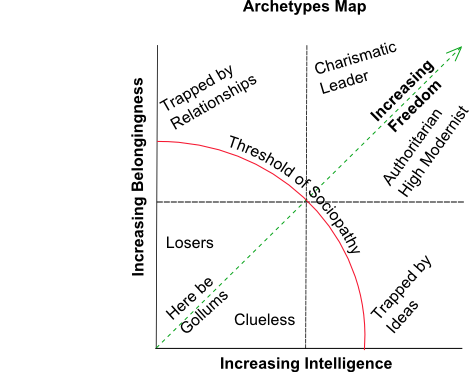 Let's do a quick guided tour.
The Tour
For those who came in late, here are some of the articles where I've explored these archetypes:
Let's do a quick guided tour.
The Tour
For those who came in late, here are some of the articles where I've explored these archetypes:
Let's do a quick guided tour.
The Tour
For those who came in late, here are some of the articles where I've explored these archetypes:
- Losers, Clueless and Sociopaths are explored in the Gervais Principle series. Sociopathy in my scheme of things is a threshold to freedom archetypes, defined by a variety of patterns, rather than a singular pattern, but two useful patterns to keep in mind are the Barbarian and the Nomad. One is more likely to either lead from within or attack the social order from the outside. The other is more likely to leave a social order via self-imposed exile.
- Authoritarian high modernism as a leadership archetype is explored in A Big Little Idea Called Legibility.
- Gollums -- increasingly degenerate and dehumanized individuals within a social order -- are explored in The Gollum Effect.
- Trapped by Ideas and Trapped by Relationships are explored in Extroverts, Introverts, Aspies and Codies as well as various other pieces that explore more specific ones. The Turpentine Effect explores a trapped-by-ideas archetype, while The Locust Economy (about the Jeffersonian middle class) and You Are Not an Artisan explore trapped-by-relationships archetypes.
- I haven't explored charismatic archetypes, but think Bill Clinton -- people who make for better political entrepreneurs than technological or financial.
15 Comments
This would make an interesting TED talk?
The word *belonging* suggests *membership* to me, but I wonder if orientation works better. In the current version, I guess 'GP-sociopaths' are scattered outside the threshold?
In other words, I wonder if you really want an archetype graph that ignores Freud and puts neurotics and sociopaths together. There's a lot of explanatory stuff in that contrast. If you make your x-axis the 'orientation to social rules', the graph is:
SMART
WILD | RULED
DUMB
and the extremes in each square are closer to:
Hannibal Lecter | Alvy Singer
The Minotaur | Inspector Clouseau
Interesting thoughts. I may be using words slightly differently than you think.
Belongingness is not membership. I am using the term in the sense of Whyte's "Organization Man" where it signified values derived from what he called the "social ethic" as opposed to Weber's "protestant ethic."
Neurotic v. Sociopath... need to think about that. First thought would be that neurotics tend to fall into one of the two "trapped by" subclasses beyond the sociopath boundary. The essential feature for me is estrangement from the mainstream due to either intellectual or relationship evolution, or both.
The way you're using the word "sociopath" is an extreme case of "not even wrong," comparable to defining "pedophile" as "a grownup who loves children." It's a shoot-self-in-foot maneuver that undermines the rest of your arguement. You need a new word for the meaning you're seeking.
Clinically, sociopathy is antisocial personality disorder (APD), and is characterized by: pathological lying, superficial charm, complete absence of empathy, extreme manipulativeness, inability to maintain stable relationships, and criminal versatility. The key subjective symptoms are chronic painful boredom (the emotional flatline state) compensated by excessive risk-taking behaviors in the attempt to feel anything at all. The archetypal cases are the violent street thug who "shows no emotion" in court, and the slick con-artist who rips off investors on a market-wrecking scale.
The sociopath's disregard for "the rules" is not based on some heroic notion of freedom, but on the inability to recognize the personhood of others, and on the behavior of treating persons as objects for his/her own pleasure or benefit. One may as well extol the virtues of asteroids hurtling through space, even when their trajectories cause them to smash into life-bearing planets and trigger mass extinctions.
Sociopathy is not a gateway to freedom. Often it's an obvious gateway to prison. When undetected or when able to charm its way out of trouble (Goldman Sachs was infested with this at the top level), it's a gateway to the kinds of fortune that is ill-gotten and deserving of contempt. More usually, it is the key ingredient in abusive marriages, failed businesses, betrayed friends, and a lifetime characterized as a string of hit-and-runs.
That is not something to admire, any more than Jerry Sandusky or Ariel Castro was someone to admire based on some abstracted notion that they "broke the rules." Breaking rules in and of itself is meaningless: what matters is which rules and how broken and for what principles. Sandusky and Castro were not Gandhi or Martin Luther King. Nor were A.G. Bell or Tesla any less free because they did not stand against the order of their times: their freedom expressed itself in the creativity of engineering that also went on to change the world.
By way of finding new words:
One possibility is "iconoclast." By denotation, "a person who attacks cherished beliefs." Etymologically, "one who breaks or burns sacred images." But the problem with that is, it attempts to define a dimension of freedom according to an "against" rather than a "for" or "toward," so it's reactive rather than proactive.
Another possibility, if you're willing to engage in the kind of language that may appear self-humiliating to at least a plurality of your audience, is "free spirit." To my mind that's actually a more accurate rendition of the freedom concept because it's not defined by an "against." And, one can use the word "spirit" without need of supernatural implications, by way of the meaning that is focused on the core essentials of the individual personality, and the foundation of meaning and goals of the individual.
And by way of freedom:
One possible archetype is the Bodhisattva, who willingly foregoes his/her own complete enlightenment in order to work for the enlightenment of all other sentient beings. Another might be "the captain of industry" who earns a fantastic fortune and then turns it toward serving the common good (Bill Gates in his support of global public health). Another might be the artist who switches genres at the call of inspiration, confounding critics and reaching new audiences. Another might be "the milkman," an ordinary worker who chooses a humble occupation and gains the time to focus attention on interactions with other people or on some other axis of personal value.
But I would also argue that freedom is not necessarily a process of constant change, and both Einstein and Teller would argue about the value of exponential functions. Freedom is the capacity to choose actively rather than react to circumstances. Sometimes choice leads to change, sometimes it leads to stability, and very often it leads to a unique and unpredictable mix of both.
What I look for in a free spirit, is someone who has consciously chosen the principles by which they live, who has willfully foregone opportunities to violate those principles for selfish ends, who is often but not necessarily creatively inspired, and who practices good will toward others that has the effect of encouraging others' freedom as well. If a value is worth living by, it's also worth encouraging in others, lest one become an island or at best a peninsula.
Read the Gervais Principle if you want to understand the backstory of why I use the term that way.
In general, if you are offended by overloaded or mangled meanings, you are not going to like this blog.
"This is because human behavior is in part a function of how well individuals have been cast in an appropriate role. Miscast people display highly constrained behaviors born of stress or misery. Well-cast people display less constrained behaviors born of contentment and/or freedom."
I really like the way you put this.
This post is a nice recap and will force me to go back and read some of your posts that I've missed.
You seem to be on a roll lately with a burst of solid postings. Does this mean we'll have to wait longer for "Game of Pickaxes"?
Not sure if this is an appropriate comment, but I think these posts are a part of figuring out the ideas of Game of Pickaxes.
:) Appropriate, and yes.
I've been very worried about this map for a few days now, it was creeping me out and I couldn't figure out why. But I think I know now: the axes are (negatively) correlated, belongingness is for suckers and the more intelligent one is the more one realizes it. Could it be venkat is suffering from a just world bias? What would it mean to live in a world where these two axes were indeed orthogonal, or even positively correlated? And I don't mean the kind of cover your ass fake belongingness that would be the easy way out to force the map to fit the territory.
It could also be the mis-use of the word "sociopathy" to refer to something admirable, which is "not even wrong" per my lengthy comment above. In general I'm highly skeptical of attempts to create two-dimensional graphs based on a-priori "theories" in the social and psychological sciences. Behavior and cognition are quite a bit more messy and multidimensional than that.
One might reasonably map out a 2-D graph by way of explaining a hypothesis that is attempting to seek a correlation between two variables. But the point of a hypothesis is either to test it empirically or to at least do a thought-experiment to ascertain its plausibility. And this breaks down when attempting to place a number of unrelated clusters of thought and behavior together on any such graph. At that point it becomes an exercise in ideology.
So at best, that graph is a work-in-progress, an outline of a starting point for a thought experiment. But I don't regard it as having present explanatory value for real-world phenomena.
Some interpretations of the binaries you're working with:
– Hedgehog vs Fox = Master vs Emissary in Iain McGilchrist's 'The Master and His Emissary'
– Trapped by Relationships vs Trapped by Ideas = Anxious/Ambivalent Attachment vs Avoidant/Dismissive Attachment in Attachment Theory (see PDF articles linked on Stan Tatkin's wikipedia page)
– Charismatic Leader vs Authoritarian High Modernist = Hackers vs Vectoralists in McKenzie Wark's 'A Hacker Manifesto'
The freedom you describe looks like negative freedom, freedom from the constraints of collectives through leadership over them (or perhaps distance from them). In contrast, I wonder about positive freedom, the freedom to be recognised as yourself in a group, to participate in group life and enjoy the benefits, company and pleasures of membership. What do you make of that kind of freedom?
That notion has always seemed completely incoherent to me to be honest. Your freedom cannot be defined in terms of others' perceptions towards you. At best, limits on their actions towards you (reciprocated by you towards them) is a piece of it. That mutual social contract also constrains leadership, but more weakly.
Enjoying relationships can be done in both free and non-free ways.
I think you're talking about a number of different things, not one thing.
Very often we (all of us, I do it too) conflate the value of freedom with the values of those things that we gain as a result of freedom, such as economic prosperity and cultural diversity.
Recognition by others is not the same thing as the freedom to act in whatever way. The actions of a free person may lead to recognition as an individual, but there isn't a necessary causality in either direction.
A free individual has the capacity to choose to belong and enjoy the benefits of membership in a group. The difference with an un-free individual is that the latter does not exercise choice of belonging, but none the less may still enjoy the benefits of membership.
To my mind there is an added benefit in knowing that one's belonging relationships are voluntary (freely-chosen) rather than coerced or assumed. But this belief is most likely part of my culture as an American. There are cultures in which belonging relationships that are determined by circumstances of birth, are considered of higher value or greater benefit because they are completely secure as parts of one's identity.
And the struggle continues...
Venkat loves two-dimensional charts, yet is famous for a system which is defined by a three-level pyramid. So he continues to struggle to capture a system with three important groups on four quadrants.
I says this with love by the way. I am a big fan!
...Actually I think I'm just upset because this graph (, like many other indicators,) shows that I'm clueless.