
The Ultimate Lifestyle Planning Guide and Map
Occasionally I get in a silly mood and make things like this. I've used the phrase getting ahead, getting along, getting away before as a shorthand description of the basic challenge of living life (an overload of a 2-pronged phrase from personality psychologist Robert Hogan: getting along and getting ahead) and I like to use it to frame any writing in this general department.
I'll do my annual round-up next week and then take the week after off, so consider this my holiday gift to you (festive colors, don't you think?). If you have trouble unwrapping this (hehe!) some hints after the image.
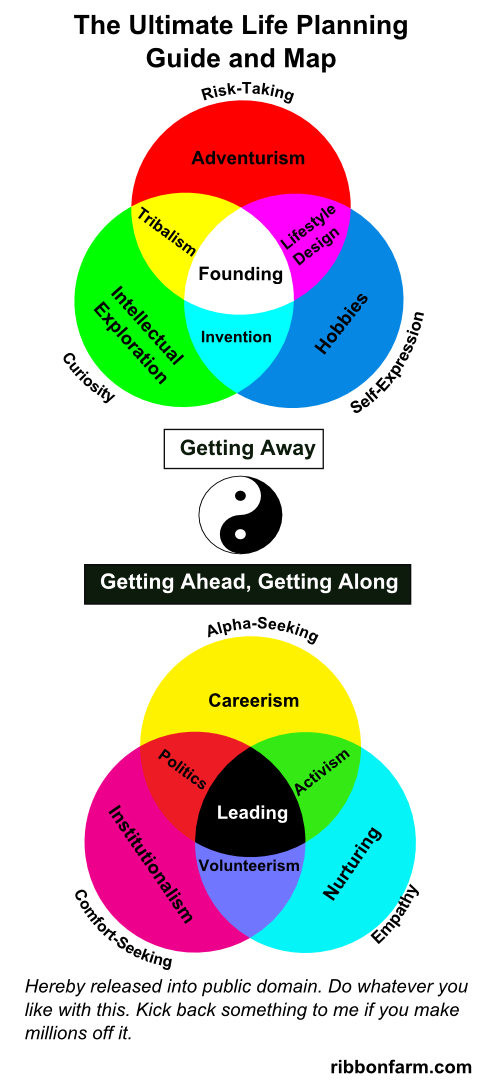 You need some basic Venn diagram and yin-yang diagram literacy to read this. The colors have less symbolism, so you can get away without knowing color science 101. For more notes, read on.
Symbolizing and Bad-Ass
For a canvas, I started with work/life as an overall yin-yang (I've done this before, but less cleverly), and then used additive (RGB) and subtractive (CMY) primaries to represent further decomposition of the white and black bits (I can never remember which is yin and which is yang) into useful pieces, in a pleasantly dualistic way.
The specific colors don't mean anything in particular. Not everything in life represents something. In life there are some arbitrary things you just have to live with. So the arbitrary color assignments in this diagram represents the arbitrariness of life (wait..., what?).
My partner in many design and analytics crimes Adam Hogan (we've gone p-value fishing together), likes to say that design always has two parts: a symbolizing part that does some work representing something, and a bad-ass part that hangs around doing no useful work, and trying to look cool.
Something to that.
In this case, the specific arbitrary assignments of RGB/CMY are the bad-ass part. They represent nothing. They're just there, because.
The Semantics
In terms of semantics, it struck me that each of the three drives could be broken down into more basic drives that combine in interesting ways depending on how strong they are. How you break them down is a matter of taste to some extent, but I broke them down as follows.
You need some basic Venn diagram and yin-yang diagram literacy to read this. The colors have less symbolism, so you can get away without knowing color science 101. For more notes, read on.
Symbolizing and Bad-Ass
For a canvas, I started with work/life as an overall yin-yang (I've done this before, but less cleverly), and then used additive (RGB) and subtractive (CMY) primaries to represent further decomposition of the white and black bits (I can never remember which is yin and which is yang) into useful pieces, in a pleasantly dualistic way.
The specific colors don't mean anything in particular. Not everything in life represents something. In life there are some arbitrary things you just have to live with. So the arbitrary color assignments in this diagram represents the arbitrariness of life (wait..., what?).
My partner in many design and analytics crimes Adam Hogan (we've gone p-value fishing together), likes to say that design always has two parts: a symbolizing part that does some work representing something, and a bad-ass part that hangs around doing no useful work, and trying to look cool.
Something to that.
In this case, the specific arbitrary assignments of RGB/CMY are the bad-ass part. They represent nothing. They're just there, because.
The Semantics
In terms of semantics, it struck me that each of the three drives could be broken down into more basic drives that combine in interesting ways depending on how strong they are. How you break them down is a matter of taste to some extent, but I broke them down as follows.
You need some basic Venn diagram and yin-yang diagram literacy to read this. The colors have less symbolism, so you can get away without knowing color science 101. For more notes, read on.
Symbolizing and Bad-Ass
For a canvas, I started with work/life as an overall yin-yang (I've done this before, but less cleverly), and then used additive (RGB) and subtractive (CMY) primaries to represent further decomposition of the white and black bits (I can never remember which is yin and which is yang) into useful pieces, in a pleasantly dualistic way.
The specific colors don't mean anything in particular. Not everything in life represents something. In life there are some arbitrary things you just have to live with. So the arbitrary color assignments in this diagram represents the arbitrariness of life (wait..., what?).
My partner in many design and analytics crimes Adam Hogan (we've gone p-value fishing together), likes to say that design always has two parts: a symbolizing part that does some work representing something, and a bad-ass part that hangs around doing no useful work, and trying to look cool.
Something to that.
In this case, the specific arbitrary assignments of RGB/CMY are the bad-ass part. They represent nothing. They're just there, because.
The Semantics
In terms of semantics, it struck me that each of the three drives could be broken down into more basic drives that combine in interesting ways depending on how strong they are. How you break them down is a matter of taste to some extent, but I broke them down as follows.
- Getting away breaks down into 3 drives: curiosity, risk-taking and self-expression.
- Getting along breaks down into 2 drives: empathy and comfort seeking.
- Getting ahead stays atomic as seeking alpha
8 Comments
Myers-Briggs: INTJ
StrengthsFinder 2.0:
1 Ideation
2 Intellection
3 Deliberative
4 Maximizer
5 Relator
RibbonFarm "True Belief" archetype: Hacker/Outside Contractor
I'm checking in here under "Invention" and "Lifestyle Design", with some attempts at "Founding" but never "winning!!!" ;) through to "Getting Ahead, Getting Along"/"Leader".
Everything in "Getting Ahead, Getting Along" is unappealing to me as an introvert, since they're the definition of extroverted. (I laughed at "Getting Ahead, Getting Along" and "Getting Away". Such an apt slogans.) But when I do find myself in that foreign territory and "Getting Away" hasn't worked (e.g., I'm stuck in a "social situation") I aspire to "Empathy", fail at that, then do as much "Leading" as my introvert batteries can take (I'm forcing it). Then I retreat back through the wormhole into silently observing and noting (most often environmental) elements as pulp for my "Lifestyle Design". Worst-case: I shut down/numb out, but that happens less because I know anything "social" dissipates my energy like a heating element.
Now that I write this it occurs to me that the chronological progression was roughly: "Invention", attempts at "Founding", then "Lifestyle Design". And, looking back, I only ever tried "Founding" as a means to support "Lifestyle Design", perhaps as a means to support "Invention".
Curious if you have any embellishments or finer points, Venkat?
陰陽 is the rendering of yin-yang. First character is shade/negative/black, and the second light/positive/white. So you can remember based on the common English phrasing of "Black and white" for the order.
I don't know if it's useful to point this out. Or if it's commonly known already. But I remember learning from my Chinese history professor in college that the yin-yang symbol represents motion. The dots of opposing color are in each larger segment. This is showing how the two are always becoming the other, until they switch places. And it cycles this way forever.
You should give Emergenetics a look: emergenetics.com
It is basically the Myers-Briggs test, but it uses statists to check the types against reality and has a different results -
The four innate personality groups are:
Conceptual, Social, Structural, and Analytical. You can be 0 to 100 on any of these.
The 3 principles are:
Assertiveness, Flexibility, and Expressiveness - these can be 0 to 100 as well.
I think these three map pretty well to getting ahead, getting away, and getting along. These groups may fit your pattern better, considering you can be a composition of any of these.
Curiosity + Adventurism = Tribalism?
To my eyes that looks totally broken, but I'm sure there are some nice intuitions anchoring it for you and stopping it itching!
It is the lack of self-expression as a strong motive that distinguishes the tribal mindset from the creative ones. Think startup employee #5 or the 100th person to climb Everest rock climbing was an example of a tribe in Godin's book). Attraction to a relatively informally structured social environment that has been mapped roughly, but with lots of room for risky novelty for those who want that, but aren't driven by inner impulses to create novelty.
Interesting, that almost makes "tribalism" equivalent to "student"; someone who wishes to explore, but in the absence of any requirement to be unique, is happy to explore where others have already trod, and build off them if possible.
In fact, this reminds me of the armies of students that various experimental low tech/alt tech/permaculture communities thrive off of, doing a bit of labour here and there to pick up from the existing best practices.
There are quite a few great points here, and overall the diagram can be a very useful "snapshot" thinking tool. The one area where I see minor room for improvement is the "Tribalism" part (and you already point out the slight dissonance yourself). Of course it all depends on your definition and understanding of 'tribalism', but I for one would say that the entire bottom half is the tribalist half, while the top is the individualist half.
This solves not only your "Getting Ahead/Getting Along" dichotomy, because in a tribe the entire process is one of position ("getting ahead" of the *others*) AND cooperation, but it also aligns rather neatly with Grave's Values Levels that you may have heard of before, which alternate from (odd numbered) levels of: "Express Self Now" to the (even numbered) levels of "Sacrifice Self Now - for the tribe".
It is true as you point out that at the Alpha end the Yin/Yang dynamic almost turns into its opposite, i.e. the alpha leader turns nearly into an individualist again (Graves sees this as Values Level 3s - "the Outlaw/Rambo" type ending up in control of the VL 2s tribals; compare the process for the Mafia or similar organizations), while there can also be a strongly individualist pursuit landing you in a "tribal" situation once again: You don't start out with confederates in mind, but you find each other at the destination?!
So maybe the "Tribalism" you had in mind could be replaced with "(Nomad) BAND"? Because such a band eschews most if not all of the mechanisms of tribes, not asking the individual to subsume themselves into a tribal process, submit, etc. Which is not to say that this could not also happen at this end of the spectrum, probably especially once the number goes beyond a small handful (7 +-2 (?), but certainly far less than Dunbar Number).