
How the World Works: Part II
Last time, I did a quick comparative scan of Francis Fukuyama’s The Origins of Political Order, Pankaj Ghemawat’s World 3.0 and David Graeber’s Debt: the first 5000 years, and covered Fukuyama's book in more detail.
Let's tackle World 3.0 next.
Ghemawat's book is a tour de force of quantitative synthesis. Let's start with an annotated version of the 2x2 that anchors World 3.0 (cleverly rotated by 45 degrees; I don't know why other 2x2 inventors don't do this). 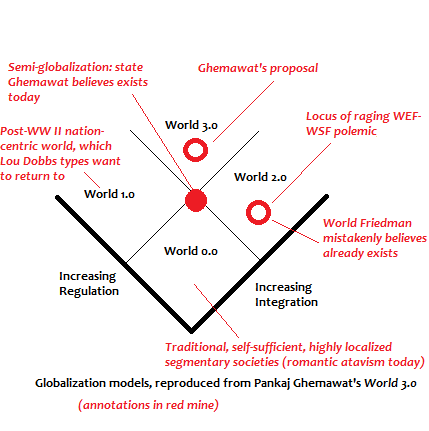 This 2x2 is almost the only major piece of conceptual scaffolding in a book that is otherwise an empiricist's delight. Everything is argued with numbers, and what cannot be argued with numbers is mostly not argued at all. It makes for a book with a lot of narrative potholes wherever the data gods to not smile, but where there is data, the book is extremely solid. It's a refreshing change for me to read something that stays away from data-free speculation.
For conceptual/narrative types like me, this relentless assault with numbers can be hard to process, but it is worth the effort. I found myself taking notes of key interesting statistics. I compiled some highlights, if you want a data cheat-sheet.
The book is devoted to unpacking this 2x2 in gory, quantitative detail. The main point of the diagram is to separate the global economic integration conversation from the global regulation conversation.
This 2x2 is almost the only major piece of conceptual scaffolding in a book that is otherwise an empiricist's delight. Everything is argued with numbers, and what cannot be argued with numbers is mostly not argued at all. It makes for a book with a lot of narrative potholes wherever the data gods to not smile, but where there is data, the book is extremely solid. It's a refreshing change for me to read something that stays away from data-free speculation.
For conceptual/narrative types like me, this relentless assault with numbers can be hard to process, but it is worth the effort. I found myself taking notes of key interesting statistics. I compiled some highlights, if you want a data cheat-sheet.
The book is devoted to unpacking this 2x2 in gory, quantitative detail. The main point of the diagram is to separate the global economic integration conversation from the global regulation conversation.
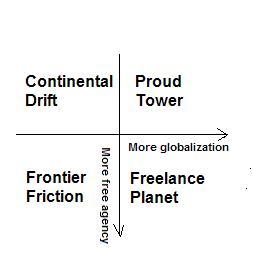 Though the global labor markets are a major theme in Ghemawat's model, he doesn't call out the free agency phenomenon per se. Instead, he argues for greater international labor mobility, and presents the quantitative case for the anti Lou-Dobbs argument: that it actually costs far more taxpayer money to "save" a job domestically than to allow freer migration and pursue comparative advantage models.
His slogan, which the free agency camp will like, is protect work, not jobs.
But on to the main part of the book.
The 3.0 Challenge
Both Ghemawat and Fukuyama belong to a breed of thinkers about world affairs whom you could characterize as being neither pro or anti-globalization. You could call them, instead, irreversabilists. They are historicists who believe that the process of globalization -- gradual global political and economic integration -- is irreversible. In the sense that reversal would be very painful, not conceptually impossible. A tiger-by-the-tail effect. Letting go could turn you into lunch.
For Ghemawat, the irreversibility is simply a matter of the sheer scale and momentum of the processes underway. As he notes, by 2050 the world will have doubled in population, and will be attempting (based on the rise of the middle class in the developing world) to create a five-fold increase in average per-capita income.
I hadn't really thought of the effects of simultaneous population increase (from 6 to 9 billion) and attempts to raise the standard of living (moving a large segment of the global population to the middle class).
To avoid structural collapse along the way, Ghemawat argues, we have no choice but to try and make globalization work. Reversal of globalization processes would be extraordinarily painful for large portions of the world's population.
I agree with Ghemawat's point that we don't have much choice. I am much less optimistic that it is actually possible. A five-fold increase in global output means something like a steady 4.2% global growth rate for the next 38 years (and that's without adjusting for inflation).
What's more, much of the population increase will actually happen in the next 15-20 years (i.e., population growth will be front-loaded). If economic growth is not front-loaded as well, we will be left with several decades where growth fails to match the demand.
This means that hundreds of millions of people who appear poised to enter the middle class around the world will either fail, or endure a couple of decades of pretty terrible times. It would be a modified global version of what happened in parts of Africa following the AIDS epidemic: a phenomenon called demographic fatigue, where growth cannot be sustained and ends up being reversed. In the African case, the death of many working-age males caused economies to collapse, which in turn destroyed standards of living and triggered population declines.
We just crossed 7 billion this year. We'll hit 8 billion by 2025, and 8.5 billion by 2035. The last half billion on the way to 9 billion will take 15 years (at which point the world population is expected to stabilize and start decreasing). We happen to be in the midst of a global downturn now, with no real recovery on the horizon until at least 2015 0r 2016. All in all, the next 20 years or so look extremely gloomy to me.
Broadly speaking, the book is about whether we can meet this challenge. It starts with a round of debunking of dangerous globalization myths.
Globaloney Slaying
The book starts of with an unsparing take-down of what Ghemawat calls "globaloney" -- data-free posturing and rhetoric that he sees as characterizing both the pro- and anti-globalization political camps. The early part of the book is devoted to such debunking.
While he spends a fair amount of time debunking claims from the far left, he reserves his most strident criticism for Thomas Friedman. You may want to read (or re-read) Friedman's The World is Flat just to get reoriented around globalization as the dangerously uninformed understand and frame it.
For the left, he takes a quick look at their pet ideas: highly local, self-sufficient economies built around organic farming, green practices and so forth, and quickly demonstrates that when you attempt to translate those ideas to a 9-billion-person planet, you basically fail. Those models are at best survivalist models for an elite.
The anti-Friedman narrative in the book is the most entertaining part. Ghemawat recounts several anecdotes where his own dry and pragmatic data-driven advocacy of globalization ran into Friedmanology. As part of his work, he encountered several business and political leaders (Colin Powell among them) who were operating with The World is Flat as their guide, and leaning towards dangerously flawed decision-making as a result. I can imagine his frustration at being told to "go read Friedman" to educate himself about globalization.
Rather cleverly, he turns the sales figures for The World is Flat as yet another piece of data to shed light on globalization itself.
The heart of the criticism of Friedman-style thinking lies in two points. First, globalization has simply not progressed as far as Friedman and his fans think it has. Second, if it were to progress in the manner Friedman hopes it will, we'll get to a very dangerous sort of world.
The first claim is based on an interesting model of actual and potential levels of globalization in the world.
Distance Sensitivity, Economic Integration and ADDING Value
The framework for analysis of globalization data that Ghemawat presents is based on a notion of distance sensitivity of international relationships of all sorts (ranging from email communication patters to trade). The distance measure he uses combines geographic, cultural, administrative (similar governance forms) and linguistic ideas of distance. Using these, he shows that all economic interaction is strongly sensitive to distance.
His most compelling piece of evidence is probably his analysis of US-Canada trade, the closest bilateral relationship in the world. He shows that even in this best-case scenario, compared to an ideal situation where distance and borders (in his abstract sense) didn't matter, the US-Canada bilateral trade, the biggest in the world, is missing several trillion dollars.
From there, he broadens the scope of his argument and shows how most kinds of interaction are nowhere near their actual potential if distance and borders really didn't matter. He goes into measure after measure and demonstrates the distance effects that exist. A table he compiles at the end of this exhaustive survey provides a great freeze-frame picture of globalization. These numbers represent how far globalization has progressed, with respect to a "full economic integration" end state represented by 100%. The details of the analytical model are more than I can get into, but they are worth making an effort to understand. Here's a summary of internationalization measures, approximately captured by a chart on page 30:
Though the global labor markets are a major theme in Ghemawat's model, he doesn't call out the free agency phenomenon per se. Instead, he argues for greater international labor mobility, and presents the quantitative case for the anti Lou-Dobbs argument: that it actually costs far more taxpayer money to "save" a job domestically than to allow freer migration and pursue comparative advantage models.
His slogan, which the free agency camp will like, is protect work, not jobs.
But on to the main part of the book.
The 3.0 Challenge
Both Ghemawat and Fukuyama belong to a breed of thinkers about world affairs whom you could characterize as being neither pro or anti-globalization. You could call them, instead, irreversabilists. They are historicists who believe that the process of globalization -- gradual global political and economic integration -- is irreversible. In the sense that reversal would be very painful, not conceptually impossible. A tiger-by-the-tail effect. Letting go could turn you into lunch.
For Ghemawat, the irreversibility is simply a matter of the sheer scale and momentum of the processes underway. As he notes, by 2050 the world will have doubled in population, and will be attempting (based on the rise of the middle class in the developing world) to create a five-fold increase in average per-capita income.
I hadn't really thought of the effects of simultaneous population increase (from 6 to 9 billion) and attempts to raise the standard of living (moving a large segment of the global population to the middle class).
To avoid structural collapse along the way, Ghemawat argues, we have no choice but to try and make globalization work. Reversal of globalization processes would be extraordinarily painful for large portions of the world's population.
I agree with Ghemawat's point that we don't have much choice. I am much less optimistic that it is actually possible. A five-fold increase in global output means something like a steady 4.2% global growth rate for the next 38 years (and that's without adjusting for inflation).
What's more, much of the population increase will actually happen in the next 15-20 years (i.e., population growth will be front-loaded). If economic growth is not front-loaded as well, we will be left with several decades where growth fails to match the demand.
This means that hundreds of millions of people who appear poised to enter the middle class around the world will either fail, or endure a couple of decades of pretty terrible times. It would be a modified global version of what happened in parts of Africa following the AIDS epidemic: a phenomenon called demographic fatigue, where growth cannot be sustained and ends up being reversed. In the African case, the death of many working-age males caused economies to collapse, which in turn destroyed standards of living and triggered population declines.
We just crossed 7 billion this year. We'll hit 8 billion by 2025, and 8.5 billion by 2035. The last half billion on the way to 9 billion will take 15 years (at which point the world population is expected to stabilize and start decreasing). We happen to be in the midst of a global downturn now, with no real recovery on the horizon until at least 2015 0r 2016. All in all, the next 20 years or so look extremely gloomy to me.
Broadly speaking, the book is about whether we can meet this challenge. It starts with a round of debunking of dangerous globalization myths.
Globaloney Slaying
The book starts of with an unsparing take-down of what Ghemawat calls "globaloney" -- data-free posturing and rhetoric that he sees as characterizing both the pro- and anti-globalization political camps. The early part of the book is devoted to such debunking.
While he spends a fair amount of time debunking claims from the far left, he reserves his most strident criticism for Thomas Friedman. You may want to read (or re-read) Friedman's The World is Flat just to get reoriented around globalization as the dangerously uninformed understand and frame it.
For the left, he takes a quick look at their pet ideas: highly local, self-sufficient economies built around organic farming, green practices and so forth, and quickly demonstrates that when you attempt to translate those ideas to a 9-billion-person planet, you basically fail. Those models are at best survivalist models for an elite.
The anti-Friedman narrative in the book is the most entertaining part. Ghemawat recounts several anecdotes where his own dry and pragmatic data-driven advocacy of globalization ran into Friedmanology. As part of his work, he encountered several business and political leaders (Colin Powell among them) who were operating with The World is Flat as their guide, and leaning towards dangerously flawed decision-making as a result. I can imagine his frustration at being told to "go read Friedman" to educate himself about globalization.
Rather cleverly, he turns the sales figures for The World is Flat as yet another piece of data to shed light on globalization itself.
The heart of the criticism of Friedman-style thinking lies in two points. First, globalization has simply not progressed as far as Friedman and his fans think it has. Second, if it were to progress in the manner Friedman hopes it will, we'll get to a very dangerous sort of world.
The first claim is based on an interesting model of actual and potential levels of globalization in the world.
Distance Sensitivity, Economic Integration and ADDING Value
The framework for analysis of globalization data that Ghemawat presents is based on a notion of distance sensitivity of international relationships of all sorts (ranging from email communication patters to trade). The distance measure he uses combines geographic, cultural, administrative (similar governance forms) and linguistic ideas of distance. Using these, he shows that all economic interaction is strongly sensitive to distance.
His most compelling piece of evidence is probably his analysis of US-Canada trade, the closest bilateral relationship in the world. He shows that even in this best-case scenario, compared to an ideal situation where distance and borders (in his abstract sense) didn't matter, the US-Canada bilateral trade, the biggest in the world, is missing several trillion dollars.
From there, he broadens the scope of his argument and shows how most kinds of interaction are nowhere near their actual potential if distance and borders really didn't matter. He goes into measure after measure and demonstrates the distance effects that exist. A table he compiles at the end of this exhaustive survey provides a great freeze-frame picture of globalization. These numbers represent how far globalization has progressed, with respect to a "full economic integration" end state represented by 100%. The details of the analytical model are more than I can get into, but they are worth making an effort to understand. Here's a summary of internationalization measures, approximately captured by a chart on page 30:
 A Brief Note on Graeber's Debt
Thanks to a skirmish in the comments of Part I, that I'd rather not continue, with a commenter who appears to be Graeber himself, I've decided not to review Debt after all. It's a good book, but not worth that much trouble for me.
While I do have opinions on many of the questions raised in the book, a review is not the place to present them. I'll save them for exploration within my own preferred frames of reference. I still think it is well-worth a read. There's plenty of value there, and I'll be citing some of the book's ideas selectively in future posts.
I recommend you read Julio Rodriguez' review and Daniel Lemire's shorter review. There are also plenty of other good reviews around.
A Brief Note on Graeber's Debt
Thanks to a skirmish in the comments of Part I, that I'd rather not continue, with a commenter who appears to be Graeber himself, I've decided not to review Debt after all. It's a good book, but not worth that much trouble for me.
While I do have opinions on many of the questions raised in the book, a review is not the place to present them. I'll save them for exploration within my own preferred frames of reference. I still think it is well-worth a read. There's plenty of value there, and I'll be citing some of the book's ideas selectively in future posts.
I recommend you read Julio Rodriguez' review and Daniel Lemire's shorter review. There are also plenty of other good reviews around.
This 2x2 is almost the only major piece of conceptual scaffolding in a book that is otherwise an empiricist's delight. Everything is argued with numbers, and what cannot be argued with numbers is mostly not argued at all. It makes for a book with a lot of narrative potholes wherever the data gods to not smile, but where there is data, the book is extremely solid. It's a refreshing change for me to read something that stays away from data-free speculation.
For conceptual/narrative types like me, this relentless assault with numbers can be hard to process, but it is worth the effort. I found myself taking notes of key interesting statistics. I compiled some highlights, if you want a data cheat-sheet.
The book is devoted to unpacking this 2x2 in gory, quantitative detail. The main point of the diagram is to separate the global economic integration conversation from the global regulation conversation.
- Low economic integration and low regulation gives you traditional, pre-nation-state societies, which some atavists believe they can and should return to. Ghemawat calls this World 0.0. It accounted for most of the world until about 1650.
- Low economic integration and high regulation gives you a world economic order where nation-states are the dominant unit. This is the world as it was between about 1650 and 1910, and the world people like Lou Dobbs want to return to.
- High economic integration and low regulation gives you the world Thomas Friedman thinks exists, but does not (as Ghemawat shows). It is something of a Darwinian state of nature, red in tooth-and-claw, where regulation, tied to strong nations and weak international bodies, cannot do much.
- Finally, high integration and high regulation gives you World 3.0, the one Ghemawat believes we should work towards. In fact, he believes we have no choice but to work towards it.
Though the global labor markets are a major theme in Ghemawat's model, he doesn't call out the free agency phenomenon per se. Instead, he argues for greater international labor mobility, and presents the quantitative case for the anti Lou-Dobbs argument: that it actually costs far more taxpayer money to "save" a job domestically than to allow freer migration and pursue comparative advantage models.
His slogan, which the free agency camp will like, is protect work, not jobs.
But on to the main part of the book.
The 3.0 Challenge
Both Ghemawat and Fukuyama belong to a breed of thinkers about world affairs whom you could characterize as being neither pro or anti-globalization. You could call them, instead, irreversabilists. They are historicists who believe that the process of globalization -- gradual global political and economic integration -- is irreversible. In the sense that reversal would be very painful, not conceptually impossible. A tiger-by-the-tail effect. Letting go could turn you into lunch.
For Ghemawat, the irreversibility is simply a matter of the sheer scale and momentum of the processes underway. As he notes, by 2050 the world will have doubled in population, and will be attempting (based on the rise of the middle class in the developing world) to create a five-fold increase in average per-capita income.
I hadn't really thought of the effects of simultaneous population increase (from 6 to 9 billion) and attempts to raise the standard of living (moving a large segment of the global population to the middle class).
To avoid structural collapse along the way, Ghemawat argues, we have no choice but to try and make globalization work. Reversal of globalization processes would be extraordinarily painful for large portions of the world's population.
I agree with Ghemawat's point that we don't have much choice. I am much less optimistic that it is actually possible. A five-fold increase in global output means something like a steady 4.2% global growth rate for the next 38 years (and that's without adjusting for inflation).
What's more, much of the population increase will actually happen in the next 15-20 years (i.e., population growth will be front-loaded). If economic growth is not front-loaded as well, we will be left with several decades where growth fails to match the demand.
This means that hundreds of millions of people who appear poised to enter the middle class around the world will either fail, or endure a couple of decades of pretty terrible times. It would be a modified global version of what happened in parts of Africa following the AIDS epidemic: a phenomenon called demographic fatigue, where growth cannot be sustained and ends up being reversed. In the African case, the death of many working-age males caused economies to collapse, which in turn destroyed standards of living and triggered population declines.
We just crossed 7 billion this year. We'll hit 8 billion by 2025, and 8.5 billion by 2035. The last half billion on the way to 9 billion will take 15 years (at which point the world population is expected to stabilize and start decreasing). We happen to be in the midst of a global downturn now, with no real recovery on the horizon until at least 2015 0r 2016. All in all, the next 20 years or so look extremely gloomy to me.
Broadly speaking, the book is about whether we can meet this challenge. It starts with a round of debunking of dangerous globalization myths.
Globaloney Slaying
The book starts of with an unsparing take-down of what Ghemawat calls "globaloney" -- data-free posturing and rhetoric that he sees as characterizing both the pro- and anti-globalization political camps. The early part of the book is devoted to such debunking.
While he spends a fair amount of time debunking claims from the far left, he reserves his most strident criticism for Thomas Friedman. You may want to read (or re-read) Friedman's The World is Flat just to get reoriented around globalization as the dangerously uninformed understand and frame it.
For the left, he takes a quick look at their pet ideas: highly local, self-sufficient economies built around organic farming, green practices and so forth, and quickly demonstrates that when you attempt to translate those ideas to a 9-billion-person planet, you basically fail. Those models are at best survivalist models for an elite.
The anti-Friedman narrative in the book is the most entertaining part. Ghemawat recounts several anecdotes where his own dry and pragmatic data-driven advocacy of globalization ran into Friedmanology. As part of his work, he encountered several business and political leaders (Colin Powell among them) who were operating with The World is Flat as their guide, and leaning towards dangerously flawed decision-making as a result. I can imagine his frustration at being told to "go read Friedman" to educate himself about globalization.
Rather cleverly, he turns the sales figures for The World is Flat as yet another piece of data to shed light on globalization itself.
The heart of the criticism of Friedman-style thinking lies in two points. First, globalization has simply not progressed as far as Friedman and his fans think it has. Second, if it were to progress in the manner Friedman hopes it will, we'll get to a very dangerous sort of world.
The first claim is based on an interesting model of actual and potential levels of globalization in the world.
Distance Sensitivity, Economic Integration and ADDING Value
The framework for analysis of globalization data that Ghemawat presents is based on a notion of distance sensitivity of international relationships of all sorts (ranging from email communication patters to trade). The distance measure he uses combines geographic, cultural, administrative (similar governance forms) and linguistic ideas of distance. Using these, he shows that all economic interaction is strongly sensitive to distance.
His most compelling piece of evidence is probably his analysis of US-Canada trade, the closest bilateral relationship in the world. He shows that even in this best-case scenario, compared to an ideal situation where distance and borders (in his abstract sense) didn't matter, the US-Canada bilateral trade, the biggest in the world, is missing several trillion dollars.
From there, he broadens the scope of his argument and shows how most kinds of interaction are nowhere near their actual potential if distance and borders really didn't matter. He goes into measure after measure and demonstrates the distance effects that exist. A table he compiles at the end of this exhaustive survey provides a great freeze-frame picture of globalization. These numbers represent how far globalization has progressed, with respect to a "full economic integration" end state represented by 100%. The details of the analytical model are more than I can get into, but they are worth making an effort to understand. Here's a summary of internationalization measures, approximately captured by a chart on page 30:
- Mail: 1%
- Telephone calls: 2%
- University students: 2.5% (?)
- Immigrants: 3%
- Charity: 5-10%
- Direct investment: 10%
- Patents: 15%
- Venture capital: 17%
- Internet traffic: 17%
- Exports: 20%
- Equity investment: 20%
- News media: 21%
- Bank deposits: 25%
- Government debt: 35%
- Adding volume, (raw growth)
- Decreasing costs (through best-sourcing)
- Differentiating (adapting to distance sensitivity effects via localization)
- Improving industry attractiveness or bargaining power
- Normalizing (or optimizing) risk
- Generating and deploying knowledge (and other resources and capabilities).
A Brief Note on Graeber's Debt
Thanks to a skirmish in the comments of Part I, that I'd rather not continue, with a commenter who appears to be Graeber himself, I've decided not to review Debt after all. It's a good book, but not worth that much trouble for me.
While I do have opinions on many of the questions raised in the book, a review is not the place to present them. I'll save them for exploration within my own preferred frames of reference. I still think it is well-worth a read. There's plenty of value there, and I'll be citing some of the book's ideas selectively in future posts.
I recommend you read Julio Rodriguez' review and Daniel Lemire's shorter review. There are also plenty of other good reviews around.
12 Comments
So I take it from your framing here that Ghemawhat refers to "regulation" in the common nation-state oriented sense of the word. However, you also mentioned "institutions of the right kind". What are these world 3.0 style institutions that he proposes?
A more productive framing would replace "regulation" with "coordination". I can understand why he would argue against Friedman's vision as Friedman promotes anything as is hyperfast or ultracompetitive. Obviously those sorts of trends lead us in a direction that is so chaotic as to be unsustainable. But coordination doesn't have to mean regulation. It simply means creating structures that facilitate some degree of stability and predictability.
Organized markets like stock exchanges or trading posts like app stores are forms of coordination. Industry standards are forms of coordination. Behavioral norms are forms of coordination.
Does he outline the domains that he proposes are in need of regulation?
He has some circuit-breaker type ideas for preventing things like the Asian financial crisis from spreading. Mostly on currency levels. I don't recall if he had deeper ideas for debt contagion.
And I think he does mean regulation more in the Keynesian sense. He's not a monetarist. He also proposes mechanisms to amplify stabilizing effects of globalization and has a long discussion of how better globalization could have prevented the rice crisis in Haiti, the effects of US sugar subsidies etc. So he's something of a pro-market interventionist at all levels from bilateral to the UN.
That's a pretty low standard for cultural diversity.
My overall impression from the review is that Ghemawat is a very linear thinker. The similarity between him and Fukuyama, who was reviewed before, is that they both view history as a linear evolution that progresses from a primitive to a sophisticated state in which it can only further advance on their trajectory ( or reach its end in a Hegelian fulfillment ) or decay otherwise.
I guess, measured by the sentiments of both I'm a postmodern relativist, who ultimately believes that grand narratives are a literary genre, one which is mostly associated with the heroic idealism of the 19th century or early 20th century pop historians like O.Spengler.
The most interesting aspect highlighted by the article were in fact the numbers attempting to quantify globalisation with respect to various connectivities. When you strip linear evolutionist ideology aside, what is the major argument then to go local or regional - when the global financial system can't be patched anyway, the "global citizen" turns out to be mostly fictitious, the "global players" of the last wave of economical and cultural imperialism fall prey to smaller web 2.0 style corporations and politics is asked for openness, liquid democracy and proper responsibility?
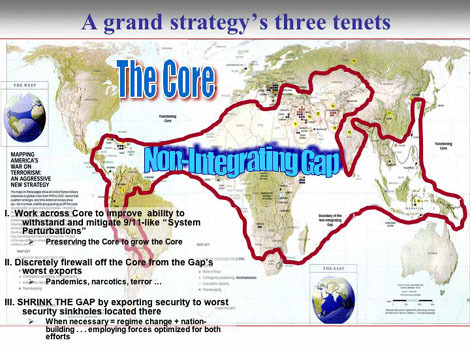
Btw the depicted Core/Gap duality seems to somehow suggest that it doesn't exist inside of either the Core or the Gap. It's a bit tiresome to see such models to be resurrected after decades of their happy deconstruction.
Both are historicists, which is a much more sophisticated position than naive linearity. Ghemawat's historicism is more limited and therefore more robust.
The argument on diversity isn't a standard for diversity. Merely a rebuttal of some simplistic arguments about homogenization which the data invalidate.
I don't know the details of the Core/Gap model outside of one Barnett video, but I am happy to use simple models to make/understand simple points. Of course all dichotomies are false. Some are useful if you use them with caution and taste.
I don't think postmodern relativists have demonstrated anything with their 'decades of happy deconstruction' to anyone's satisfaction besides their own. I find it to be too closed an intellectual tradition for my tastes, though I borrow its techniques on occasion.
Thanks for this. I am sorry/disappointed that you will not be reviewing Debt in more detail, the skirmish in the previous review Comments was unfortunate. I will read Fukuyama and Graeber, but probably not Ghemawat due to your comments about his focus on numbers which I think will bore me to tears.
Do you know Ha-Joon Chang? He's got a few interesting things to say on globalization vs. regulation.
A pity about the Debt review it was the one I was looking forward to the most.
I initially thought your characterization of Graeber as angry was a bit of a stretch but after his forceful reaction in the comments of the last piece I would have to say that you were spot on.
You do realize that you just fell for the oldest trick in the book. Call someone "angry" and if they react by contradicting you, cite their reaction as proof.
I guess the days when everyone on the Internet knew about the World’s Smallest Political Quiz really are gone…
@davidGraeber If they shout and thump their shoe on the table - yes. If they contradict calmly with counter arguments and intelligent presence - not so much.
BTW - I have no judgement about your anger. When I look at how most people treat each other and the natural world I get pretty angry too. That's the difference between you and I and Venkat - we are moral he is a pure strategist. In religious terms this could be viewed as the difference between an Ararat and a Bodhisattva.
Although I am quite behind in my RSS list and only getting to this post now, I truly feel you should go ahead with the Debt piece anyway, and had to offer a supportive comment. That is the one I was looking forward to the most as I likely won't be able to include any of the three in my reading list for some time.
I know this is a very public forum, but I hope you won't back down from writing exactly how you think and feel - that has lead to some of your best work in the past.