
The Evolution of the American Dream
Remember the pigs in George Orwell's Animal Farm and their sloganeering? In the beginning of the story, when they overthrow the humans, they lead with the chant, "four legs good, two legs bad!" By the end, they've become human-corrupt, and lead the chant, "four legs good, two legs better!"
Just one word changed, and the new and old words both begin with b, bolstering the illusion of continuity and natural evolution.
Let's call such a slowly shifting narrative, simple enough to be captured in a slogan, and designed to help a small predatory class dominate a larger prey class, a Pig Narrative. The American Dream is a Pig Narrative. For the record, in case you are immediately curious about my politics, I think this Pigs-and-Prey structure of the world is the natural order of things. You can mitigate its effects, but not change it in any fundamental way. If I had to pick, I'd side with the pigs. Moving on.
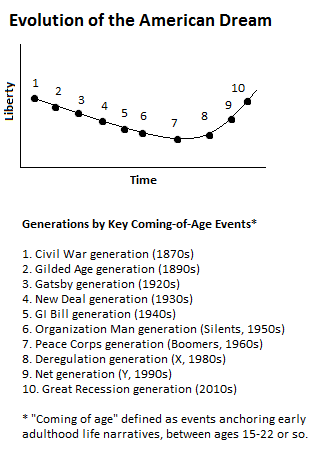 You can compare Pig Narratives on the basis of the degree of prey liberty (or conversely, predator control) they represent, allowing you to plot the evolution over time. If you plot the course of the American Dream through its many rewrites (9 so far by my count, each associated with a major coming-of-age event that defined a generation), you get something like the picture above.
The Rate of Change of Pig Narratives
For Pigs (I'll capitalize from now on, to distinguish my pigs from Orwellian pigs and real pigs) to remain secure, Pig Narratives must not be shifted too quickly, because they provide the functional logic of dominant institutions. So if a key piece of the narrative is go to college and get a good job, the narrative allows colleges to exist. If the Pigs change it to go to college to learn entrepreneurial skills, they get to keep existing institutions. But if some renegade Pigs want to stage a coup, and successfully rewrite it as drop out of college and found a startup, universities face an existential threat.
Ideally, changes should be so small that the prey barely notices.
Fortunately for the Pigs, Pig narratives are naturally hard to shift. We imprint on the dominant one during the crucial coming-of-age window of 15-21 say, just as baby ducks imprint on the first thing they see as "Mommy." And like Mommy Ducks, Pig Narratives are essentially sources of authoritative and trusted parental guidance.
Unfortunately for the Pigs, there is also a dynamic which forces rapid shifts despite their best efforts. This is the impact of the defining events for each generation, which provide the motivation and raw material for each rewrite, and therefore constrain the level of spin achievable. For the generations that came of age during the Great Depression or the 2000-01 boom-bust/9-11 period, the pig narrative had to shift rapidly, even with the most creative damage control on the part of the Pigs. Things get garbled during such times, leading to widespread anomie among those waiting and expecting to be programmed by a Pig. It's like being a duckling faced with no stable shape to imprint upon.
As another way to understand why pig narratives must change slowly, you can apply the Milo Criterion (products must mature no faster than the rate at which users can adapt) to the body politic as a whole. The pig narrative is a normative behavior at the scale of the average life, and it can change no faster than the rate at which generations displace each other from the population. The American Dream in this interpretation is merely the core user experience of "America" as a product sold by Pigs to prey.
The 9 American Dream Rewrites
The phrase American Dream was apparently coined by James Truslow Adams in 1931 and was defined by him as the idea that "life should be better and richer and fuller for everyone, with opportunity for each according to ability or achievement."
Except that that isn't the definition. That's merely the brand. Here are the actual premises of the 9 scripts between the 1870s to the 1990s, and the archetypical life stories they informed. I am playing fast and loose with generational and cohort analysis here to make a broad point, so please don't hold me to very precise sociological details.
Note that the dates are the coming-of-age windows for each generation (i.e. when they were between 15-21 and impressionable), not birth decade. Subtract 15-21 years to get the birth year range.
You can compare Pig Narratives on the basis of the degree of prey liberty (or conversely, predator control) they represent, allowing you to plot the evolution over time. If you plot the course of the American Dream through its many rewrites (9 so far by my count, each associated with a major coming-of-age event that defined a generation), you get something like the picture above.
The Rate of Change of Pig Narratives
For Pigs (I'll capitalize from now on, to distinguish my pigs from Orwellian pigs and real pigs) to remain secure, Pig Narratives must not be shifted too quickly, because they provide the functional logic of dominant institutions. So if a key piece of the narrative is go to college and get a good job, the narrative allows colleges to exist. If the Pigs change it to go to college to learn entrepreneurial skills, they get to keep existing institutions. But if some renegade Pigs want to stage a coup, and successfully rewrite it as drop out of college and found a startup, universities face an existential threat.
Ideally, changes should be so small that the prey barely notices.
Fortunately for the Pigs, Pig narratives are naturally hard to shift. We imprint on the dominant one during the crucial coming-of-age window of 15-21 say, just as baby ducks imprint on the first thing they see as "Mommy." And like Mommy Ducks, Pig Narratives are essentially sources of authoritative and trusted parental guidance.
Unfortunately for the Pigs, there is also a dynamic which forces rapid shifts despite their best efforts. This is the impact of the defining events for each generation, which provide the motivation and raw material for each rewrite, and therefore constrain the level of spin achievable. For the generations that came of age during the Great Depression or the 2000-01 boom-bust/9-11 period, the pig narrative had to shift rapidly, even with the most creative damage control on the part of the Pigs. Things get garbled during such times, leading to widespread anomie among those waiting and expecting to be programmed by a Pig. It's like being a duckling faced with no stable shape to imprint upon.
As another way to understand why pig narratives must change slowly, you can apply the Milo Criterion (products must mature no faster than the rate at which users can adapt) to the body politic as a whole. The pig narrative is a normative behavior at the scale of the average life, and it can change no faster than the rate at which generations displace each other from the population. The American Dream in this interpretation is merely the core user experience of "America" as a product sold by Pigs to prey.
The 9 American Dream Rewrites
The phrase American Dream was apparently coined by James Truslow Adams in 1931 and was defined by him as the idea that "life should be better and richer and fuller for everyone, with opportunity for each according to ability or achievement."
Except that that isn't the definition. That's merely the brand. Here are the actual premises of the 9 scripts between the 1870s to the 1990s, and the archetypical life stories they informed. I am playing fast and loose with generational and cohort analysis here to make a broad point, so please don't hold me to very precise sociological details.
Note that the dates are the coming-of-age windows for each generation (i.e. when they were between 15-21 and impressionable), not birth decade. Subtract 15-21 years to get the birth year range.
You can compare Pig Narratives on the basis of the degree of prey liberty (or conversely, predator control) they represent, allowing you to plot the evolution over time. If you plot the course of the American Dream through its many rewrites (9 so far by my count, each associated with a major coming-of-age event that defined a generation), you get something like the picture above.
The Rate of Change of Pig Narratives
For Pigs (I'll capitalize from now on, to distinguish my pigs from Orwellian pigs and real pigs) to remain secure, Pig Narratives must not be shifted too quickly, because they provide the functional logic of dominant institutions. So if a key piece of the narrative is go to college and get a good job, the narrative allows colleges to exist. If the Pigs change it to go to college to learn entrepreneurial skills, they get to keep existing institutions. But if some renegade Pigs want to stage a coup, and successfully rewrite it as drop out of college and found a startup, universities face an existential threat.
Ideally, changes should be so small that the prey barely notices.
Fortunately for the Pigs, Pig narratives are naturally hard to shift. We imprint on the dominant one during the crucial coming-of-age window of 15-21 say, just as baby ducks imprint on the first thing they see as "Mommy." And like Mommy Ducks, Pig Narratives are essentially sources of authoritative and trusted parental guidance.
Unfortunately for the Pigs, there is also a dynamic which forces rapid shifts despite their best efforts. This is the impact of the defining events for each generation, which provide the motivation and raw material for each rewrite, and therefore constrain the level of spin achievable. For the generations that came of age during the Great Depression or the 2000-01 boom-bust/9-11 period, the pig narrative had to shift rapidly, even with the most creative damage control on the part of the Pigs. Things get garbled during such times, leading to widespread anomie among those waiting and expecting to be programmed by a Pig. It's like being a duckling faced with no stable shape to imprint upon.
As another way to understand why pig narratives must change slowly, you can apply the Milo Criterion (products must mature no faster than the rate at which users can adapt) to the body politic as a whole. The pig narrative is a normative behavior at the scale of the average life, and it can change no faster than the rate at which generations displace each other from the population. The American Dream in this interpretation is merely the core user experience of "America" as a product sold by Pigs to prey.
The 9 American Dream Rewrites
The phrase American Dream was apparently coined by James Truslow Adams in 1931 and was defined by him as the idea that "life should be better and richer and fuller for everyone, with opportunity for each according to ability or achievement."
Except that that isn't the definition. That's merely the brand. Here are the actual premises of the 9 scripts between the 1870s to the 1990s, and the archetypical life stories they informed. I am playing fast and loose with generational and cohort analysis here to make a broad point, so please don't hold me to very precise sociological details.
Note that the dates are the coming-of-age windows for each generation (i.e. when they were between 15-21 and impressionable), not birth decade. Subtract 15-21 years to get the birth year range.
- Civil War generation (1870s): If I Go West as a Young Man, and work hard, I have as good a chance as anyone else of making it (gold miner, wildcatter)
- Gilded Age generation (1890s): If I work hard, I can make it (Horatio-Alger-inspired young people working for Robber Barons)
- Gatsby generation (1920s): Anybody can make it (Gatsby type easy money)
- New Deal generation (1930s): Together, we can make it* (worker building Hoover Dam)
- GI Bill generation (1940s): Any American can make it if he fights hard (WW II veteran, college-educated and starting high-responsibility job white collar job with young, growing American post-war companies)
- Organization Man generation (Silents, 1950s): I already have it; if I don't screw it up, I can keep it (employee of mature, wealthy post-war company)
- Peace Corps generation (Boomers, 1960s): Americans already have it; we should share it (progressive, generous child of Cold War prosperity)
- Deregulation generation (X, 1980s): We're losing it. If I keep my head down and step around the falling rubble smartly, I may escape (entering workforce among layoffs and uncertainty in manufacturing)
- Net generation (Y, late 1990s): We're losing it. I don't know what to do, I'll go Occupy Wall Street (this generation lived through a boom and a bust and 9/11 while coming of age, turning the pig narrative into garbage at the starting gate, leaving a harsh, anomic landscape)
- Next generation (coming of age right now ): If I Go East as a Young Person, and work hard, I have as good a chance as anyone else of making it (lifestyle entrepreneur in Asia or Eastern Europe -- this script will likely take shape with the 2016 election, when the generation is first courted by politicians).
- Risky vs. risk-free
- Effort-ful vs. effortless
- Individualist vs. collectivist
- Upturn vs. Downturn vs. Cusp
- Scarcity vs. Abundance vs. Surplus
- Mine to Make vs. Mine to Lose (Make/Lose) framing
- Civil-War: risky, effort-ful, individualist, upturn, scarcity, make
- Gilded: risk-free, effort-ful, individualist, upturn, abundance, make
- Gatsby: risk-free, effortless, individualist, upturn, surplus, make
- New Deal: risky, effort-ful, collectivist, downturn, scarcity, make
- GI Bill (WW II vets): risky, effort-ful, collectivist-individualist, upturn, abundance, make
- Organization Man (Silents): low-risk, medium effort, collectivist, upturn, abundance, lose
- Peace Corps (Boomers): low-risk, effortless, collectivist, upturn, surplus, lose
- Deregulation (X): risky, effort-ful, individualist, downturn, scarcity, lose
- Net (Y): risky, schizoid on effort, collectivist, cusp, schizoid on abundance/scarcity, schizoid on make/lose
- Next Generation: risky, effort, unclear, downturn, unclear, unclear
- If the script is positive, but there is a downturn overall across prey lives for that script, denial or disillusionment follows. Silents, who began retiring amidst the 80s turmoil, I suspect are largely disillusioned.
- If the script is positive and the prey get lucky, an unfounded sense of redemption follows. That gives you the boomers and early X'ers who made piles of money in the 90s and got away with it.
- If the script is negative and outcomes are negative, you get fatalism. I think that's where we X'ers are headed.
- If the script is negative and outcomes are positive, I don't know what happens. I suppose the New Deal generation (say somebody who was 20 in 1930 and 35 in 1945) sort of qualifies. They would have come of age amidst depression and looming war, rejoined the post-War boom economy as older veterans, and possibly mellowed out and became more positive.
13 Comments
I love the notion of trying to understand people through their dominant narratives. But I've always approached this spatially (across nations or cultures) rather than temporally (across ages). If history rhymes than this is an interesting way to look a little into the future.
Although I wonder if things might be different now, and the pattern (and essential optimism) you outlined for the Net Generation may take a sharp and unexpected turn. Here is what I mean...
What if the Pigs have anticipated the garbling of the dominant narrative and have thus begun putting the pieces in place maintain control and prevent too much liberty from spreading?
Mediation allows regulation. Regulation requires policing. As human interaction (in other words, culture) becomes increasingly mediated it becomes increasingly susceptible to regulation, and inevitably to policing. And so we see things like WIPO, ACTA, and SOPA slowly laying the foundation to legitimize exactly this type regulation under the guise of trade and property rights.
To what degree will this work I don't know (self-organizing networks have way of working around damage). But I do wonder how the pattern of natural tensions you've illustrated might change now that regulating and policing our cultural narratives is possible, legal, and increasingly normal.
I don't really see a conspiracy of Pigs here. Pig narratives come together bottom-up via a number of forces that are better at telling stories than listening to them.
I don't think it is regulation catching up that is cause for worry. It is exploitation of the FUD by a radicalizing narrative. This is one reason both the Tea Party and OSW bother me. When things get complex, the winning Pig narratives tend to get more simplistic, not less. This is because people who like to think a little get frozen by the complexity, so the simplistic outliers take over the storytelling.
I was't trying to suggest a conspiracy of pigs (a great band name btw). Rather the narratives that shape how we see the world are increasingly mediated, and that there is incredible pressure on numerous initiatives to regulate and police both the narratives and their mediation (I listed just a few well publicized examples above).
The broad cultural narratives you identified all come from a time when this sort of control simply wasn't feasible. But now it is. Technology has made it feasible. How do our future narratives change and how do they change us in a world where they are so easily and artificially manipulated by those is a position to do so? What happens when these narrative become more top-down, more prescriptive?
A quick thought on grand narratives (or, for that matter, on any narratives). Should we view them more as prescriptive (Pigs/sociopaths shaping the world) or as descriptive (pigs and prey acting individually to very personal, 'micro' incentives, the aggregate product of which we can then discern as the emergent 'macro' patterns)?
I think this is important to answer because it is critical to system stability and the smoothness of its evolution. If the observed narrative is more prescriptive, then the system is more designed and streamlined, and more limited in its potential avenues of development as a result. On the other hand, if narratives are more descriptive, then they are the product of a large number of more chaotic interactions, a small but rare shift in one of which can, Butterfly Effect style, result in a large shift in the 'macro' patterns.
From this perspective, I think the distinction between sociopaths in the workplace and Pigs in the broader economy comes from the former being more behaviour/thought difference driven, and the latter being more capability/capital difference driven. In the former, you enter in the same place as everyone and see where you end up; in the latter, everyone enters at quite different places and tries to make the best of it. This capability difference (where a small number of people control most of the social/economic/political/etc. capital, with the vast majority of people personally controlling next to none) has been a defining feature of most modern civilisations, and one that has always persevered (or quickly reestablished itself) across social upheavals. It's like competing in a sport in which the top players also win the privilege of being both player and umpire for their forthcoming matches...
I think it is a bit of both. It is indeed micro-narratives adding up, but Pigs also have a way of opportunistically jumping on any story that happens to work well for their purposes. The result is that a handful of micro-narratives get blown up to grand-narrative size. Think about how Gatsby somehow became the Great American Novel and central to high school curricula for instance. It is a good novel, but not THAT good in my opinion. But it was a USEFUL novel for many Pig forces.
The Tom Friedman "World is Flat" alarmist narrative is another one that appeared at the right place at the right time and had fuel poured on it.
"I’ll stop this post now. For those of you who have read Tempo[...]"
When is the Kindle edition of Tempo coming up? I'm waiting for it, since I'd rather have it in electronic form and avoid the shipping costs.
Submitted the Kindle manuscript to Amazon 2 days ago. Should get through their approval process and go live within the week. Will post here when it is available.
Spotted it from G+. I'll go ahead and start reading.
I fun thing, it was ordering Tempo that got me to place my first order at amazon (living in sweden). After having bought Tempo the confirmation page was pushing for the kindle, and they do a great up-sell at Amazon, so I bought a Kindle.
The Kindle arrived 2 days later, and Tempo 3 weeks after that. I never started reading Tempo since by then analog books were seen as a nuisance.
The book is available on the Kindle now.
I am mentally stuck on your liberty vs. time chart.
I don't see a turn-around. Full disclosure: I am a GenXer from middle America.
On the whole, Americans have continued to surrender pieces of our individual liberties for both percieved and real improvements in societal safety and peaceful coexistence. I don't see individual liberty on the rise, maybe I am assuming individual liberty for some other liberty you reference? (maybe I am just being too pragmatic and fatalistic because of my generation)
Last question, what happened to the Disco Generation, 1970's?
Hmm... yeah, I guess I am seeing fatalism as a certain kind of liberty. Acknowledging that you are trapped is the first step to not being trapped as much. Beyond us X'ers, the Y'ers who are not currently squatting on Wall Street do seem to approach life with a kind of chutzpah that I rarely see in our own generation.
The Disco generation is more a pop-cultural thing I suppose. Generational analysis types view it as a sub-group of X (early X, maturing in 70s vs. late X like me, maturing in 80s). Music and other surface cultural traits may have changed, but I think the downward swing of the economy and disillusionment with Boomer style 60s idealism had already begun in the 70s I think (Nixon, oil shock, Vietnam in America, similar events elsewhere in the world. In India, the 72 war, the harshness of the Indira Gandhi years and the Emergency years had already displaced the idealism of the Nehru years).
A little late to the conversation, hope it’s okay if I add my two cents (Gen Y, born in 79, not occupying). I think the liberty idea on the graph is tied closely with the concept of individuality/collective rather than with constitutional liberty (ala Bill of Right/Patriot act). As a Gen Y I have watched the rise and fall of the world view of my boomer parents. Their world view is very much rooted in the collective and the war between the two collectives: communism (big government) vs capitalism (big corporation). The bedtime stories of my childhood were based on the triumph of the corporate collective, with the fall of the Berlin wall and the internet & media boom of the 90s. Then I grew up, and much like finding the truth about Santa, watched the repeated debunking of the story through the internet bust, Enron, 9/11, Rise of the East, Housing Crash, Corporate Recovery/worker recession. Despite all this, I see opportunity everywhere, with no secure institutions (corporate, academic, government collective to join) there is nothing to lose, so I am free to make my own path through the wasteland and thus hold my destiny in my own hand. This is liberty. Many of my Gen X coworkers essentially have the attitude Venkat describes, “If I keep my head down and step around the falling rubble smartly, I may escape”, thinking if they stay put in the corporate structure that they’ll make it to retirement. Instead, I’ve watched them mercilessly (they have children in high school, mortgage payments, stressed savings/retirement accounts) get laid off time and time again. I have no illusions that I’ll be with a single corporation until I reach “retirement age”, and thus have moved freely within and between crumbling institutions when its best for me (not when a manager/HR person thinks it is) and see, not surprisingly, entrepreneurship as the “ultimate” path. That is the liberty I think Venkat as talking about. The patriot act, SOPA, DMCA…while they are limiting constitutional liberties…they have been put in place to prop up boomer institutions until the last of them makes it off the sinking ship. Gen Y for the most part ignores these rules because once those ships sink those protections make no sense and the rules will disappear. And these ships will sink, Gen Y doesn’t trust their seaworthiness enough to work to keep them afloat, and this is demonstrated by the lack of work place loyalty corporate boomers/Xers complain about. Unfortunately for many Gen Xers, particular the older ones, they are stuck on the ships and so risk averse most won’t do anything to save themselves.
I agree my generation is schizoid, as the other reaction to this devastation – the shattering of our childhood stories – is denial and depression. The Occupiers can’t accept the reality of all that has happened. They think this all unfair because despite the collapse, most of their boomer parents are financially well off and are providing them support. They think that perhaps the story got told slightly wrong, and that the government collective not the corporate should have won and if they push it back in that direction it will all be okay. Thus in the short term the Occupy movement will grow, but it will fade as people people realize both versions of the story are wrong, get over the denial, accept things as they are, and move on. There will always be a some who are stuck in denial, and they will be an every present voice and reminder for our lifetime.