
The Impossibility Triangle in Talent Management
I have taken to asking an unfair question in interviews in recent months: as a manager, how can you make sure you help people play to their strengths, while making sure the organization meets its goals on time? The question is unfair because I believe the right answer is you can't. I haven't yet gotten that answer from anybody. Most of the time, I get carefully noncommittal answers couched in terms of "there are always trade offs" or faux-pragmatic ones of the form, "well at some point people have to get on the same page and realize that a company is in business to make money." Both answers are misguided. By trade-off people usually mean deterministically balancing coupled motivations in the presence of some sort of scarcity; they do not usually factor in uncertainty. Talent management introduces competing uncertainties, which are more complex beasts. The second answer is faux-pragmatic because everybody already understands tautological statements about companies being in business to make money. The realization makes no difference at all in how the psychological calculus of strengths and motivations plays out. In other words, yelling business realities out from the rooftops won't help you attract talent or prevent you from hemorrhaging it.
So let's keep ourselves honest here, by beginning our search for a next-generation talent management theory, Theory W, by acknowledging the fundamental limits in play. I represent these in the Theory W Triangle (if you are curious, this is inspired by the well-known Pizza triangle and the less well-known Spreng triangle, which I discussed before).
[caption id="attachment_338" align="aligncenter" width="283" caption="The Theory W Triangle"]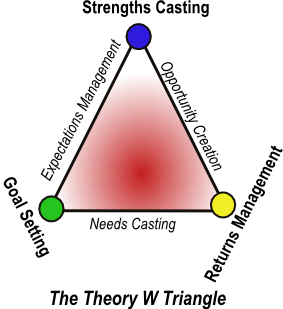 [/caption]
Let's dig in.
The Three Basic Uncertainties of Talent Management
The Theory W triangle captures 3 coupled uncertainties that relate rather like position and momentum do in the Heisenberg uncertainty principle. These three basic uncertainties constraining talent management are:
[/caption]
Let's dig in.
The Three Basic Uncertainties of Talent Management
The Theory W triangle captures 3 coupled uncertainties that relate rather like position and momentum do in the Heisenberg uncertainty principle. These three basic uncertainties constraining talent management are:
[/caption]
Let's dig in.
The Three Basic Uncertainties of Talent Management
The Theory W triangle captures 3 coupled uncertainties that relate rather like position and momentum do in the Heisenberg uncertainty principle. These three basic uncertainties constraining talent management are:
- What uncertainty: You may know nearly exactly what you will attempt to do, to deliver business value (goal-setting), or you may only have a broad set of ideas/directions (opportunity creation).
- Who uncertainty: You may know whether each individual will perform at nearly their maximum potential (strengths casting), or you may not (needs casting -- where you're never quite sure until you try whether you've shoved square pegs into round holes).
- When uncertainty: You may know exactly when you will realize the value of your investment in people (returns management) or you may not (expectations management).
- You insist on specific goals being achieved. You will be forced to do needs casting: putting people in roles dictated by the logic of the fixed goals, which will lead to unpredictable performance. You will also find it necessary to leave deadlines flexible, since needs-cast people deliver over unpredictable time horizons (aptitude is sometimes defined as the time it takes somebody to learn something. When individuals are not playing to strengths, this becomes a crapshoot).
- You insist on a strengths philosophy -- you will only give people assignments that play to their strengths. This will in general mean that you will need to give up fixed goals, and instead maintain a large opportunity set to allow all individuals to find strengths-oriented niches with high probability. So you won't know what you will actually deliver until people actually find their way. You also (again) lose control over time of value delivery, since that is related to what people choose to take on. You can only expect that a certain proportion of individuals might deliver.
- Finally, you can insist on timeliness of value delivery (returns management) -- you want delivery by a certain date, and you want a certain amount of value delivered (commensurate with headcount), in some not-wildly-inappropriate metric for comparing apples and oranges (patents, sales targets, number of software features or lines of code for example). In this case goals will slip in a qualitative sense, as will the match between people's strengths and roles, since the time-pressure will not allow people enough time to explore and find their ways to predictably-high-performance niches. If you loosen your grip on value delivered per unit time, you will switch to expectation management: your returns will become more variable per unit time, or there will be variability in deadlines.
- Movement: Make sure you keep moving your location within the triangle, matching your chosen uncertainty-trade off point to the situation. This will allow you to selectively drive down the uncertainty that is currently hurting you the most. If you see a lot of potential in somebody and that person is currently needs cast in an unhappy situation, do some tactical strengths casting. If your organization hasn't delivered in years, risk losing people by moving to need casting, so you deliver something. If you just got a big win, use the temporary reprieve to let deadline pressures go and meet goal-clarity and strengths-casting needs. This game is rather like the keep-multiple-plates spinning metaphor I used earlier in a different context.
- Bench dynamics: Even within a fixed point (at least within the interior of the triangle), you can keep uncertainty levels the same by swapping people in and out of 'active play' roles, while making sure the same proportion of goals stay fixed, at the same level of time uncertainty. This obviously means you are financially healthy enough to be carrying some slack in the first place. But if you are playing with zero bench strength, you are probably on the brink of bankruptcy. No fat is anorexia.
- Money: It goes without saying that the more financial freedom you have -- discretionary funds that aren't earmarked for anything -- the more you can break the constraints of the triangle. Google can create such a great work culture (and accept a high failure rate and lack of value delivery from a big proportion of its people) because it has a cash cow that produces money to burn.
- Hiring for the triangle: You can explicitly use hiring to move you to parts of the triangle that your current set of people cannot get you to, or even move boundaries up (which improves the average case performance). Here's how it works. To raise the 'average case' performance of all three of your boundaries, hire multi-talented people who can contribute in multiple ways in terms of direct content of work, and play multiple roles in terms of management (both lead and follow) and are comfortable with both deadline-oriented and exploratory environments. If this sounds like a panacea, it isn't. Most people who are multi-talented aren't deeply good at one thing, which means you'll lose your ability to go after goals beyond a certain level of technical complexity. There are, of course, those superstars who are world-class on multiple fronts (Michael Jordan on scoring and assists for instance), but those are so rare that you can't rely on being able to find and hire them.
Talent Management: dynamically managing the returns on human resource investments by exploiting the coupled uncertainties involved in who, what and when decisions.
We'll explore more as I can think of more things to say about this. In the meantime, anecdotes welcome, since as you can see, this series of articles has been heavy on concept and light on examples (partly because I can't share the examples I personally encountered, that inspired these theories, because they are too recent, and I can't think of ways to anonymize them. Presumably, those of you with more years spent managing people can find anecdotes that are distant enough to be safely shared!).
3 Comments
Nice post about the challenges of managing people. I definitely experience some of these issues here at PARC.
I think this model is _slightly_ flawed. I think that goal-setting and time-setting are two sides of the same coin. Really, the trade-off for talent management is a spectrum with only two variables:
* Strengths philosophy
* Product philosophy
This is the same dichotomy that exists in the current consulting environment. Do you focus on people management (Good to Great) or product positioning (strategic consulting over the last couple of decades.) I think you've covered this in more recent posts.
Now, I do think you're onto something in breaking product philosophy into goals and time. But think about that old adage: "Good, cheap, fast: pick 2." This implies that you can also put in a fourth variable: cost.
I'm sure we can also break talent management down into a variety of variables. The conclusion is that the first tier is bi-variate, and the second tier may be x-variate, depending on your perspective.
I wrote this more than 2 years ago (wow! time flies) and now I find I don't really understand the post myself. Which must mean there is a fundamental flaw as you suggest.
In my experience my more solid pieces age well, like good wine, gaining in clarity and depth with each re-reading. I see more depth and insight in them over time, and am struck by how the "younger me" managed to intuit things that I only now understand more explicitly.
This is not one of those pieces.
I'll have to think more about your refinement though, since I don't understand that either. Maybe I am just getting slowly dumber overall :)