
Towards a Philosophy of Destruction
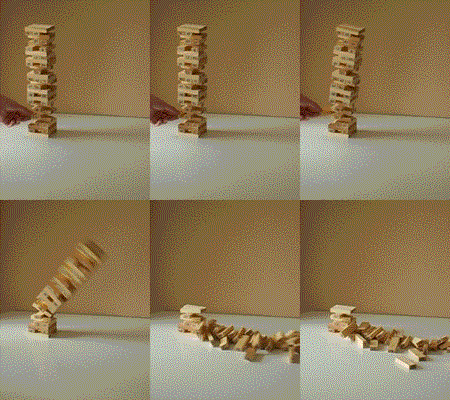 [/caption]
Destruction in Business and Innovation
It is relatively easy to separate out obviously evil destruction (Hitler, 9/11). It is also easy to separate out non-evil and non-painful destruction (demolition of unsafe, derelict buildings, controlled burns to contain the risk of forest fires...). Here are three gray-area examples:
[/caption]
Destruction in Business and Innovation
It is relatively easy to separate out obviously evil destruction (Hitler, 9/11). It is also easy to separate out non-evil and non-painful destruction (demolition of unsafe, derelict buildings, controlled burns to contain the risk of forest fires...). Here are three gray-area examples:
- Version 6.2 of your company's great software, everybody recognizes, represents an end-of-life technology (for example, a famous product beginning with V and ending in ista). Layers of band-aid bug-fixes and patches have destroyed the architectural integrity of the original product. You must make the painful decision of completely discarding it and starting with a clean-sheet design based on a more advanced architecture. Maybe some key employees, for whom the product represents their life work, and who still believe in it, quit in bitter disappointment, seething with a sense of betrayal.
- Widget Inc. has an old legacy product A, that is nearing the end of its design life. Most new investment is going towards a new product B, that requires a completely new set of business and technical competencies. There is buzz and excitement around B, while A is surrounded by an atmosphere of quiet despair . You gradually stop hiring A-relevant skills and increase hiring of B-relevant skills. A population of employees, too old or too set in its ways to learn new skills, is left providing legacy system support as the product slowly dies out of the economy. As CEO, you eventually offer a very attractive trade-in program to the few remaining customers, stop support, and lay off the few remaining employees who don't adapt.
- What do you think of all the great (including life-saving) technology that came out of both the Allied and Axis sides of World War II (radar, microwaves, rocketry, computing, jet engines, the Volkswagen Beetle)? Is it morally possible to appreciate these technologies without condoning Hitler?
 [/caption]
Remember how Lumberg gradually took away Milton's work and authority, degraded his office space, took him off the payroll, stole his stapler and consigned him to the basement? When Milton ultimately snaps, he burns down the office. He escapes to a tropical island paradise with a lot of loot, but his victory does not last -- waiters ignore his drink requests, causing him to mumble about further arson attempts.
In less dramatic forms, you can observe similar dynamics in any modern corporation. Look away from the bright glow of the new product/service lines and exciting areas with plenty of growth and cool technology. Look into the darkness that defines the halo around the new, and you'll see the slow undermining and ongoing multi-faceted destruction of the old. Resources are moved, project priorities are lowered, incentives are handed out to the participants in the growth. Things crumble, with occasional smaller and larger collapses. Watch closely, and you will feel the actual pain. You will participate in the tragedy.
If you happen to be part of new growth, recognize this. One day, a brighter light will put you in the shadows, and you will have to face the mortality of your own creations. One of my favorite Hindi songs gets at this ultimately tragic, Sisyphean nature of all human creation:
[/caption]
Remember how Lumberg gradually took away Milton's work and authority, degraded his office space, took him off the payroll, stole his stapler and consigned him to the basement? When Milton ultimately snaps, he burns down the office. He escapes to a tropical island paradise with a lot of loot, but his victory does not last -- waiters ignore his drink requests, causing him to mumble about further arson attempts.
In less dramatic forms, you can observe similar dynamics in any modern corporation. Look away from the bright glow of the new product/service lines and exciting areas with plenty of growth and cool technology. Look into the darkness that defines the halo around the new, and you'll see the slow undermining and ongoing multi-faceted destruction of the old. Resources are moved, project priorities are lowered, incentives are handed out to the participants in the growth. Things crumble, with occasional smaller and larger collapses. Watch closely, and you will feel the actual pain. You will participate in the tragedy.
If you happen to be part of new growth, recognize this. One day, a brighter light will put you in the shadows, and you will have to face the mortality of your own creations. One of my favorite Hindi songs gets at this ultimately tragic, Sisyphean nature of all human creation:
Main pal do pal ka shayar hun, pal do pal meri kahani hain pal do pal meri hasti hai, pal do pal meri jawaani hain
Mujhse pehle kitne shayar, aaye aur aa kar chale gaye kuch aahe bhar kar laut gaye, kuch naghme gaa kar chale gaye woh bhi ek pal ka kissa they, main bhi ek pal ka kissa hun kal tumse juda ho jaoonga, jo aaj tumhara hissa hun
Kal aur aayenge naghmo ki, khilti kaliyan chunne wale Mujhse behtar kehne waale, tumse behtar sunne wale
kal koi mujhko yaad kare, kyon koi mujhko yaad kare masroof zamaana mere liye, kyon waqt apna barbaad kare? Which roughly translates to the following (better translators, feel free to correct me):
I am but a poet of a moment or two, a moment or two is as long as my story lasts I exist but for a moment or two, for a moment or two does my youth last
Many a poet came before me, they came and then they faded away they took a few breaths and left, they sang a few songs and left they too were but anecdotes of the moment, I too am an anecdote of a moment tomorrow, I will be parted from you, though today I am a part of you
And tomorrow, there will come other pickers of blooming flower-songs Poets who speak more eloquently than I, listeners more sophisticated than you...
Were somebody to remember me tomorrow -- why would anybody remember me? this busy, preoccupied world, why should it waste its time on me? Life After People It seems likely that the universe at large is likely a place of destruction-by-entropy. Yet, on our little far-from-equilibrium home here on earth, the picture, at least for a few millenia, is one of renewal, emphasizing creation over destruction. The history channel recently aired a show about what would happen to our planet if all humans were to suddenly vanish. There is also a brilliant book devoted to this thought experiment, which I am currently reading:
Though the events in both the show and book are largely about how human-created reality would collapse, the overall story is an uplifting one of growth and renewal, as nature -- not as brittle and in-danger as we like to think -- gradually reclaims the human sphere.
4 Comments
Quick thoughts:
Creative destruction shows up at its best in evolution. Look at a tiger chasing a herd of deer and picking up the slowest straggler. By definition - mathematically, in fact - that act of destruction has improved the average speed of the herd and, over time, its genes. (The inverse is the tiger who is too slow to catch anything - by his death of starvation, the average tiger is improved)
And let's not forget the most spectacular own-goal in all of history - anaerobic bacteria poisoning the atmosphere with oxygen, almost wiping themselves out, but in the process paving the way for oxygen based life forms. Perhaps we are merely returning the favour now...
We are unlikely to destroy life itself, no matter what stunt we pull. But think of life as the most interesting phenomenon in the universe, bubbling and frothing and teeming on the surface of the only known Goldilocks planet. A few bits of froth even burst forth to briefly touch the moon, before falling back to earth.
The only way to keep this interesting stuff happening is to leap right off the planet and keep going... and it's taken about half the lifetime of the sun to get to the point where the self-replicating bags of chemical soup have a chance in hell of doing it. And if instead, they get sidetracked into blowing themselves up spectacularly, there may not be enough time for a repeat performance. Only a few billion years left before the Sun calls it a day and goes nova, which - who knows - may give another star system a legacy of gold and silver and iron and all the other heavy elements which make life worth living :)
Why Sisyphus? Why must our metaphors be limited to the imagination of the ancient Greeks? I give you a far better Sisyphus than Sisyphus: one who dwells in a stark, rocky desert landscape, whose eternal optimism and (often) ground-breaking technical innovations are always thwarted by a universe which is not merely capricious but actually malicious; flouting its own laws to keep him from attaining the basic goal of all living things: a full stomach.
Wile E. Coyote, I salute you.
See... you naturally jump to creative-destruction or plain creativity when you think of this stuff! You went off on a fun riff going from evolution to supernovas, and destruction per se got lost. Destruction never gets an appropriate share of the attention. Forget the better deer and the faster tigers. Focus on the killed deer and starving tiger in isolation. What can we say about that? I have a friend who is a major animal rights activists and I once challenged him on the question of pain caused to animals by other animals, and his moral stance on that. Did he think, in fact, that robotic tofu-deer should be released into the wild so lions could live a pseudo-full life without creating pain? I meant that as a reductio ad absurdum of a first-cause-no-pain ethical system, but he stuck to his guns and said yes to tofu deer.
On Sisyphus vs. Wile E. Coyote... you missed the point in that comparison. The reason Sisyphus is so interesting (and no, it ain't reverence for ancient greeks...more for Camus' reconstruction) is the absurdity of his situation. There are 2 differences between Sisyphus and Wile E. One is that Sisyphus knows the rock will never stay at the top of the hill (that's the rule of his punishment). The second is that Sisyphus' predicament is absurd. As you say, Wile E. has a meaningful goal (full stomach). Sisyphus must somehow construct meaning from his entirely meaningless goal. And do so knowing that his victory even in this meaningless goal will be fleeting and gone in an instant as the rock rolls back down.
I have to admit, much as I agree with you that Greek references are overused, Sisyphus is one story that I have found no equivalent to anywhere. If you know of one with the same characteristics (known impossibility of success and absurdity of goals), I'd like to know.
Dear Venkat,
just a little correction on Sahir's wonderful poetry. The 2nd line of the mukhDa reads thus:
Pal do pal meri 'hasti' hai, pal do pal meri jawani hai.
Hasti = existence
Regards,
Manju
Now that makes MUCH more sense :) I'd always misheard it as hansi. But 'laughter' accidentally works neatly too, don't you think?