
What Got You Here Won't Get You There by Marshall Goldsmith
I am not much of a video game fan, but I've noticed that skills you learn that enable you to kill the aliens at Level 1 often become liabilities at Level 2. Everyday life in a corporation, unfortunately, is not quite as explicit as your favorite video game in signaling level changes. Wouldn't it be nice if one fine day, when you boot up in the morning, you get a big message saying, "You are now in Level 2" instead of the Windows welcome screen? Wishful thinking aside, Marshall Goldsmith's "What Got You Here Won't Get You There" is as good a guide as you could hope for, for navigating Level changes in the career game. The book is interesting whether you are an obsessed careerist who wants to "Get There," or merely curious about workplace psychology and sociology (I put myself in the latter bucket; being "There" seems like a lot of work, though I don't mind occasional tourist visits).
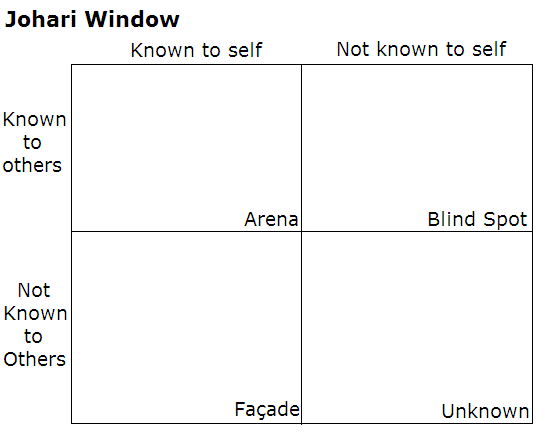
Goldsmith is an executive coach who specializes in fixing apparently trivial personality failings that, without intervention, often end up derailing promising careers headed towards the C-suite. He does this using the sorts of instruments you'd expect -- 360 degree reviews and 1:1 sessions. As he explains towards the end of the book, that's not the sort of thing you want to do yourself. But what is illuminating is his inventory of the behaviors that tend to do most of the derailing. A good way to frame what the book is about is the Johari window diagram, which is discussed towards the end. Here it is (hopefully self-explanatory):
- Winning too much: Needing to have the winning line in every discussion. It takes some time to notice that you've actually gained enough trust through what you've done that you can let things go and pick your battles, and that coming across as needing to win is more damaging than the winning itself can offset, beyond a point.
- Adding too much value: When a senior manager jumps in to 'improve' an idea in a discussion with a thoughtful build or two at every opportunity, as Goldsmith notes succinctly, the idea is improved by 5%, while commitment levels drop by 50%; the report's idea now becomes the manager's idea, killing motivation.
- Passing judgment: The more credibility you gain, the more careful you have to be in revealing your opinion, especially on trivial things. If you have no authority or influence, voicing well-judged opinions gets you those things, but if you already have them in some measure, even throwaway remarks get taken seriously.
- Destructive comments: the higher you go, the more damage is done by thoughtless remarks, especially if making them is a habit.
- No|But|However: Being the sort of person whose default reaction to any suggestion or idea is to push back. Symptom: too many sentences with no, but or however in them.
- Telling the World How Smart We Are: Ever feel the urge, when you've just heard a presentation, to add something just to demonstrate that you already know the material and are one step ahead? This is one I have done recently enough for it to be personally embarrassing.
- Speaking when angry: This one's self-explanatory. Anger can get you noticed the first time, as someone who cares enough to get mad, but keep getting angry and you'll do too much damage to be worth working with.
- Negativity: This is a more comprehensive version of 5. Being the jerk who is always the one to offer the "It won't work because..." case.
- Withholding Information: Another self-explanatory one -- if you are holding back information just to use as leverage, rather than for good need-to-know reasons, at some point, you are just going to stop adding value in a collaborative setting.
- Failing to give credit: I was on the receiving end of this one a few years ago, so I know how it feels. But what is surprising is how often Goldsmith claims this happens out of simple things like forgetting, rather than active credit-hogging.
- Taking credit: a less forgivable cousin of 10.
- Making excuses: Goldsmith notes the interesting point -- it is not the validity or lack thereof that leads to excuse-making being a derailer. It is the projected perception of being the sort of person who makes excuses. He points out an especially subtle one -- self-labeling ("that's just the way I am, sorry"), which is still an excuse.
- Clinging to the past: Another self-explanatory one.
- Playing favorites: Goldsmith doesn't mean favoritism in the usual sense, but the implicit sort of favoritism that creeps in simply by listening more to some people than to others, even for reasons that aren't intended to cut others out. High-resonance Inner Circles may achieve good things, but they also imply disenfranchised Outer Circles.
- Not apologizing: being able to say sorry without qualifications. I suspect this one is the hardest for a lot of people.
- Not listening: Goldsmith points out a very interesting manifestation of this -- senior managers impatiently asking presenters in a meeting to go to the next slide.
- Not thanking: This is another subtle one. Goldsmith means being able to say 'Thank You' when you are complimented. Most people know to thank others for services/work rendered. But a lot of successful people don't know how to respond when complimented, and end up fumbling around with self-deprecating remarks or clumsily returning the compliment. Simply saying 'thank you' in such situations is a small but powerful signal about the kind of person you are.
- Punishing the messenger: there have been enough cartoons about this. Of the twenty, this is the only one I haven't personally witnessed though.
- Passing the buck: this one is covered as an interesting composite: needing to win+ making excuses + refusing to apologize + failing to recognize + punish the messenger+ getting angry. That's one horrible behavior then.
- It wouldn't be "me": Self-limiting self-perceptions/definitions. It sorta makes sense that successful people would make up mental models of their own personalities that become their default reason for refusing to change.
0 Comments