
Jump Point by Tom Hayes
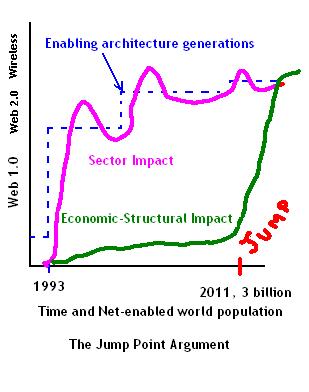
Tom Hayes' Jump Point, a recent addition to the emerging World 2.0 canon presents an argument that evokes a foggy sort of deja vu. If you've been keeping up with the literature, you'll probably frown a bit and think, "wait, this is familiar, somebody's said this before." But as you process the argument, you'll realize that though it is fairly straightforward, and something others have flirted with (The World is Flat and Wikinomics being the prominent ones), nobody has said it quite this way before. The argument is this -- we won't feel the full-scale impact of the Internet until penetration levels are near complete. At that point, we'll see a massive structural impact on the world that will make what we've seen so far pale in comparison. For Hayes, the critical moment is the moment when the 3 billionth human gets connected to the Internet (which current projections suggest will happen around 2011). The number 3 billion isn't arbitrary -- it is roughly the size of the global workforce. So Hayes' argument is that something dramatic will happen when the world's workforce gets completely wired. What and Why are the subjects of the book.
The Basic Argument Let's get the basic argument out of the way quickly, with a visualization:
3 Comments
Terrific review, Venkat. I'm thinking about Clay Shirky's work (Here Comes Everybody) a lot these days. And one of the things he writes is that it's only when a new technology becomes old-hat and is taken for granted that the really interesting things start to happen. In other words, the truly interesting things start to happen when the technology itself becomes boring.
So maybe the jump point doesn't occur when the number of Internet users hits X billion. Maybe it occurs when the people using email or Twitter or Facebook or whatever dream up an innovative way of using this service that leads to deep social transformations.
And yeah, as you concluded, I anticipate a totally different sort of jump point when gas hits $7 or rice hits $4 pound. At that point, only the people who *must* commute to be effective at their jobs will be able to afford to commute. So maybe this jump point of resource scarcity will be the driver forcing people to reach the jump point of a society transformed by Internet use.
"The future is already here, its just unevenly distributed" remains true . Predicting the "jump point" (tipping point in drag?) for the true impact of the internet to arrive may be an interesting academic sideshow but I am left feeling - So What?
Erik -- that's twice you've brought up Clay Shirky, and I've seen him cited in other places a bunch of times. So sounds like I should read him :)
Brendan -- I agree the 'unevenly distributed' point remains true. The point of the book, however, is that significant things tend to happen when a technology does get evenly distributed. Major second order effects appear only when first order effects have matured. Major highway systems were built only after cars went from being 'unevenly distributed' to 'evenly distributed' in the US. Similarly, we oughta expect big things when everyone is at a sufficiently high baseline of connectivity.
I deliberately did not bring up Gladwell's 'tipping point' because that is both very narrow and, by recent results (Duncan Watts has showed recently that 'influentials' aren't really, for instance), a flawed argument. Discontinuous change models, as I noted are broader and older than Gladwell -- he didn't invent that conceptual framework anymore than Al Gore invented the Internet. Hayes' approach to the jump point concept is a little more sound, though still not rigorously argued.
As for predicting the date. Yes, in one way an academic exercise (but then, I like those :)), but in other ways, very central. To cite a precedent, the first significant exercise in predicting when the world would face natural resource crunches (the 'Limits to Growth' system dynamics/Malthusian exercise by the Club of Rome) got it wrong by at least several decades, though they correctly claim that they were shooting for qualitative/directionally correct results. The question of when the world might be turned upside down is hardly academic -- very practical in my mind. If it is 2050, I don't really care. If it is 2015, I do.
Venkat