
Generation Blend by Rob Salkowitz
Generation Blend: Managing Across the Technology Age Gap, by Rob Salkowitz is a book that might have saved me a lot of trouble. I have been managing a social media evangelism effort at Xerox for the past year, and learned many of the lessons in this book the hard way. But then, a year ago, this book probably could not have been written; 2007 was, in many ways, the year these lessons became very clear. The book tries to do three things: describe generational differences in attitudes and approaches towards work and careers, explain them, and examine one aspect of how to manage them: social computing technology. The results, respectively, are very competent, exceeds expectations and competent. Or B+, A+ and B- if you prefer letter grades. But the one A+ is well worth the cost of the book, and it is relatively straightforward to manage around the weaknesses on the other two fronts. It would have been a brilliant book if it had just focused on the explain bit.
Generation Blend is part of the growing crowd of books examining generational aspects of present-day demographics. The genre includes books like The Coming Generational Storm and The Empty Cradle. It deals with two distinct issues (often conflated): the short-term problems caused by the historically unusual population distribution created by the Baby Boom, and the long-term problems that loom due to falling birthrates around the globe. The two demographic phenomena do interact in many ways (particularly important are the ways they exacerbate certain shocks and tipping points), but are, in general, separable. Generation Blend focuses on the short-term Boom-related problems.
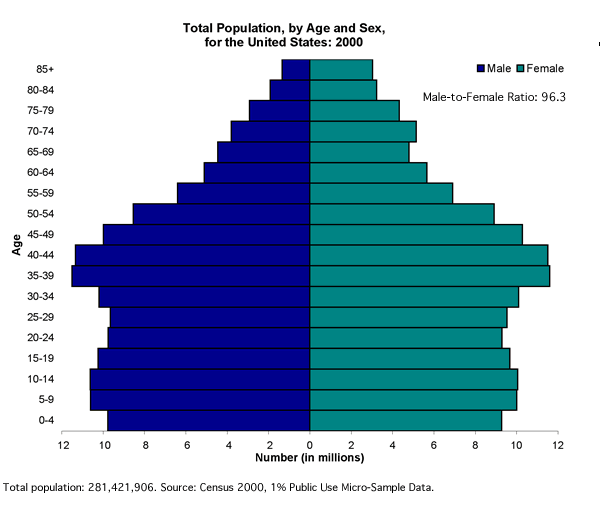
The problem is this: for a transitional period in the next decade or so, you'll have four generations in the workplace -- the Silents (b. 1925-1945 -- just following the WWII Veteran generation), the Boomers (1946-62), Generation X (1963-1980) and Millenials (1980-2000). The boundaries aren't arbitrary, since they arise from important cultural bookends, except for 1980, which is rather arbitrary (1925 and 1945 obviously relate to WWII, and 1963 marks the advent of the pill in America). But cultural features aren't the reason this mix of generations is worth special attention. The ``special-attention" factor is of course the well-known fact that the Baby Boom is a statistical anomaly. In the US, there are about 78 million Boomers, about 51 million Gen X'ers and 80 million Millenials (or Gen Y'ers, Gen Next'ers, Baby Boomlet'ers). Here is the famous graphic, from the US Census Bureau, if you haven't seen it before (in which case, what rock were you hiding under?):
3 Comments
One aspect of the generational split that doesn't often get much attention is that "boomers" are not really one group. Those, like me, who were born in the last few years of the baby boom have almost nothing in common with the ones born at the beginning. We were too young to go to Woodstock or Vietnam, hated the hippies, and are far more comfortable with computers than the majority of the older ones will ever be.
I've seen plenty of older boomers who still treat computer technology the way my 82 year old father does: As some kind of new-fangled toy that's nice for the kids to play with but has nothing whatever to do with real life.
Those people will see efforts to use technology to "capture" their knowledge as being annoying and pointless.
The technology gap is bigger than some of us, who work with the newer technologies every day, realize. Trust me on this ...
Good point. Salkowitz addresses this in the book, by segmenting into younger/older members of each gen. He talks about 2nd half boomers as 'arriving late to a party in its weird, 2nd half stage' and points out a number of consequences, including the greater comfort with computers. In fact the 2nd half of the boomers invented personal computing. The first half of Gen X took personal computing from 'baby' to 'mature' technology....
Speaking optimistically as a Gen X'er I'd like to think that our generation (which as probably been able to live through more change than any of the others) is best placed to support and realise initiatives of the Milenials.
It remains to be seen whether the current era of accelerated innovation will sustain itself - the more involved, advanced and complicated it gets (despite the advent of solutions like cloud computing... explain that to anyone!) the more processes and systems will need to be bullt to support.
The revolution of the crowd has to be superceded some time.