
Visual Thinking with Triangles
We use triangles to visualize certain types of mathematical and non-mathematical relations and concepts. Unlike 2d and 3d visualizations, triangles aren't mathematically coherent in any intuitive way. So let's try and figure out the logic of triangular representations of ideas, and why we use triangles so extensively but not other shapes. Here are two common examples:
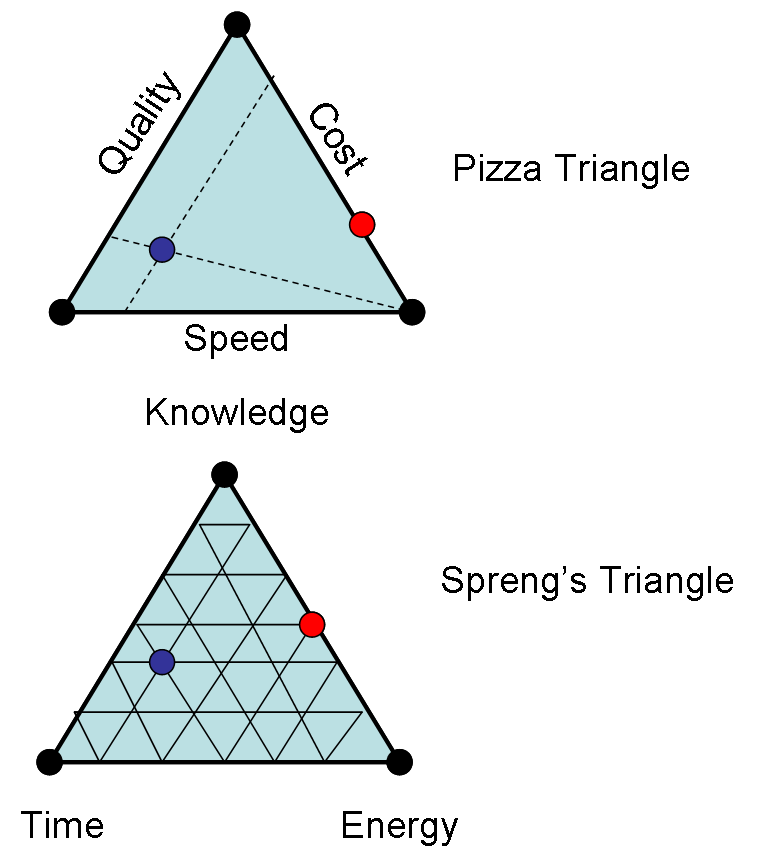 The first is a representation of a commonly recognized set of tradeoffs among quality, speed and cost of a service, with the simplest interpretation being "you can have any two." I have no idea who invented this one, but you'll see signs whimsically asserting that tradeoff at some pizza places. You'll find one exploration in The Age of Speed by Vince Poscente, which I reviewed earlier.
The second is attributed to the physicist D. T. Spreng, and I found it Impossibility: The Limits of Science and the Science of Limits by John Barrow. The idea there is that to accomplish any given task, you can use a mix of three "pure" capabilities: unlimited knowledge and no time or energy, unlimited time, but zero knowledge or energy, or unlimited energy and zero time and knowledge. You can also have various mixes of the three. The pure cases are, approximately, the archetypes of muscular caveman, great philosopher and immortal lazy idiot.
Here are some more examples that I won't try to draw:
The first is a representation of a commonly recognized set of tradeoffs among quality, speed and cost of a service, with the simplest interpretation being "you can have any two." I have no idea who invented this one, but you'll see signs whimsically asserting that tradeoff at some pizza places. You'll find one exploration in The Age of Speed by Vince Poscente, which I reviewed earlier.
The second is attributed to the physicist D. T. Spreng, and I found it Impossibility: The Limits of Science and the Science of Limits by John Barrow. The idea there is that to accomplish any given task, you can use a mix of three "pure" capabilities: unlimited knowledge and no time or energy, unlimited time, but zero knowledge or energy, or unlimited energy and zero time and knowledge. You can also have various mixes of the three. The pure cases are, approximately, the archetypes of muscular caveman, great philosopher and immortal lazy idiot.
Here are some more examples that I won't try to draw:
The first is a representation of a commonly recognized set of tradeoffs among quality, speed and cost of a service, with the simplest interpretation being "you can have any two." I have no idea who invented this one, but you'll see signs whimsically asserting that tradeoff at some pizza places. You'll find one exploration in The Age of Speed by Vince Poscente, which I reviewed earlier.
The second is attributed to the physicist D. T. Spreng, and I found it Impossibility: The Limits of Science and the Science of Limits by John Barrow. The idea there is that to accomplish any given task, you can use a mix of three "pure" capabilities: unlimited knowledge and no time or energy, unlimited time, but zero knowledge or energy, or unlimited energy and zero time and knowledge. You can also have various mixes of the three. The pure cases are, approximately, the archetypes of muscular caveman, great philosopher and immortal lazy idiot.
Here are some more examples that I won't try to draw:
- Consider an idea guys toss around half-seriously: that women are either smart or beautiful, never both. A friend of mine, worried by the sexist nature of the proposition, but trying to get to any truth it might have, once proposed an extension, "The product of a woman's brains, beauty and availability is bounded by a constant." Can a 2d-triangle represent this 3d constraint approximately?
- Consider color spaces. Color is infinite-dimensional as a physical phenomenon (a reflectance spectrum), but given the the biology of vision, 3d representations work well. It turns out that triangles are among the most intuitive representations of color. In Adobe Photoshop Elements for instance, you select a hue in a hue circle, and then pick a point inside a triangle to determine lightness/darkness and saturation. Other color interfaces use triangles in different ways. If this example doesn't make sense to you, don't worry. I only know this color-science-101 stuff because I work in the print industry.
- There is also a simpler use of triangles in color science to represent the notions of additive and subtractive primaries (red-green-blue and cyan-magenta-yellow respectively) and how they relate.
- They are often used with an up-is-more gravitational-orientational metaphor to represent things like reporting hierarchies, levels of decision-making and the like.
- Then, you also have more mathematical ideas like the triangle inequality, which might have some interesting visual interpretations. Someday I'll mull that.
- Then, there is their rigidity, which made them so useful to Buckminster Fuller.
- Finally, being one of the two simplest polygons (the other being the circle, with an infinite number of sides), triangles are often used in conceptual analysis.
3 Comments
Stat pentagons are quite popular in video games.
I love teh triangles as analytical tools, so I decided to post way back in this ancient offering. I am reminded of the apocryphal triangle governing male-female relations from the man's perspective. Women can only be two of three traits: attractive, intelligent, or sane. Anecdotally, I have dated more than one smart, hot, but crazy (bi-polar) gal. It's tiring. I now prefer smart and sane.
Ah, I found an easier one for women (and put it down to "people" so that girls could participate in the fun):
1) Smart (or "interesting"--which I prefer)
2) Attractive
and, the new one...
3) Well-Adjusted
Getting (1) and (2) but not (3) is not as much fun as people think.