
Where is I?
I kicked off my writing on consciousness with a post on my overall framing of the problem. Now, by way of warm-up, let's explore a problem that is confusing and interesting, but not completely mysterious, which I call the problem of indexical extent. The indexical problem is this: assume somebody explains consciousness satisfactorily, and even the existence of specific conscious points of view. Follow-up question: Why are particular conscious points of view associated with particular conscious beings? In particular, why is this particular conscious point of view associated with me? That's still too hard, so let's start with a simpler question: "Where is I?" This is the problem of indexical extent.
"Where am I?" is a question that reduces the question of the spatio-temporal location of subjective consciousness to a matter of linguistic convention. We assume, for the purposes of the question, that the subjective self is collocated with the body with which it is associated, and this works for practical situations whether we are asking about the body or the I. Let's question the intuition behind this convention, by asking Where is I?
Why is Alice not Mabel?
Let's get a feel for the underlying indexicality problem first. Early in Alice in Wonderland, Alice attempts to explain her confusing condition by pondering if she is herself:
And she began thinking over all the children she knew that were of the same age as herself, to see if she could have been changed for any of them..."I'm sure I'm not Ada," she said, "for her hair goes in such long ringlets,... and I'm sure I can't be Mabel, for I know all sorts of things, and she, oh! she knows such a very little!"At this point Alice attempts to recall some simple arithmetic and geography, fails, and concludes that she is Mabel after all, and her concerns shift to practical matters:
"I must be Mabel after all, and shall have to go and live in that poky little house, and have next to no toys to play with..."This is a good way of approaching the question. Why is this funny? Why are we so convinced that Alice is not Mabel? This is not just a physical appearance-switching thought experiment (a fairly harmless idea, philosophically speaking, that is at the heart of many movies and the polyjuice potion episodes of Harry Potter). We are talking about becoming another conscious being, an idea which is only intriguing if individual physical beings are normally conceptually inseparable from their indexicals -- their I's. So let's review: the four problems, in sequence, are:
- Main Problem: What is consciousness? What is the I that Alice and Mabel experience?
- Why does it normally appear to come in localized, limited-extent 'points of view'? Why are there separate Alice and Mabel instances of I?
- Why is there indexicality? Why is this physical lump of matter named "Alice" associated with a specific conscious point of view, Alice's "I", and that one with Mabel's "I." Why can't they switch places?
- Where, spatio-temporally, is the I associated with Alice?
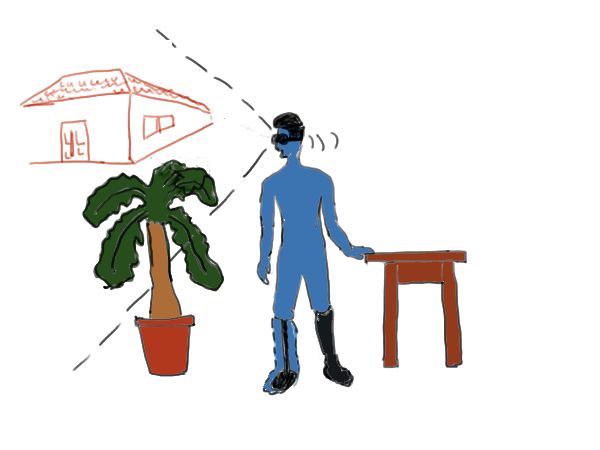
- Co-extensivity: The I is co-extensive with my body, with a canonical point somewhere behind my eyes. This is obviously wrong, since, if my foot falls asleep (i.e. a part of the sense of proprioception fails) the I adapts and the asleep leg feels like an attached object. The 'behind the eyes' part is very stable; I have tried and failed to shift this perception consciously.
- Proprioceptive-extensivity: The I is co-extensive with my field of proprioception. This is possibly correct, as phantom phenomena in amputees demonstrate. The I is clearly a constructed entity that is maintained as an ongoing fiction by a brain. The brain itself is not immune, and the constructors of I can themselves fail. You could argue that the I splits into at least two pieces in surgeries that split left and right brain hemispheres.
- Sensory extensivity: The physical world of sensation comprises photons dashing around, getting entangled and so forth, waves of air pressure, mechanical pressure and chemicals binding to receptors. Yet, even though the physical phenomena that comprise sensory perception happen within our proprioceptive extent (at least in terms of classical physics), we perceive the sensory phenomena there, where they occur. The I extends, at least in a sense of projective constructive control, to everywhere we can construct the hypothesized sensory landscape. As virtual reality glasses demonstrate, this need not be consistent with any notion of objective reality.
- Imaginative extensivity: In a very weak sense, I can mentally 'see' an imagined Bombay right now. Or imagine a highly zoomed-in view of the Andromeda galaxy. Both have some basis is in a memory of actual sensory perception. This does not appear to be a serious case to me.
- Co-construction of Object and Subject. You get this case by attempting to undermine case 3. Ask the question: if the constructed-projected outside world were actually inside your skull, how would you know without an independent knowledge of 'outside my skull' to refer to? In other words, our sense of 'skull' being also constructed as part of an overall constructed objective reality, it is largely meaningless to ask if we perceive reality inside it or outside. But since the constructed sense is the only way we engage reality (if it exists), the point is moot, and we might as well assume that if there is an out there, it is where we project it to be. With this caveat, the relative question of where the constructed I is, with respect to the constructed out there, is meaningful. But if subjective I and objective out there, skull, and inside, are all constructed together the extent question is uninteresting, since there is no ground truth representing the spatio-temporal extent of anything, including space-time itself. If this is the case, then the extent problem should be replaced with the problem of conceptualizing the idea of object-subject co-construction by one of the constructed elements itself. Confusing, huh? I'll punt on this one, since it deserves a separate essay. Let's continue with an unexamined notion of objective "out-there."
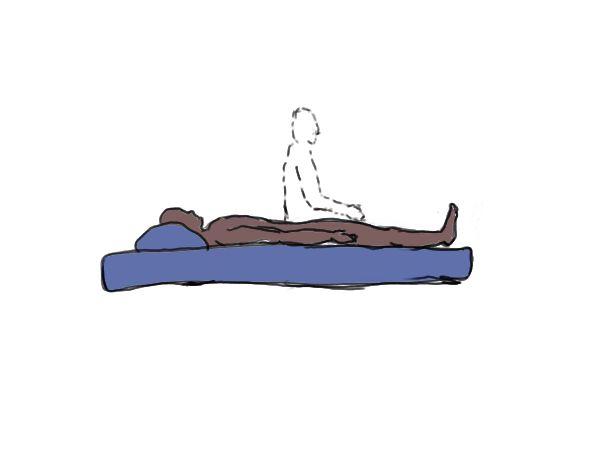
- The I simply isn't during deep (non-dreaming) sleep. It is reconstructed from manifest memory during awakening, and a sense of continuity (stream of consciousness) is constructed.
- The I shrinks to below a critical threshold and expands again during the processes of falling asleep and awakening. If ontogeny recapitulates phylogeny, and ontogeny is as much a process of awakening consciousness as it is about biological maturation, then we can say, awakening recapitulates ontogeny, which recapitulates phylogeny. Or, while falling asleep, you go from human, to ape, to amoeba to rock. And back.
10 Comments
Hi Venkat!
Thanks for your thoughts on this! I am actually very deeply interested in the indexicality problem. Why am I me and not something else?
I recently realized something interesting about this. Suppose that metaphysical materialism, dual-aspect monism, or even some sort of absolute idealism or panpsychism is true. Then finding yourself being a living thing is extremely improbable. It would be much more likely that you would find yourself being a rock.
The amount of stuff in the universe(s) that isn't an organism vastly outweighs the stuff that is. And even if you suppose that only organisms have being, and that you could only possibly be an organism on Earth, the odds against you finding yourself being a human are astronomical.
The average lifeform on Earth is smaller than an ant. I read somewhere that the world population of ants is over one quadrillion, and the number of bacteria is clearly higher.
The point is that if it is possible to be anything, then, as a human, and not only as a human, but as the executive part of a human brain - not a pancreas or something - you are in an extraordinarily privileged position. The odds against you finding yourself being you are absolutely, incomprehensibly huge! On the bell curve, you are very, very far from the bulge.
I don't think that it really makes sense to even try to calculate the odds. How much dirt does it take to make a dirt-being? It would not be sound to take the total mass of all the matter in the universe and divide that by the mass of human brains. If you could be a rock, why are you all of the particles that make up the rock together, and not anything beyond that rock? Why are you not one subatomic particle and why are you not the whole planet? Why would what you are be both bound and bounded? The Sorites Paradox shows up. When is a heap a heap? One grain? Two grains? Fifty grains?
Of course, these questions also apply to your brain. Why are you the activity of multiple particles, multiple neurons, multiple circuits, and so on, and if you can be a collection of related things, why stop there? Why are you not a group of ten people, or the whole ecosystem, or the whole universe?
If, on the other hand, it is only possible to be a human, other things having no being in themselves, then in finding yourself being a human, you are a typical case.
I think that this might suggest that materialism, dual-aspect monism, and ontologies of that sort are wrong. I think that this suggests either solipsism or something like Cartesian dualism.
In an MMORPG like World of Warcraft or Second Life, you can't be a hill or a river or a house or a blade of grass. You can only be a player character. Maybe our world is analaguous to an MMORPG.
I am very interested in what you think about this line of thought, that it is too improbable to find yourself being the consciousness of a human if it is possible to be anything. I think that it is like winning the lottery ten times in a row.
If you just divide the world population of bacteria by the world population of humans, you get something like 800,000,000,000,000,000,000. If you could only be a human or a bacterium, then you would have a chance of one against that huge number of getting to be a human. And that is only the bacteria on this one planet. And there are many billions of stars in every galaxy and many billions of galaxies in the known universe, and possibly many, many, many universes, most of which don't support life. What are the odds that if materialism were true, that you would find yourself being a human, and not just a human, but the best part of a human: the conscious part, the king of the body?
I have discussed this with a number of my philosophically inclined friends, and nobody seems to get what I am getting at. They say that the question of why I am me is nonsensical, that of course something would find itself being me, that I have a one in one chance of being me, and that it is absurd to think that I could be something else. They think that I am out of my mind to think that it is odd that I find myself being me.
When I look at it objectively, it does not seem problematic that other people find themselves being people rather than rocks. I see plenty of rocks that clearly didn't find themselves being people. But subjectively, it is very odd indeed. How did I win the ultimate lottery? Why am I such an extraordinarily atypical case?
What do you think? Do you think I am crazy, or am I onto something here? I saw your blog entry and thought that you might be able to appreciate what I am saying better than most, since you at least recognize the basic problem of indexicality and indexical extent.
James
James:
Interesting comment there, and it took me a long time to process. I think what misled me here is your use of probabilistic language, which is a distraction. I don't think probability has any role to play here at all -- it is purely a matter of conceptual analysis.
My own sense is that one part -- the trivial part -- is explainable in evolutionary terms. Let us assume that there is a 'consciousness field' that could extend anywhere. When we were born, a boundary could have been drawn anywhere from 'whole universe' to 'cell number 83,211 in brain.' It is not a coincidence that the typical boundary (proprioceptive) is a useful one for survival. It does not make sense for my consciousness boundary to include, say, my mom, or NOT include my left leg.
Note that this does NOT answer the question of indexicality at all. It assumes it. But it does add some logic to the proprioceptive extent argument.
Unfortunately, I think the proprioceptive boundary is deceptive, and really, something closer to co-construction of object and subject must hold. But this is such a slippery concept I get no traction with it.
I don't get the point of your bacteria math though. But your MMPORG thing suggests some very fruitful lines of inquiry. In particular, I think it would be possible to shed light on these matters by using fiction as an analytical tool. An anthropomorphic identification with a hill or tree would be pointless, but to work the "bat" argument, it would be interesting to understand what it would feel like, for a hill to be a hill. I can't get that far, but I was trying the other day to imagine that sort of thing with my cat: construct a stream of consciousness using just some 'emotion' symbols. So if hungry is A and playful is B and so forth, my cat's indexical probably goes like AABACBDAABC... through the day. That suggests some ways to understand what it might feel like to be 'the weather' and so forth, but I don't know what would justify such speculation at all.
But the more I think of it, the more your probability stuff sounds just mistaken. You didn't win the lottery. A simple anthropic argument might work well there to explain anything beyond the indexicality problem itself.
Lots of great questions with tough answers...I watched the Movie The Matrix the other night and I could see how that is becoming a reality. From the years of playing an mmorpg in the virtual world you get a sense of what is reality and what is "fake".
Did you read Dennett's great essay, Where am I? in that same volume on the Mind's I?
Evan: Haven't really thought through the issues posed by immersive virtual realities besides my one cartoon above, but I suspect there are tricky things hidden there, perhaps distinct from the "dreaming" argument/the Matrix/allegory of the cave.
Eric: need to check out that essay. Must have read it since I read the whole thing, but that was more than 10 years ago, so I probably need a refresher read.
oh my god, hit a roadblock in the first paragraph, indexical extent, something like that
i this is going to be a conversation about an artificially constructed world of of concepts, i need the education you have had in order to read it. and by that time all innate wisdom will be lost, in an avalanche of received concepts having no bearing on anything but each other..
like art criticism, the critics are only talking to themselves
ok, will try to get through this, obviously a lot of work for the writer too
more later, enjoy, gregory
like a bunch of brahman pundits arguing over being, is it real, or apparent, who is the knower, and unless you know the knower how can you know anything, including that there is a you to know. and then who knows that?
could you do the two paragraph version the next time you enter into this field
the above is way too much. more than way. obscurity by a thousand words
no wonder yogis say thinking is a disease
the i is the consciousness
now back to the comics
yikes, headache stuff
Hi Venkat.
I want to describe my personal conclusions on this very topic. I think the "I"-feeling, the self, is an emergent process in the brain. How does this work? Let's start from the perception.
An image is formed on the retina, for example. The neurons on the retina and those in the optical cortex extract simple features - like - a circle, a pattern, a line, etc. At the next level, these patterns are themselves assembled in more general structures - a face, a ball, a chair - etc. Then at an even higher level they are translated into concepts and so on. The more we go on the more abstract is the perception. Brain is just a cascade of abstraction layer upon abstraction layer, each feeding its output into the input of the next.
Each layer learns by watching its own input patterns. The first level watches the senses. The second level watches the first level, etc. They all learn "unsupervised" - as is the consecrated AI term for such neural nets.
At the top there is nothing but a re-entrant loop - the I feeling. The "I" is what we abstract from perceiving our own internal state and all its variations. I repeat - we abstract the internal state of our own brain, and model every possible state it can be in. This model of our own brain state is the "I" feeling (possibly the abstraction of ourselves is itself subject to more and more levels of self-abstraction - is this what spiritual evolution means, in neural terms?).
I found a lot of inspiration in watching a presentation on the so called "Restricted Boltzmann Networks" (a kind of unsupervised learning neural net) and in Giulio Tononi's mathematical model of "integrated information".
So my position is that I can see how the brain does perception, thinking and even constructs the self. But still, why is all this conscious?