
Open Innovation, or is Business War?
The catchphrase of Henry Chesbrough's work on innovation (a doctrine called "open innovation" and described in Open Innovation, 2003, and Open Business Models, 2006), is "not all the smart people work for you." The key operational message that corporations seem to take away from it though, is "buy and sell intellectual property vigorously and throw some money at universities." Somewhere along the way unfortunately, a sophisticated reconstruction of the logic of innovation becomes reduced to quick-money recipes. Part of the blame rests with Chesbrough himself, for raising and framing a very important subject, but then being somewhat timid about running with the idea to some daring conclusions. In this article, I am going to rush in foolishly where, apparently, Henry Chesbrough fears to tread. I'll interpret the idea of open innovation as business is not war, and you'll see where that line of reasoning takes us.
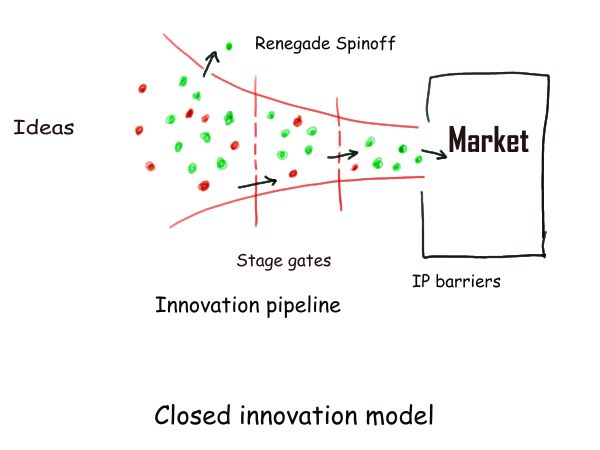 In this picture, called closed innovation, progress is slow, and occasionally good ideas break out of the funnel walls and leak out as renegade startups into the desolate interstices of the economy. Gatekeepers ask very different questions than, say, venture capitalists. This is the underlying model that informs the notion of disruptive innovation. My employer, Xerox, being the favored case study for all innovation researchers, is often interpreted within this model, as having fumbled the future (the most common interpretation of the story of the invention of personal computing at PARC, though alternate views are also extant, for instance the one in Dealers of Lightning, which favors a more disruption-style "why bad things happen to good companies" explanation).
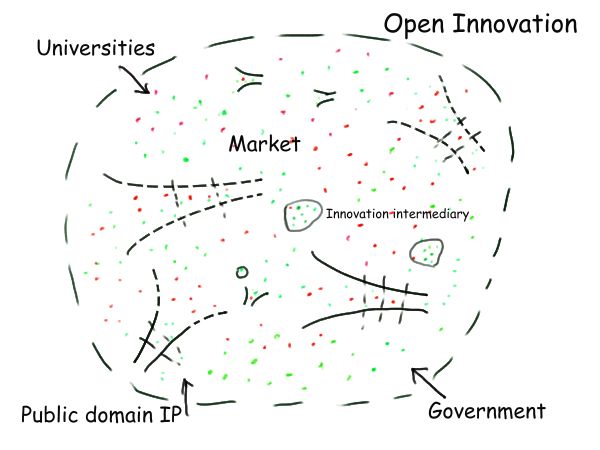
The problem with this model is that it is not only descriptively wrong (the world doesn't work this way), it is also normatively flawed (the world shouldn't work that way). The right way to think of innovation, according to Chesbrough (and I largely buy his viewpoint) is as an active trading of ideas among entities with different sorts of strengths in bringing inventions to market as successful innovations that benefit the whole economy. The interpretation of the story of Xerox PARC under this model is that the management didn't fumble the future -- they just traded away ideas they couldn't successfully bring to market. At best, under this model, Xerox can be blamed for undervaluing the ideas that came to life at PARC. This model makes sense (and not least because most of the ideas that left PARC to grow outside Xerox did so with the blessings of Xerox management, rather than via a fumble). Here is a picture illustrating what the ideal Open Innovation economy looks like: a bunch of leaky-by-design funnels of varied permeabilities, existing in an environment of fairly frictionless flow of ideas from wherever they are born to wherever they can best find a path to market. In between is a rich interstitial soup of small startups, innovation intermediaries and other mechanisms for transporting ideas between companies. Hardly a desolate wasteland where lone renegades must fight for sustenance, detached from the maternal love of larger corporations.
In this picture, called closed innovation, progress is slow, and occasionally good ideas break out of the funnel walls and leak out as renegade startups into the desolate interstices of the economy. Gatekeepers ask very different questions than, say, venture capitalists. This is the underlying model that informs the notion of disruptive innovation. My employer, Xerox, being the favored case study for all innovation researchers, is often interpreted within this model, as having fumbled the future (the most common interpretation of the story of the invention of personal computing at PARC, though alternate views are also extant, for instance the one in Dealers of Lightning, which favors a more disruption-style "why bad things happen to good companies" explanation).
The problem with this model is that it is not only descriptively wrong (the world doesn't work this way), it is also normatively flawed (the world shouldn't work that way). The right way to think of innovation, according to Chesbrough (and I largely buy his viewpoint) is as an active trading of ideas among entities with different sorts of strengths in bringing inventions to market as successful innovations that benefit the whole economy. The interpretation of the story of Xerox PARC under this model is that the management didn't fumble the future -- they just traded away ideas they couldn't successfully bring to market. At best, under this model, Xerox can be blamed for undervaluing the ideas that came to life at PARC. This model makes sense (and not least because most of the ideas that left PARC to grow outside Xerox did so with the blessings of Xerox management, rather than via a fumble). Here is a picture illustrating what the ideal Open Innovation economy looks like: a bunch of leaky-by-design funnels of varied permeabilities, existing in an environment of fairly frictionless flow of ideas from wherever they are born to wherever they can best find a path to market. In between is a rich interstitial soup of small startups, innovation intermediaries and other mechanisms for transporting ideas between companies. Hardly a desolate wasteland where lone renegades must fight for sustenance, detached from the maternal love of larger corporations.
 What the Model Dictates
The open innovation model dictates several things:
What the Model Dictates
The open innovation model dictates several things:
Open Innovation Let's do a quick review first. Here is the idea in pictures. We start with the mental model many people and companies have of innovation (which recall, is usually defined today as an invention successfully taken to market). The model is both descriptive and normative, in that many corporations, especially large ones, organize their processes and organizational structures around it. The model looks like a narrowing funnel, with the R&D function at the wide mouth and the market, protected by defensive and offensive IP barriers, at the other end. In between, we get a series of stage-gate review processes, whose job it is to filter good (green) ideas from bad (red ones), thereby reducing risk.
In this picture, called closed innovation, progress is slow, and occasionally good ideas break out of the funnel walls and leak out as renegade startups into the desolate interstices of the economy. Gatekeepers ask very different questions than, say, venture capitalists. This is the underlying model that informs the notion of disruptive innovation. My employer, Xerox, being the favored case study for all innovation researchers, is often interpreted within this model, as having fumbled the future (the most common interpretation of the story of the invention of personal computing at PARC, though alternate views are also extant, for instance the one in Dealers of Lightning, which favors a more disruption-style "why bad things happen to good companies" explanation).
The problem with this model is that it is not only descriptively wrong (the world doesn't work this way), it is also normatively flawed (the world shouldn't work that way). The right way to think of innovation, according to Chesbrough (and I largely buy his viewpoint) is as an active trading of ideas among entities with different sorts of strengths in bringing inventions to market as successful innovations that benefit the whole economy. The interpretation of the story of Xerox PARC under this model is that the management didn't fumble the future -- they just traded away ideas they couldn't successfully bring to market. At best, under this model, Xerox can be blamed for undervaluing the ideas that came to life at PARC. This model makes sense (and not least because most of the ideas that left PARC to grow outside Xerox did so with the blessings of Xerox management, rather than via a fumble). Here is a picture illustrating what the ideal Open Innovation economy looks like: a bunch of leaky-by-design funnels of varied permeabilities, existing in an environment of fairly frictionless flow of ideas from wherever they are born to wherever they can best find a path to market. In between is a rich interstitial soup of small startups, innovation intermediaries and other mechanisms for transporting ideas between companies. Hardly a desolate wasteland where lone renegades must fight for sustenance, detached from the maternal love of larger corporations.
What the Model Dictates
The open innovation model dictates several things:
- You should buy and sell IP, and in general view it as a trading asset rather than territory to protect
- You should ally with universities and innovation intermediaries
- You should set up your processes to gracefully let ideas enter and leave your systems
- Use new technologies to build an innovation ecosystem within and outside your company
- Competition is the most pressing reality for individual companies, but is not the most fundamental dynamic in an economy. The most fundamental dynamic is growth, or the creation of new wealth, via a process of creative destruction, a la Schumpeter.
- This creative destruction is a Darwinian struggle, but a Darwinian struggle, in turn, is not like war. Darwinian systems are as much about creating new and more complex structures as they are about lions eating gazelles and companies driving their competitors out of business. Creative destruction tends to create more than it destroys. War by contrast, is primarily about destruction (even if some industries and technologies grow rapidly as an indirect result).
- The business-as-war zero-sum model, paradoxically, is socialist rather than capitalist in origin (factoid, the game of Monopoly was originally designed to communicate a communist message about land being the primary source of wealth. While modern economists like Hernando de Soto preach a superficially similar doctrine, this view is more about land acting as security in managing risk, rather than as the primary manifestation of wealth).
- Information being eventually free is the only way to maximize overall economic growth. Intellectual property rights therefore are reduced in stature from moral rights to something more like a macroeconomic control measure. In fact, an argument could be made that central banks ought to vary copyright and patent protection awarded as a function of the performance of the economy, the way they do interest rates (how you would do this is a mystery though -- varying protection durations wouldn't work, and you can't legislate trading prices).
0 Comments