Breadth-Depth Metaphors and Beyond
We commonly use a set of dynamic spatio-temporal orientation and observation conceptual metaphors to talk about knowledge, its communal organization, and individual styles of knowing. We use depth-versus-breadth to talk about track records and abilities, "long-term" versus "short-term" (and "upstream/downstream") to talk about intentions and decision-making, and "big-picture" versus "details" to talk about the scopes of discourses. All these will come up for critique and more analysis as I continue developing the themes of this blog. But I want to start off this fresh new week with a question for you to ponder: how do you organize your view of knowledge, and how much faith do you have in your organization?
I'll do a tutorial on conceptual metaphor and George Lakoff in a bit, but for now, all you need to do is understand a conceptual metaphor to be an organizing frame of reference rather than a figure of speech. We tend to use conceptual metaphors for talking about at least four (per my count) distinct aspects of the phenomenology of knowledge. These are, the organization of knowledge itself, the organization of communities of knowers (including notions of in-scholars and out-amateurs), perspectives and action-orientations of individual knowers, and the evolution over time of these three types of elements (knowledge, communities, perspectives). That's a lot to talk about, yet we do it comfortably (though, as I will argue, not very soundly).
Organizing Knowledge
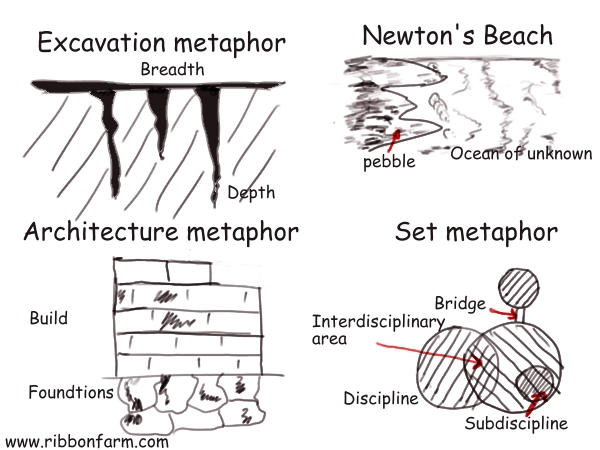
Consider just the first one: ways of organizing knowledge itself; the stuff in books, papers and people's heads. Here is a sampling of metaphors: excavation, set theoretic, architectural and Newton's beach ("I do not know what I may appear to the world, but to myself I seem to have been only a boy playing on the sea-shore, and diverting myself in now and then finding a smoother pebble or a prettier shell than ordinary, whilst the great ocean of truth lay all undiscovered before me.")