
How to Define Concepts
Let us say you are the sort of thoughtful (or idle) person who occasionally wonders about the meaning of everyday concepts. So there you are, at the fair, laughing at yourself in a concave mirror, when suddenly it hits you. You don't really know what "concave" means. You just recall vague ideas of concave and convex lenses and mirrors from high school and using the term in general conversation to describe certain shapes. So you decide to figure out a definition.
What do you? How do you make up a definition? Let's get you into some trouble.
So the first thought you have is: concavity has something to do with "indentations" or inward curvature of shapes. You quickly abandon open-ended curves, of the sort you see in graphs of population growth and the like. Being smart, you realize that the concavity there is not fundamental -- you could turn a concave graph upside down, and make it convex with respect to your preferred visual orientation of "up is against gravity."
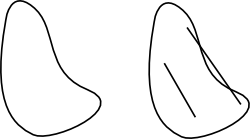
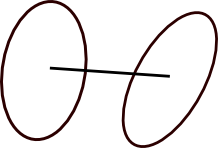
So you decide that the notion of concavity probably only makes sense for closed curves: things with an inside and an outside (congrats, you just found a use for the Jordan curve theorem!). You draw yourself a prototypical closed curve, like the one on the left below, and stare at it:
4 Comments
Hi Venkat,
Don't want to make it an "Orkut" but Hi.
At the risk of being ridiculed, I would like to share the perspective from the other side. Most of the world is a heavy and unaware consumer of these concepts. ( One man discovered the bulb and rest of them used it, most of them without ever knowing the word tungsten ). Its as if the world is giant cloud of particles and the people who understand and define these "concepts" are magicians waving their wands guiding the particles at will.
Trishant (TK)
Hey TK,
Yes, it is interesting that most of us don't question the definitions of very basic things, so the people who manage to own the definitions can exercise a lot of influence. I like the giant cloud of particles metaphor.
Not quite magic though, since an unsound definition usually loses ground over time. Sort of like darwinian evolution among concepts, similar to evolutionary competition among living things or technologies (like VHS/Beta Max). Many math definitions have also gone in and out of fashion because of this type of evolution in concepts.
The interesting thing about concepts that makes them useful for fiction/fantasy writers is that they can be just about anything. But this very thing makes them useful for mathematicians too. :-) It would be a very boring world for mathematicians if they couldn't invent/discover new concepts and call them axioms, within which they could creatively find new theorems to play with and prove.
"The search for proper concepts and definitions is one of the main features of doing great mathematics." --- Richard Hamming, "The Unreasonable Effectiveness of Mathematics".
Clearly concavity can be a concept. So can the curling up of a fourth space dimension. So can poisonous glasses that affect the wearer's feet.
But some concepts may be more interesting than others, no doubt. And these are probably the primary ones. You may be able to deduce poisonous glasses from concavity, and perhaps glasses can be concave only if you have a fourth curled up space dimension. I don't know.
But here is a foundational question nevertheless.
What are the axiomatic concepts of modern science?
--- Viraje
I do not get the meaning of concept. Could you please help me get another word for concept. Thanks