Concepts and Prototypes
We think about abstract concepts in terms of prototypical instances. These prototypical instances inform how we construct arguments using these concepts. At a more basic level, they determine how we go about constructing definitions themselves. Prototypes pop up in all sorts of conceptual domains, ranging from "war" to "airplane" to "bird." So how do prototypes work in our thinking? Let's start with an apparently simple example -- the concept of triangle -- that can get tricky really quickly.
If I asked you to draw a triangle, you would probably draw one that looked something like the one below, a scalene triangle, almost certainly drawn with the longest side as base and obtuse angle, if there is one, on top. Call this a prototypical triangle, understood as the sort of instance most people would draw. Why we draw such instances is the question of interest here. Let's exercise this instance in a simple argument to see what role "prototypicity" plays in thinking. We will convince ourselves of the validity of the formula for the area of a triangle -- half base times height -- through mental visual manipulations.
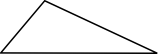
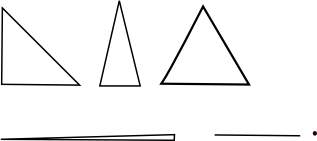
Imagine a line dropping from the top vertex vertically down to the base. This line enables you to visualize two right triangles. Now imagine a copy of the triangle on the left being rotated clockwise 180 degrees. Position this imaginary triangle so that you now have a complete rectangle on the left. Repeat the process for the right. The two imaginary rectangles now form a larger rectangle. The area of this rectangle is the product of the base and height of the original triangle. Since you constructed this rectangle by copying, rotating and pasting two triangles that exactly covered the original triangle, the original triangle must have an area given by half the product of the base and height. You used imaginary visual manipulations to convince yourself of the formula for the area of a triangle. Now ask yourself, why did you not start with any of the following set of perfectly legal triangles: